
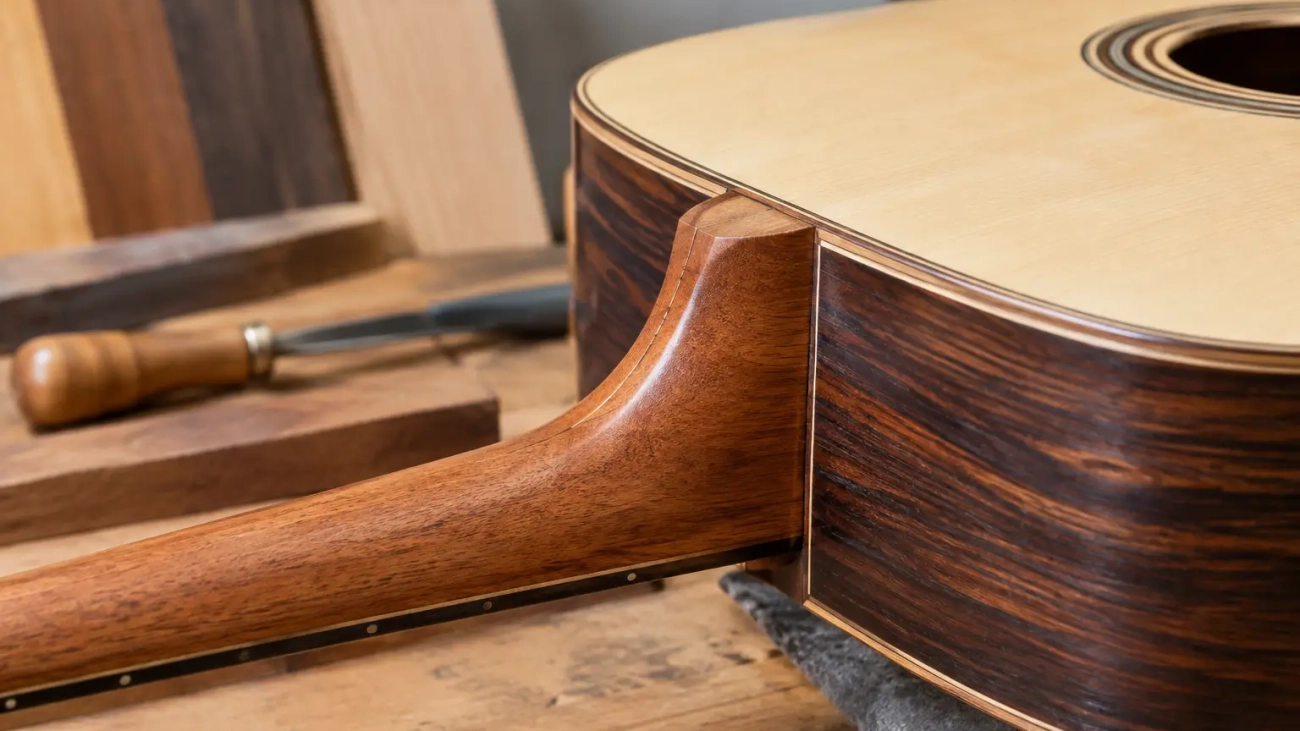
The point where a guitar neck meets its body is easy to overlook until the instrument is in your hands. Yet it is one of the defining decisions in its architecture. This guide to guitar neck joints explains how that meeting influences response, stability, serviceability, and the quiet sense of unity a fine guitar can possess.
A neck joint is not simply a method of attachment. It establishes the path through which string tension is managed, determines the neck angle in relation to the bridge, and affects how the player experiences the instrument as a whole. Its tonal contribution should not be exaggerated in isolation: soundboard design, bracing, wood selection, bridge mass, and the builder’s voicing remain profoundly important. But a well-conceived neck joint supports those choices rather than working against them.
A Guide to Guitar Neck Joints: What Really Matters
Every neck joint must answer the same fundamental questions. How securely will the neck resist the continuous pull of the strings? How accurately can the builder establish the playing geometry? How will the joint behave as wood responds to seasonal humidity changes? And, over many decades, can the instrument be maintained without compromising its integrity?
For the player, the most immediate evidence is rarely visible. It is felt in the assurance of the left hand, the relationship between the strings and the fingerboard, and the instrument’s willingness to speak under a light touch or a forceful attack. A joint that is beautifully executed has no need to announce itself. It allows the neck, body, and player to behave as one musical system.
Neck angle is the essential geometry
The neck must meet the body at a precise angle so that the strings clear the fingerboard and arrive at the bridge with sufficient height to create an effective break angle over the saddle. Too little projection can leave the action low and the saddle without enough height. Too much can make the guitar difficult to play or place excessive leverage on the top.
This geometry is set during construction, but it must also anticipate the gentle changes that occur as a guitar matures. A master-built instrument is not designed merely for the day it leaves the workshop. It is designed with an understanding of tension, wood movement, and a long musical life.
The Spanish Heel: An Integrated Classical Tradition
For classical and flamenco guitars, the Spanish heel remains the most eloquent and historically grounded solution. The heel is carved as part of the neck itself. During assembly, the guitar’s sides are fitted into slots cut into that heel, and the body is built around the neck rather than the neck being attached to a completed body.
This creates an exceptionally direct, continuous structure. There is no separate mechanical connection hidden beneath the fingerboard extension. The neck and heel begin as one piece of wood, with the sides received into it as the instrument takes shape. In a refined classical guitar, that continuity belongs not only to the construction method, but also to the visual and tactile character of the instrument.
Players often associate the Spanish heel with an immediate, unified response. There is a good reason to value that feeling, although it cannot be reduced to a single construction feature. The top, fan bracing, bridge, and setup all remain central to the voice. Still, the integrated heel supports a traditional design philosophy in which every part of the guitar is resolved as a whole.
The trade-off is future adjustability. A Spanish-heel neck is not intended for routine removal. If major correction becomes necessary many years later, the work is demanding and should be entrusted to an experienced repair specialist. That is not a flaw in the design. It is a consequence of choosing an integrated construction method, and it underscores why accurate geometry and thoughtful material selection are so important from the beginning.
For flamenco guitars in particular, the Spanish heel complements an instrument built for immediacy, clarity, and percussive energy. In classical work, it offers the same structural poetry while serving a broader range of tonal ideals, from singing lyricism to concert-hall projection.
Dovetail Joints: Precision Beneath the Fingerboard
The dovetail joint is a traditional choice in many steel-string acoustics and some archtop-inspired constructions. A tapered, interlocking shape is cut into the heel and matched with a corresponding pocket in the body. When fitted correctly and glued, it creates a strong connection with considerable contact area.
Its reputation rests partly on serviceability. A skilled repairer can use controlled heat and moisture to release the joint when a neck reset is needed, then adjust the angle and refit it. For guitars expected to live under steel-string tension, this can be a meaningful long-term consideration.
A fine dovetail is painstaking work. The joint must fit with great precision, neither so tight that it distorts surrounding wood nor so loose that gaps must be concealed with excessive adhesive. The builder also needs to control alignment in three dimensions: centerline, angle, and lateral orientation. It is exacting craftsmanship, and shortcuts are often revealed years later.
Sonically, a dovetail is sometimes credited with special warmth or transfer of vibration. Such claims deserve restraint. A clean, properly fitted joint supports an efficient instrument, but it cannot rescue an uninspired top or poorly considered bracing. Its real value lies in the marriage of structural strength, tradition, and the possibility of responsible future service.
Mortise-and-Tenon and Bolt-On Neck Joints
A mortise-and-tenon joint uses a projecting tenon on the neck that enters a matching cavity in the body. It may be glued, secured with bolts, or designed as a hybrid. Compared with a dovetail, its geometry is generally more straightforward to machine and fit, but simplicity does not prevent excellence. A carefully executed mortise-and-tenon can be stable, elegant, and highly effective.
In a bolt-on neck, bolts draw the neck heel firmly against the body, often with alignment pins or a closely fitted tenon ensuring accurate placement. The phrase can suggest a utilitarian electric-guitar association, but that is too narrow. In the hands of a discerning luthier, a bolt-on system can offer precise adjustability and comparatively direct access for future neck-angle work.
The question is not whether glue or hardware is inherently more musical. The question is whether the entire neck-body interface is designed and executed with care. Good bearing surfaces, accurate fit, stable woods, and correct geometry matter more than mythology. A bolt-on joint may be an intelligent choice for a player who values long-term maintainability, while a traditional dovetail or Spanish heel may better serve a particular instrument’s design language and musical purpose.
Set Necks in Archtop Guitars
Archtop guitars commonly use a glued set neck, often based on a mortise-and-tenon configuration. Here, the relationship between neck angle, bridge height, carved top, and tailpiece is especially important. The elevated bridge and floating bridge base create a different geometric landscape from that of a classical guitar.
A set neck allows the heel to flow gracefully into the body, giving the instrument its familiar sculptural silhouette. For the player, heel contour deserves as much attention as the internal joinery. A refined transition can make upper-register work feel natural without sacrificing the substantial support required by the joint.
Because an archtop’s character depends on the interplay of carved plates, air volume, bridge, tailpiece, and strings, no neck joint should be judged apart from that larger acoustic system. The right solution is the one that honors the desired voice, whether the player seeks dry articulation, a warm comping sound, or a more open and singing response.
Do Not Confuse the Joint with Neck Construction
A discussion of guitar neck joints can become muddled when the body connection is confused with the way the neck itself is made. A scarf joint, for example, joins the angled headstock to the neck shaft. It can be structurally sound and may use wood efficiently, but it is not a neck-to-body joint.
Likewise, a laminated neck uses multiple pieces of wood in the shaft, often chosen for stability or visual expression. Laminations may help a neck resist movement, especially where changing climates and travel are part of a musician’s life. They do not, by themselves, determine whether the neck is Spanish-heeled, dovetailed, bolted on, or set into the body.
These details nonetheless belong to the same larger conversation. A neck is asked to remain stable under tension while offering the player a particular profile, weight, and resonance. The best construction decisions are made together, not as isolated features selected from a catalog.
Choosing the Right Joint for the Instrument and Player
There is no universally superior neck joint. A concert classical guitar and a hand-voiced flamenco guitar naturally invite the Spanish heel because it is integral to their traditional architecture. An archtop may call for a graceful set neck shaped around its bridge geometry and tonal ambitions. A steel-string instrument built for decades of touring may place greater emphasis on an accessible future neck reset.
The player should also be part of the decision. Repertoire, touch, climate, travel, preferred action, string choice, and expectations for maintenance all matter. At Scharpach, such questions belong at the beginning of a commission, when the instrument is still an idea and every structural choice can be aligned with a musician’s voice.
A guitar earns trust slowly: in the first quiet note of the morning, in the steadiness of its setup through changing seasons, and in the way it continues to invite the hand back to the fingerboard. The finest neck joint is the one that disappears into that relationship, leaving only music and the feeling that the instrument has been made for you.