
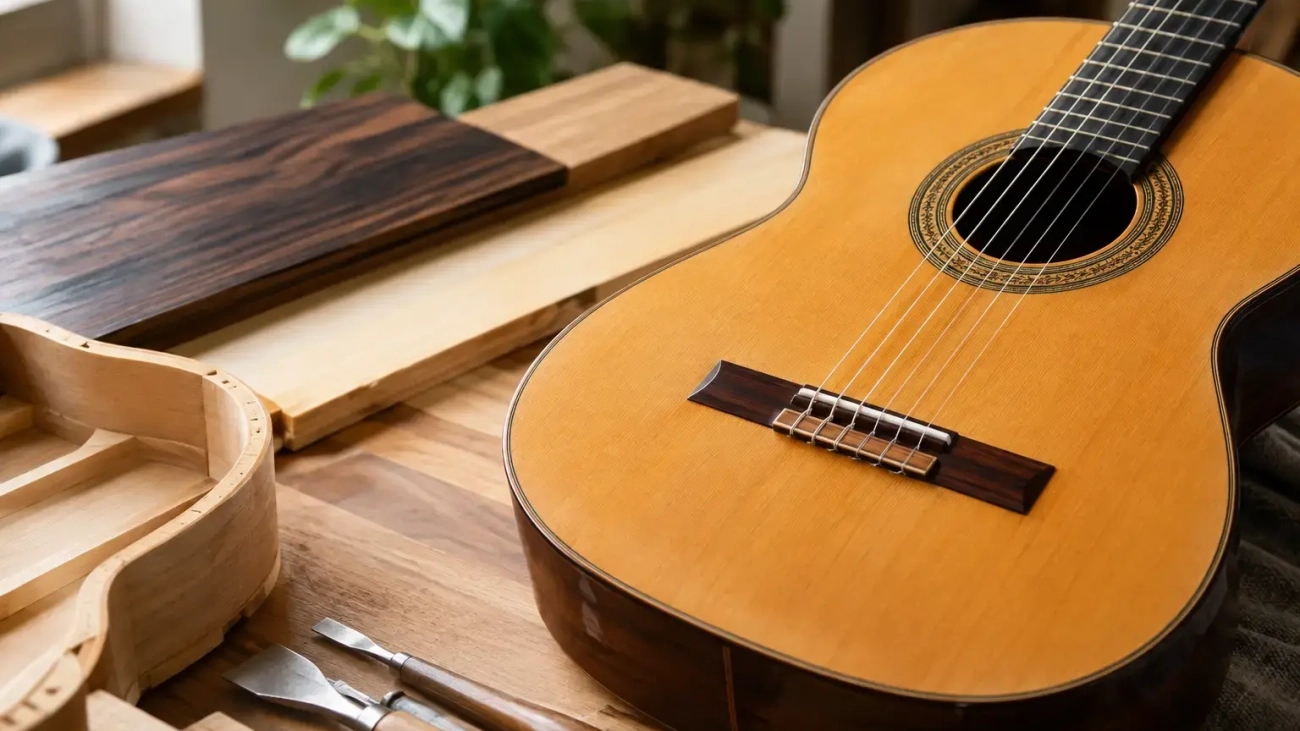
A fine classical guitar reveals itself before the first full phrase. There is a sense of readiness beneath the fingertips: a quick response to a quiet apoyando stroke, a singing treble that does not turn brittle under pressure, and a bass voice with depth rather than mere volume. This premium classical guitar review guide is for players who understand that a serious instrument should not simply make sound. It should clarify intention.
At the highest level, evaluating a guitar is not a hunt for the loudest or most ornate example in the room. It is an act of listening for balance, color, physical ease, and the elusive feeling that the instrument is meeting your musical thought without resistance. A guitar can be beautifully made yet wrong for a particular player. Another may have less immediate spectacle but a voice that remains compelling hour after hour, in a studio, a hall, or the privacy of a practice room.
What a Premium Classical Guitar Should Reveal
A premium classical guitar is not defined by an exotic wood label or a polished presentation alone. Its distinction lies in the relationship between materials, design, construction, and the hand of the maker. Every decision affects the result: the stiffness and thickness of the soundboard, the arching or doming of the top, the voicing of the braces, the weight of the bridge, the character of the finish, and the precision of the setup.
The first quality to assess is response. Play a single note softly on each string, particularly in the first position and above the seventh fret. Does the note speak immediately? Is there a clean center to the sound, or does it need force before it comes alive? A highly responsive instrument gives the player a wide dynamic range. It permits intimate pianissimo passages without sacrificing the authority needed for concert repertoire.
Then listen for separation. In a well-voiced guitar, a chord retains its internal architecture. You can hear the bass foundation, the middle voices, and the line at the top rather than receiving a single wash of sound. This matters especially for Bach, Villa-Lobos, Britten, and contemporary music where counterpoint and harmonic tension demand clarity.
Projection deserves a more careful definition than simple loudness. A guitar may feel powerful under the ear while losing focus at a distance. Another may seem reserved to the player but carry a concentrated, lyrical voice across a room. If possible, have another guitarist play while you listen several yards away. The best instruments retain their character in the air. Their notes do not merely travel. They arrive with shape.
Premium Classical Guitar Review Guide: Tone Before Decoration
The language of tone can become vague unless it is tied to playing. Instead of asking whether a guitar sounds “good,” ask what it does with a phrase. Does it support the round, dark sonority sought in Romantic repertoire? Does it offer the quick attack and dry distinction that suits Spanish dance music? Can it move between these worlds with grace?
Cedar and spruce remain important reference points, though no species tells the entire story. A cedar top often offers warmth, immediacy, and a mature bloom early in its life. It can be deeply persuasive for players seeking an intimate, colorful voice. Spruce commonly brings a more crystalline attack, greater tonal contrast, and a sense of reserve that can open over years of playing. Yet a gifted maker can draw startling warmth from spruce or remarkable clarity from cedar. The individual top matters more than the category stamped on a specification sheet.
Back and side woods influence the voice as well, but they should be understood as part of a whole. Indian rosewood is valued for its overtone richness and generous bass response. Cypress can bring a quicker, more direct sound associated with flamenco traditions. Maple may lend transparency and definition, while other carefully selected tonewoods can offer their own balance of warmth, sustain, and immediacy. The question is not which wood is objectively best. It is which tonal landscape serves your repertoire, touch, and ear.
A mature review also considers sustain with restraint. Long sustain is not always a virtue. For some music, especially fast passages or rhythmically charged writing, excessive resonance can blur articulation. The most satisfying guitar gives each note a natural life, then releases it cleanly enough to preserve the next idea.
The Craftsmanship You Can Feel
Examine a fine guitar closely, but do not mistake visual perfection for the whole of craftsmanship. Crisp purfling, clean joinery, a carefully fitted bridge, and a refined French polish or other thin finish all speak to discipline. More revealing still is the work you feel while playing.
The action must invite confidence. If it is too high, the left hand tires and the player begins to work against the instrument. If it is too low, buzzing may compromise the voice, particularly when playing with projection and authority. There is no universal ideal measurement because string tension, right-hand attack, repertoire, and personal preference all matter. Still, a premium guitar should feel intentional rather than generically adjusted.
Neck shape is equally personal. Some players prefer a substantial, traditional profile; others need a more slender carve or a custom nut width to maintain relaxed hand position. For a left-handed guitarist, a true left-handed build is more than a reversed string order. The bracing, bridge compensation, ergonomics, and voicing should be conceived for the player from the beginning.
Pay attention to fretwork. Notes should remain true and clean throughout the fingerboard, with no dead areas, choking bends, or distracting inconsistencies in position. Intonation will never be mathematically perfect on a fretted instrument, but a thoughtfully compensated saddle and accurate fret placement make a meaningful musical difference.
The finish should protect without suffocating. Thick finishes can limit the freedom of the soundboard, while a finely applied, thinner finish allows the guitar to breathe and develop. French polish is admired for its beauty and acoustic sensitivity, though it requires a player willing to accept a more delicate surface. A modern finish may offer greater durability. This is a genuine trade-off, not a hierarchy.
How to Evaluate a Guitar in Person
Do not begin with your most difficult piece. Start with scales at different dynamics, then play simple arpeggios, slurs, rest strokes, and free strokes. These reveal response more honestly than a familiar showpiece played at full intensity. Move through the entire register and listen for abrupt changes in color between strings or positions.
Bring a passage that exposes your actual musical life. A performer preparing Rodrigo needs different qualities than a player devoted to Sor, Barrios, or new music. Play the repertoire you return to when no one is listening. A guitar that serves that repertoire will tell you more than one that flatters a brief audition.
Give the instrument time. Initial excitement can be misleading, especially when a guitar has a dramatic bass or brilliant upper register. After twenty minutes, ask whether your hands are still relaxed, whether the sound remains interesting, and whether the guitar encourages more nuanced playing. The right instrument often makes you listen more carefully to yourself.
If you are considering a commission, the evaluation becomes even more personal. A direct conversation with an experienced luthier can translate impressions such as “more color,” “less resistance,” or “a deeper singing quality” into meaningful design choices. At Scharpach, that dialogue is central to the work: the player’s technique, physical comfort, repertoire, and musical imagination inform the instrument from its first material selection.
Value Is Measured Over Years
The price of a master-grade guitar reflects far more than labor hours. It represents decades spent learning how wood moves, how arches hold their tension, how a soundboard can be brought close to its expressive limit without becoming unstable, and how minute adjustments change a guitar’s voice. It also reflects the rarity of truly exceptional materials and the patience to reject those that do not meet a maker’s standard.
Still, cost alone is not proof of greatness. A premium instrument should justify itself through the depth of its musical return. Does it offer colors you can use? Does it remain stable through changing seasons when properly cared for? Does it inspire practice rather than merely admiration? Will its voice continue to unfold as the top matures under the energy of your playing?
A handmade guitar is not a standardized object, and that individuality is part of its value. Two instruments built from similar materials may speak differently. The wise buyer does not seek a mythical perfect guitar. They seek the one whose strengths align with their artistic voice, while accepting the small human distinctions that make a handcrafted instrument alive.
The finest choice is often the guitar that makes you play a little more quietly, a little more attentively, and with greater faith in the next note.