
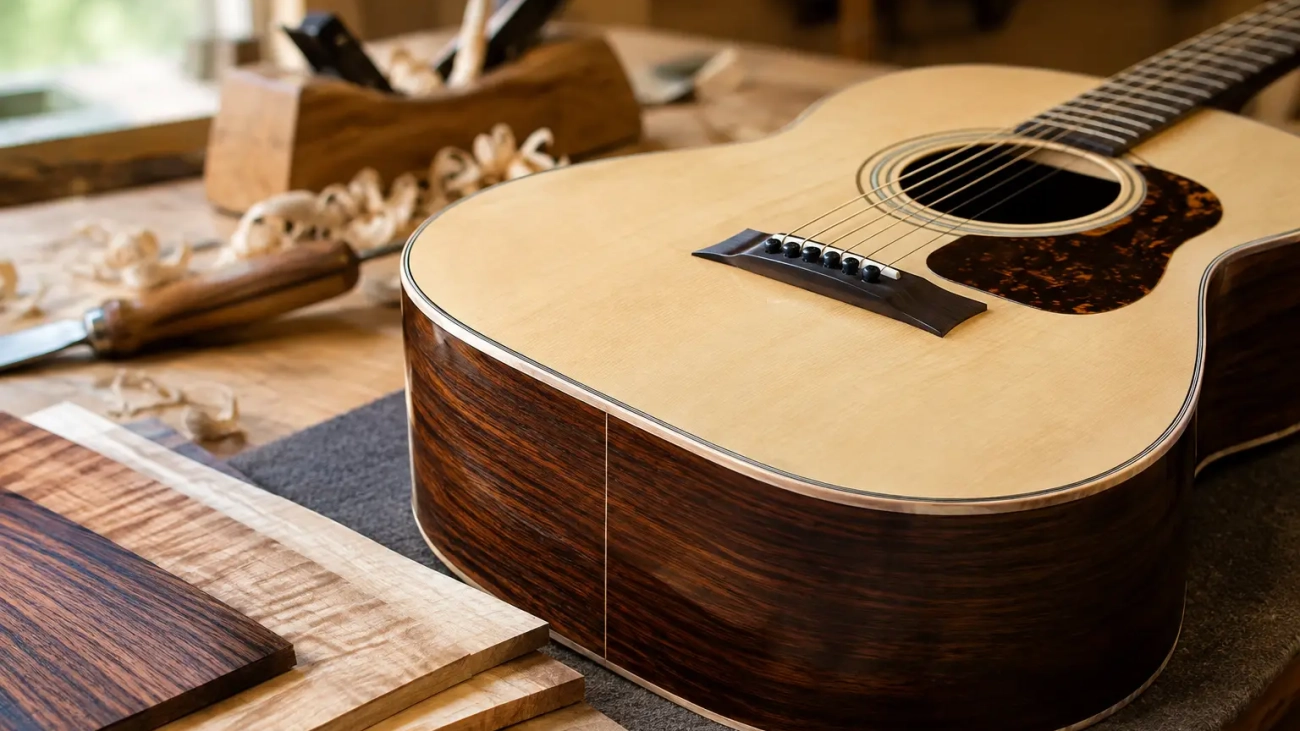
A fine guitar reveals itself in the small moments: the ease of a rest stroke at low volume, the way a tremolo line holds together, the color that appears when a player moves closer to the bridge. Artisan guitars are made for these moments. They are not simply assembled to meet a specification. They are voiced, proportioned, and refined to carry a musician’s touch into the room with clarity and character.
For a serious player, this distinction is felt long before it can be fully explained. A guitar may have beautiful woods and flawless finish work, yet still resist the hands or speak with a generic voice. A truly individual instrument brings sound, comfort, and visual presence into agreement. It invites more precise playing because it gives more back.
What Makes Artisan Guitars Different
The difference begins with intention. Factory production is designed around repeatability. Even excellent production instruments must work within established templates, inventory schedules, and consistent output targets. This serves many musicians well. It also means that the body dimensions, neck profile, bracing pattern, setup, and tonal balance are generally decided before a particular player enters the conversation.
An artisan-built guitar begins somewhere else: with the player. A classical guitarist may seek exceptional separation in counterpoint, a deep and singing treble, and restraint in the bass. A flamenco player may need immediate attack, dry percussion, and a neck that supports fast shifts without fatigue. An archtop player may want a wide dynamic range that remains articulate under a light touch and composed when driven harder.
These are not decorative preferences. They influence structural decisions throughout the instrument. The top thickness, bracing geometry, arch or dome, air volume, bridge design, neck angle, and finish all affect the final voice. The luthier’s work is to bring those elements into a living relationship rather than treat them as isolated features.
The Wood Is the Beginning, Not the Answer
Master-grade tonewood is often discussed as though its species alone determines the result. Cedar, spruce, rosewood, maple, cypress, and ebony each carry recognizable possibilities, but the individual set matters far more than the label. Two spruce tops can differ markedly in stiffness, weight, grain, elasticity, and response. Those differences deserve attention before the first joint is cut.
A discerning luthier selects wood with a specific musical purpose in mind. Spruce may offer headroom, definition, and a luminous clarity that rewards a player over many years. Cedar may offer a more immediate bloom, warmth, and tonal density. Cypress can contribute the directness and quick decay valued in flamenco construction, while rosewood may support depth, sustain, and complex overtone content.
Yet material selection requires restraint as well as knowledge. The most visually dramatic back set is not automatically the right one for every commission. Excessive density, weight, or overtone activity can work against a player seeking simplicity and projection. The finest choices are those that serve the desired sound, not those that merely impress at first glance.
Voicing for Resonance and Balance
The top is the heart of an acoustic guitar, but it does not perform alone. Its response depends on the dialogue between bracing, bridge, body, and air cavity. Voicing is the subtle process of shaping this system so that the instrument is both responsive and stable.
A lightly built guitar can feel thrilling in the first minutes, offering quick response and abundant color. But if it lacks sufficient structural judgment, it may lose balance under stronger attack or change too dramatically over time. A more heavily built instrument may offer stability and reserve, yet demand more effort than a sensitive player wishes to give. There is no single correct degree of lightness. The right choice depends on technique, repertoire, volume requirements, and the player’s preferred relationship with the instrument.
This is why a master luthier listens during construction. Tapping, flexing, measuring, and adjusting are not rituals performed for romance. They are ways of reading the materials and guiding resonance toward a coherent result. The goal is not loudness alone. It is a voice with direction: basses that support rather than obscure, trebles that sing without becoming thin, and a middle register that gives music its body.
Comfort Is Part of the Sound
A guitar that strains the player will eventually limit the music. Neck profile, scale length, nut width, string spacing, body depth, and arm position all shape the physical experience of playing. On a custom instrument, these dimensions can be considered as a whole instead of treated as compromises inherited from a standard model.
For some musicians, a slightly reduced body depth can make long rehearsals more comfortable without sacrificing the tonal weight they value. For others, a longer scale length provides the firmness and projection needed for a particular repertoire. A left-handed player should not have to accept an afterthought or a mirrored visual design that ignores acoustic balance. The instrument should be conceived properly from the first drawing.
Ergonomic details become especially meaningful over years of ownership. A neck that sits naturally in the hand encourages freedom. Thoughtful string spacing helps the right hand articulate cleanly. A carefully shaped heel makes upper-position work feel less like a negotiation. These qualities do not call attention to themselves. They allow the player’s attention to remain where it belongs: on the music.
Finish, Beauty, and the Patina of Use
The finish of a fine guitar must protect the wood while allowing it to vibrate freely. It also shapes how the instrument meets the eye and hand. A carefully applied varnish has depth, transparency, and a sense of life that synthetic uniformity rarely achieves. It lets the grain remain present rather than burying it beneath a hard visual shell.
Beauty in artisan work is rarely about excess. A rosette, purfling line, headstock, or choice of binding becomes meaningful when it belongs to the architecture of the guitar. The most enduring visual decisions are often quiet ones: graceful proportions, clean joinery, a finish that enriches rather than distracts, and materials selected for harmony.
Over time, a fine instrument acquires evidence of a musical life. The finish softens in certain places, the wood deepens in color, and the guitar begins to carry the presence of the person who plays it. This patina is not a loss of perfection. It is the beginning of identity.
A Commission Is a Musical Conversation
The finest custom work depends on an honest conversation. A player should be able to describe not only preferred woods or visual details, but also how they play, what repertoire they return to, what frustrates them in their current guitar, and what sound remains in their imagination.
A useful consultation may reveal that a request for greater volume is really a need for faster response. A desire for warmth may actually be a search for a less aggressive treble. A player who believes they need a larger body may benefit more from altered bracing or a different scale. The builder’s responsibility is not to agree with every initial preference. It is to translate musical language into sound construction choices.
At Scharpach, this exchange is central to the work. More than four decades of luthiery experience inform the practical decisions, but the commission remains personal. The finished guitar should not feel like a variation on someone else’s instrument. It should feel like a clearer extension of its player.
Choosing an Instrument for the Long Term
An artisan guitar is a serious investment, and it should be approached with patience. Listen beyond the first dramatic chord. Play softly, then with intent. Test the balance between voices, the clarity of sustained notes, the behavior of the guitar across the fingerboard, and the ease with which you can shape dynamics.
Ask whether the instrument supports the music you actually play, not only the music you hope it will make you play. A collector may value rare materials, historical references, and visual distinction. A concert musician may place responsiveness, projection, and reliability above all else. Neither priority is wrong, but an exceptional commission identifies its purpose clearly.
The right guitar does more than satisfy a checklist. It encourages return. It makes a player stay with a phrase a little longer, hear a new shade in a familiar piece, and trust the silence after the final note. Choose the instrument that makes that kind of attention feel natural, then give it the years it needs to become unmistakably yours.