
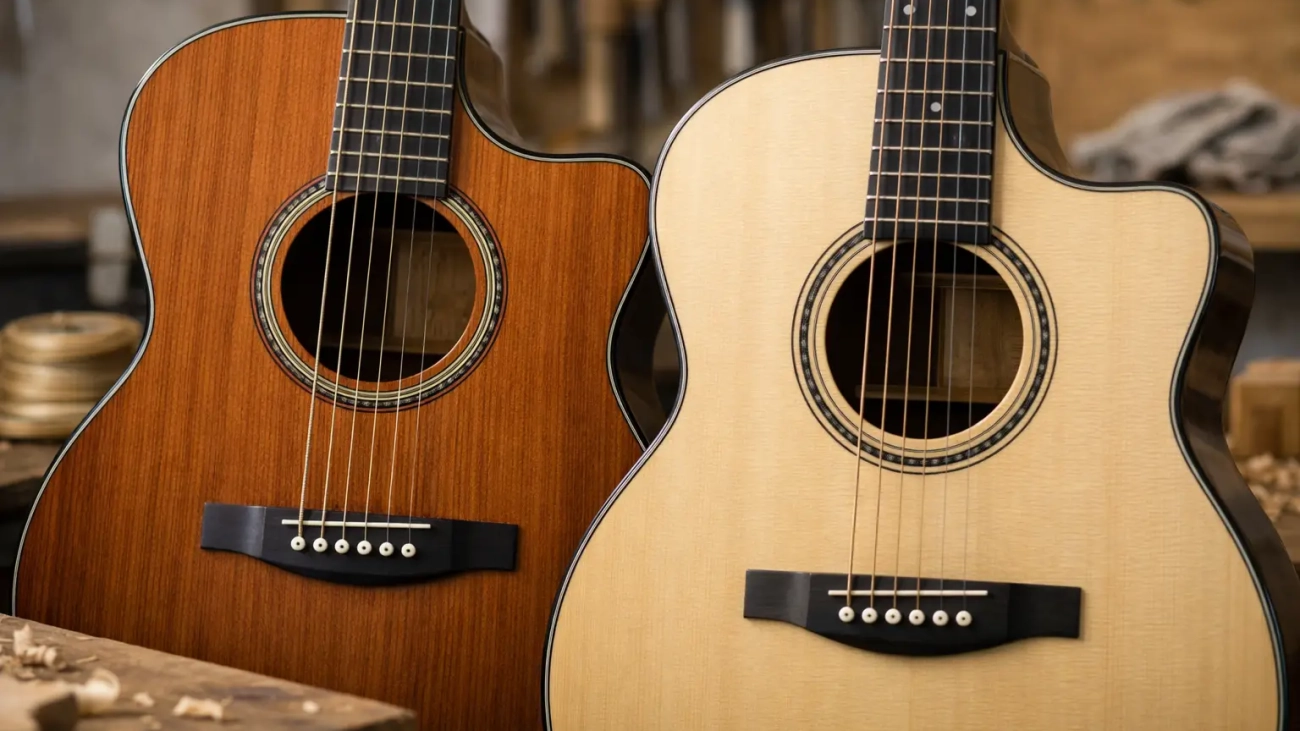
A player does not usually ask about wood in the abstract. The real question arrives in the hands: Why does one guitar answer instantly with warmth, while another seems to open wider the harder it is asked to sing? That is where cedar top versus spruce top becomes meaningful. The soundboard is not a decorative choice. It is the living diaphragm of the instrument, and its character will shape not only tone, but the player’s relationship with the guitar over many years.
For serious musicians, the comparison is rarely about better or worse. It is about temperament, repertoire, touch, and the kind of voice one wants to hear returning from the body of the instrument. Cedar and spruce can both produce exceptional guitars. Yet they do so through different kinds of eloquence.
Cedar top versus spruce top in tonal character
Cedar is often described as warm, immediate, and richly colored. Those words endure because they point to something players feel at once. A cedar top tends to offer a quick response with very little effort. Even a light attack can produce a full, rounded tone, often with a certain sweetness in the trebles and a generous bloom in the middle register. For many players, especially those who value nuance at lower dynamic levels, cedar feels intimate from the first note.
Spruce speaks in a different accent. It is commonly associated with clarity, separation, and dynamic breadth. Where cedar may offer instant warmth, spruce often gives a sense of openness and structure. Notes can feel more defined, the bass more disciplined, and the entire register more transparent under the ear. A well-made spruce-top guitar often rewards a player who draws more energy from the string, revealing greater headroom before the sound compresses.
These are not rigid rules. Fine cedar can be articulate and powerful. Fine spruce can be lyrical and tender. But as a general tonal orientation, cedar leans toward complexity and immediacy, while spruce leans toward clarity and expansion.
Response under the right hand
For a concert player or advanced amateur, response matters as much as raw tone. The guitar must not merely sound beautiful. It must answer truthfully.
Cedar often feels responsive from the first contact. It tends to favor players with a refined touch, allowing subtle shifts in color to emerge without demanding aggressive input. This can be deeply satisfying in lyrical classical repertoire, intimate solo playing, and situations where tonal richness at moderate volume is more valuable than maximum projection.
Spruce often invites a broader dynamic conversation. It can feel slightly more resistant at first, but that resistance is part of its appeal. Many players experience spruce as a surface with more reserve, more room to shape the note, and more capacity when pushed. In skilled hands, that can translate into exceptional control across pianissimo and fortissimo alike.
This is why the right question is not which top is more responsive, but responsive to what kind of touch. A light, color-oriented player may feel immediately at home on cedar. A player with a more assertive attack may prefer the way spruce stays composed and keeps unfolding.
The matter of headroom
Headroom is one of the clearest practical distinctions. Cedar often reaches its tonal richness early. That can be a gift. The instrument feels awake, generous, and emotionally available with little effort. But for some players, particularly those who play forcefully or need large dynamic range in performance, cedar may seem to arrive at its peak sooner.
Spruce generally offers more ceiling. It often retains clarity under stronger attack and can continue developing as more energy is applied. For players working in larger halls, ensemble settings, or repertoire that demands strong articulation and projection, this can be decisive.
Cedar top versus spruce top for different musical styles
Classical players have long found deep affinity with both woods, but often for different reasons. Cedar is beloved for its mature, lyrical voice and immediate expressiveness. It can flatter the singing line, enrich harmonies, and make the guitar feel generous even in a quiet room. Many modern concert instruments have used cedar to great effect because it supports coloristic playing so beautifully.
Spruce remains the traditional choice for many builders and performers who value precision, projection, and structural clarity. In contrapuntal music, fast passagework, or repertoire where separation between voices is essential, spruce can offer a particularly elegant order. It tends to preserve the architecture of the music.
In flamenco, the equation shifts again. Spruce has historically been favored for its attack, dryness, and percussive immediacy, especially in blancas. Its quick, crisp response suits the rhythmic urgency of the style. Yet cedar can also be compelling in flamenco, especially for players who want added warmth, a darker palette, or a more rounded concert voice.
For crossover players, fingerstyle artists, and musicians who move between genres, the decision often comes down to what they want the instrument to emphasize. Cedar may lend emotional immediacy and richness. Spruce may offer range, focus, and a stronger sense of tonal space.
How the top matures over time
Players commissioning a fine instrument are often thinking in decades, not seasons. That makes the aging behavior of the top especially important.
Cedar is frequently experienced as more open earlier in its life. A new cedar-top guitar can already sound developed, warm, and musically persuasive. That early maturity is one reason many players are drawn to it. The instrument feels available from the outset.
Spruce is often described as having more of a journey ahead of it. A young spruce top may sound tauter, leaner, or more reserved than it will years later. With playing time, good spruce often becomes richer, deeper, and more complex, while retaining the clarity that made it attractive in the first place. For some musicians, this gradual unfolding is part of the romance of ownership.
Still, wood does not mature in isolation. The design of the instrument, the thicknessing, the bracing, the finish, the humidity conditions, and the way the guitar is played all matter profoundly. A master-built cedar guitar can continue deepening beautifully. A poorly voiced spruce guitar will not become noble simply through age.
The builder’s hand matters more than the label
This is where many discussions become too simplistic. Cedar and spruce are not finished sounds waiting on a shelf. They are materials whose potential is realized through judgment. The finest luthiers do not treat the top wood as a marketing category. They read each set for stiffness, weight, elasticity, grain, and tap response, then build to the truth of that individual piece.
In a bespoke instrument, the top is chosen in relation to the whole guitar and to the player. Body dimensions, scale length, bracing architecture, back and sides, neck profile, and finish all shape the final voice. The question is not merely cedar or spruce. It is cedar or spruce in whose hands, for which repertoire, under what kind of touch.
Which should you choose?
If you are drawn to warmth, immediacy, and a voice that feels intimate and richly expressive at the lightest touch, cedar may be the natural choice. It often suits players who seek tonal color readily and want an instrument that feels open from the beginning.
If you value clarity, projection, note separation, and a broader dynamic ceiling, spruce may speak more directly to your musical aims. It often rewards players who want room to shape the sound over time and under greater attack.
But refined players know that preferences can surprise them. The guitarist who assumes cedar is too soft may discover extraordinary articulation in a master-built instrument. The player who fears spruce will be too austere may encounter a top of remarkable warmth and poetry. In the atelier of Scharpach, this is precisely why conversation precedes construction. The right guitar begins by listening.
The wisest choice is the one that supports your own voice with the least resistance and the greatest truth. When the top wood aligns with your technique and musical imagination, the guitar stops feeling like a specification and begins to feel like an extension of intent.