
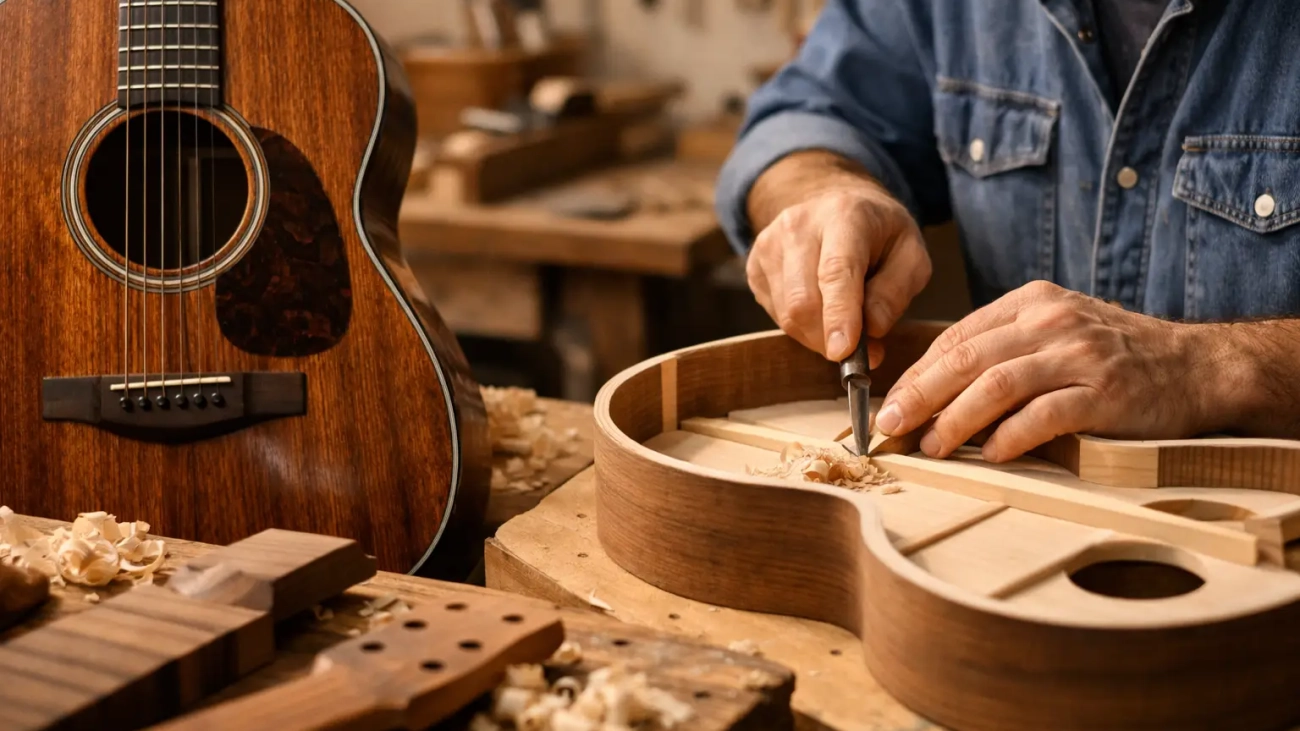
A guitarist feels it before there is language for it. One instrument seems to resist the hand, while another answers with ease. The question, why do handmade guitars sound better, usually begins there – not in marketing, but in the intimate moment when tone, touch, and intention suddenly align.
That question deserves a careful answer, because not every handmade guitar is automatically superior, and not every factory instrument is lacking. Some production guitars are excellent. Some handmade instruments are merely decorative. Yet at the highest level of luthiery, a handmade guitar can offer something a standardized process rarely achieves: a precise union of materials, structure, and musical purpose.
What players often describe as warmth, depth, projection, or sensitivity is not magic. It is the result of many small decisions made by an experienced builder who listens to the wood, understands the mechanics of vibration, and shapes the instrument around the needs of a human musician rather than the logic of a production line.
Why do handmade guitars sound better in the hands of serious players?
The simplest answer is that a handmade guitar is built for sound first. In factory production, consistency, speed, and yield must govern every stage. Thicknesses are standardized. Bracing patterns are repeated. Components are selected to fit process efficiency. This makes sense for volume manufacturing, but it places limits on nuance.
A master luthier works differently. Each top, back, and set of sides arrives with its own density, stiffness, grain structure, and acoustic potential. Two pieces of spruce may look similar and behave very differently under tension. Two rosewood backs may share a species and still produce distinct tonal color. The handmade process allows these differences to matter.
Instead of forcing every set of wood into the same formula, the builder adjusts the guitar around the material itself. That is one of the deepest reasons handmade instruments can sound more alive. They are not assembled to average measurements. They are voiced as individual bodies of resonance.
The wood is selected for character, not just appearance
Fine tone begins long before the first brace is glued. In a handmade instrument, wood is chosen not only for beauty but for acoustic behavior. The builder is listening for stiffness along and across the grain, assessing weight, studying the cut, the age, and the way the material responds under the fingers.
This matters because the soundboard is the heart of the instrument. If the top is too heavy, the guitar may feel slow and muted. If it is too light for the design, it may lose focus or structural integrity over time. The goal is balance – enough strength to support string tension, enough elasticity to move freely, enough refinement to carry subtle musical information.
In a factory setting, selection must often be simplified into grades and categories. In an atelier, selection can be much more exacting. That is where individuality begins. A great builder does not simply choose expensive wood. He chooses wood that belongs to a particular voice.
Voicing changes everything
If there is one part of the answer to why handmade guitars sound better that serious musicians should pay close attention to, it is voicing. Voicing is the art of shaping the guitar’s top, braces, and overall structure so the instrument responds in a particular way.
This is where experience becomes audible. A skilled luthier can remove or preserve very small amounts of material in order to influence attack, sustain, headroom, clarity, and tonal balance across the registers. That work cannot be reduced to a generic recipe. It depends on the exact wood in front of the builder and the kind of instrument being created.
A flamenco guitar may be voiced for immediacy, dryness, and percussive articulation. A classical guitar may ask for greater complexity, bloom, and color separation. An archtop may require a completely different relationship between top stiffness, carve, and projection. Handmade construction allows these goals to be pursued with intention rather than approximation.
The result is often a guitar that speaks more quickly, carries more overtone richness, and gives the player more control over phrasing. You do not have to fight for expression. The instrument gives it back.
Precision is not the same as sameness
Modern factories can produce instruments with impressive mechanical accuracy. Neck angles, fret placement, and component fit can be very good. But precision in luthiery is not only about measurement. It is also about judgment.
A handmade guitar benefits from close attention at every stage where tiny variables affect sound. The bridge is not merely attached. Its mass and footprint influence energy transfer. The finish is not simply applied. Its thickness affects how freely the body vibrates. The setup is not treated as the final routine step. It is part of how the instrument breathes under the player’s touch.
This is where many high-end handmade guitars distinguish themselves. They are not more beautiful only because they are made slowly. They are often more musically coherent because the whole instrument has been considered as one system.
That coherence becomes clear in the notes themselves. Bass notes have shape, not just volume. Trebles carry substance instead of thin brightness. Chords open with separation and still feel unified. The guitar does not sound assembled from parts. It sounds whole.
The instrument can be built around the player
A serious musician is never generic, so the best instrument should not be generic either. Scale length, neck shape, string spacing, action, body dimensions, and tonal emphasis all influence the relationship between player and guitar.
When an instrument is handmade for a specific musician, sound improves partly because comfort improves. A guitarist who feels physically at ease will draw more from the instrument. Better posture, cleaner attack, more confident dynamics, and reduced tension all translate into better tone.
But customization goes further than ergonomics. A builder can shape the voice around repertoire, technique, and aesthetic preference. One player may need a transparent classical guitar with strong note separation for contrapuntal music. Another may want darker color, longer sustain, and a more forgiving response for lyrical playing. A left-handed player may finally have an instrument designed without compromise rather than adapted as an afterthought.
This is one reason bespoke work remains so compelling. The guitar is not asking the musician to adapt to a preexisting mold. It is meeting the player where artistry actually lives.
Handmade does not mean romantic guesswork
There is a misconception that handcrafted instruments are guided mainly by intuition while factory instruments are guided by science. In truth, the finest luthiery unites both.
The builder’s ear, touch, and experience are essential, but so is a rigorous understanding of structure, moisture content, geometry, neck relief, bridge torque, top deflection, and long-term stability. A great handmade guitar is not precious because it is old-world. It is valuable because deep craft makes intelligent use of every variable that affects sound.
This is also where trade-offs enter the conversation. A highly responsive guitar may reveal every nuance of touch, which some players love and others find demanding. A lightly built instrument may be exceptionally open and resonant, but it requires a builder who understands how to preserve strength and longevity. A heavier guitar may offer durability and focus, yet sacrifice some immediacy.
So the real question is not whether handmade is always better in every abstract sense. It is whether the builder has the skill to make those trade-offs in service of a meaningful musical result.
Time gives the instrument a voice of its own
The best handmade guitars are often built with long musical life in mind. Materials are carefully seasoned. Joinery is executed for stability. Finishes are chosen not only for appearance but for acoustic sensitivity and aging behavior.
Over years of playing, a well-made acoustic guitar often becomes more articulate, more open, and more complex. The wood settles. The top learns the string energy placed into it. The instrument acquires a maturity that can feel almost vocal.
Mass-produced guitars can also age beautifully, of course. But heirloom-level handmade instruments are typically conceived with this development in mind from the beginning. They are not only meant to survive time. They are meant to deepen within it.
For discerning players, that changes the nature of ownership. The guitar becomes less a purchase than a relationship. In ateliers such as Scharpach, that relationship begins with listening – to the musician, to the material, and to the sound the instrument has not yet revealed.
A handmade guitar sounds better when every decision inside it serves music rather than manufacturing. Not because the word handmade is charming, but because care, judgment, and acoustic intelligence leave traces in every note. And when a guitar is built with that level of attention, it does more than produce sound. It gives the player a truer voice.