
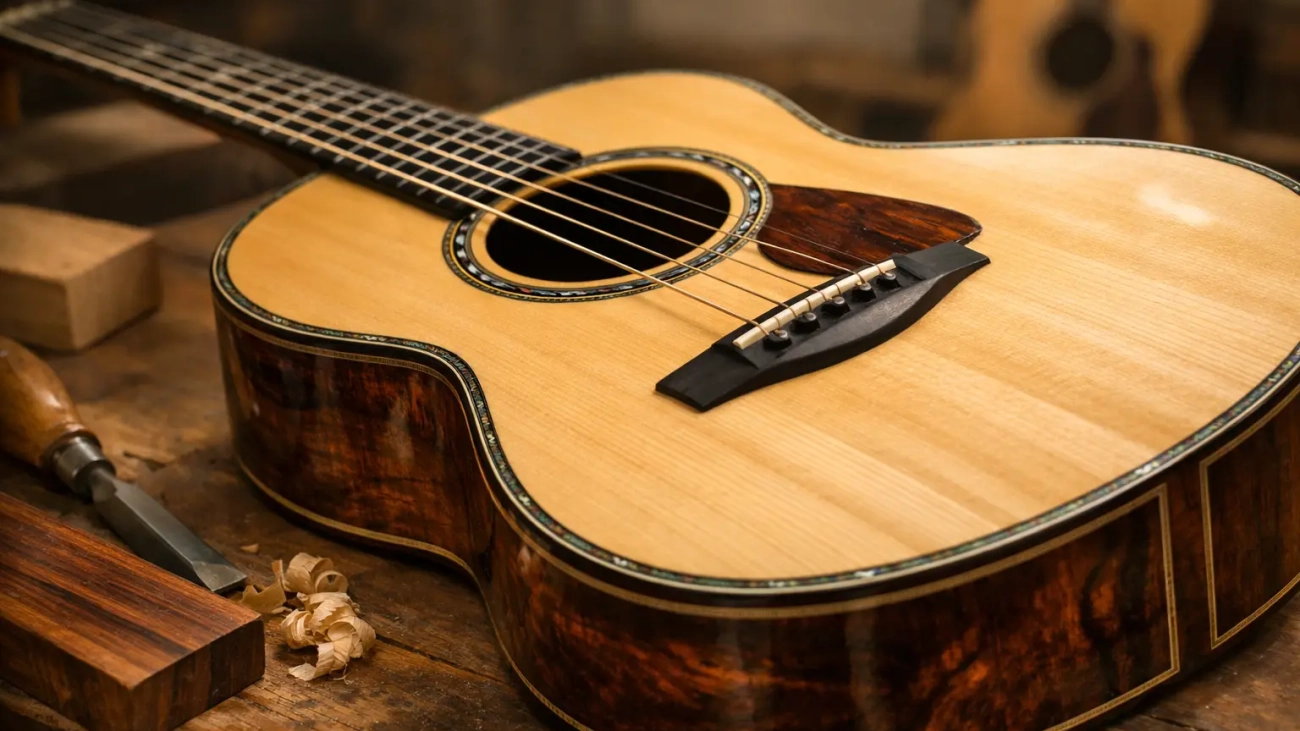
A guitarist knows the difference before the label is read. The first note rises with unusual ease, the body answers without hesitation, and the instrument seems to organize sound rather than merely produce it. That is the real starting point for understanding what makes a guitar master grade. It is not a marketing tier, a decorative upgrade, or a price bracket alone. It is the point at which material, design, and craftsmanship become inseparable from musical expression.
In fine guitar making, the term carries weight because it implies more than excellence in parts. A master-grade instrument must possess an uncommon level of tonal depth, structural intelligence, and artistic coherence. It should reward a refined touch, reveal character across the full register, and continue developing with age rather than simply holding together over time.
What makes a guitar master grade in practice
The clearest answer begins with sound, but sound never exists in isolation. A great guitar is the result of many decisions that serve one another. The woods must be exceptional, yes, but they must also be matched well. The bracing must support the intended voice. The neck geometry must invite control. The finish must protect without muting. Every detail matters because every detail either helps the instrument breathe or asks it to work against itself.
This is why master grade is not defined by visual perfection alone. A dramatic set of Brazilian rosewood or a beautifully figured spruce top may be rare, but rarity by itself does not create musical greatness. A guitar reaches master-grade territory when those materials are voiced with understanding and restraint, so the final instrument speaks with clarity, color, and authority.
Material selection is only the beginning
Fine tonewoods remain central to the conversation because they shape the ceiling of what a guitar can become. Master-grade tops are chosen for stiffness, elasticity, grain consistency, cut, and tap response. Back and side woods are judged not only for beauty but for how they reflect, absorb, and color energy. Density, seasoning, and long-term stability all matter.
Yet the finest sets can still become ordinary guitars in unskilled hands. Wood is potential, not destiny. One top may offer explosive projection suited to a concert classical guitar, while another may favor complexity and intimacy. One maple set may support a fast, articulate archtop response, while a particular rosewood may offer greater harmonic bloom. The builder must hear these possibilities before the instrument exists.
That act of judgment separates procurement from artistry. A master luthier does not simply collect rare materials. He selects them for a purpose, pairing them to the player, the model, and the desired tonal architecture.
The role of age, cut, and seasoning
Master-grade wood is often discussed as though species alone explains everything. It does not. Quarter-sawn orientation, even grain, proper drying, and long seasoning are just as decisive. Poorly prepared premium wood can be less valuable than modest wood handled with intelligence.
Seasoned wood tends to behave more predictably under tension and tends to reveal its acoustic character with greater honesty. For a serious player, that stability is not a luxury. It is part of the instrument’s reliability, both on stage and over decades of use.
Voicing is where the guitar becomes alive
If material selection sets the foundation, voicing determines whether the instrument will truly sing. This is one of the least visible and most consequential aspects of fine luthiery. Voicing is the process of shaping the top, braces, plate thickness, and overall stiffness so the guitar responds in a particular way under the hand.
This is where master grade becomes unmistakable. A superior guitar does not merely produce volume. It offers a refined balance of immediacy and complexity. The attack should be clean, but not thin. Sustain should be present, but not smeared. The bass should carry depth without clouding the middle register. Trebles should remain lyrical rather than brittle.
Great voicing also creates dynamic range. The instrument should respond to a whisper and remain composed under force. That matters profoundly for advanced players, because a serious instrument must reflect nuance rather than flatten it. The more developed the technique, the more obvious a guitar’s limits become.
Responsiveness over raw power
Many players first equate a special guitar with projection. Projection matters, especially in a concert setting, but power without sensitivity is incomplete. A master-grade guitar should answer the smallest variation in touch. It should give the player access to color, articulation, and phrasing, not just loudness.
That is why two guitars with similar volume can feel entirely different. One may sound impressive across the room but resistant under the fingers. The other may feel alive, elastic, and deeply cooperative. For the musician, the second instrument is often the more profound one.
Precision craftsmanship gives beauty its discipline
The finest instruments show discipline everywhere. Joinery must be exact. Neck alignment must be true. Fretwork must allow clean intonation and low, comfortable action without compromise. The bridge must be placed and shaped with precision. The saddle, nut, and fingerboard must work together as a unified system.
These are not secondary concerns. If the geometry is even slightly off, the player will compensate with tension, and the guitar’s expressive potential will narrow. A master-grade instrument should feel composed in the hands, balanced in posture, and trustworthy in every position.
Craftsmanship also includes what is left out. Excess mass, overbuilt plates, heavy finishes, and unnecessary ornament can all reduce vitality. Restraint is part of mastery. The best guitars often appear effortless because every unnecessary element has been removed.
Finish, elegance, and the discipline of restraint
A beautiful finish matters, but not merely for appearance. On a fine acoustic instrument, the finish must preserve the wood while allowing it to move. Thickness, composition, and application all influence response. A finish that is too heavy can suppress resonance. One that is too fragile may fail its protective role.
Master-grade work achieves a difficult balance. The guitar should present visual elegance and tactile refinement while remaining acoustically free. Rosettes, bindings, purflings, and appointments should feel integrated into the instrument’s identity, not layered on to suggest luxury.
This is where true sophistication differs from excess. Beauty on a master-grade guitar is usually coherent rather than loud. It deepens the character of the instrument instead of distracting from it.
Playability is part of the voice
An instrument can be tonally impressive and still fall short of greatness if it resists the player. Neck shape, scale length, string spacing, body dimensions, and setup all influence musical freedom. For a classical guitarist, subtle differences in neck profile or action can affect phrasing and stamina. For a flamenco player, immediacy and percussive control may be decisive. For an archtop player, attack, clarity, and comfort across extended sessions may matter most.
This is why master grade cannot be fully standardized. The finest guitar for one player may be too stiff, too soft, too narrow, or too expansive for another. A serious instrument should feel as though it has been built with a human being in mind, not an abstract market category.
At the highest level, personalization is not indulgence. It is a practical extension of craftsmanship. When an instrument is shaped around repertoire, touch, physique, and tonal preference, quality becomes more than objective excellence. It becomes relevance.
What makes a guitar master grade for the long term
A master-grade guitar should not peak on the day it leaves the bench. It should possess the structural integrity and tonal potential to mature beautifully. As the wood settles and the instrument is played, the voice often becomes more open, more complex, and more personal.
Longevity depends on intelligent construction as much as fine material. The neck must remain stable. The top must be lively without being vulnerable. The instrument should age with grace. This is especially important at the highest end of the market, where a guitar is often expected to serve not for a season but for a lifetime.
Collectors recognize this. So do professional players. They are not simply buying a polished object. They are investing in a relationship with an instrument that can grow deeper over time.
The rarest quality is artistic coherence
If there is one final measure of what makes a guitar master grade, it is coherence. Everything must belong. The voice, the response, the feel, the proportions, the visual language, and the construction must all point in the same direction.
That direction may vary. One guitar may be built for transparency and lyrical separation. Another may be built for warmth, authority, and a broad concert voice. Neither approach is inherently superior. What matters is whether the instrument fulfills its intention at a very high level, without contradiction.
This is where the hand of an experienced builder becomes unmistakable. After decades at the bench, judgment replaces formula. A workshop like Scharpach is valued not simply for making beautiful guitars, but for understanding how beauty, sound, and individuality must be brought into alignment.
For the discerning player, that is the heart of the matter. A master-grade guitar is not defined by prestige alone, but by its ability to become an extension of the musician’s inner ear. When an instrument does that with grace, authority, and lasting depth, the term has truly been earned.