
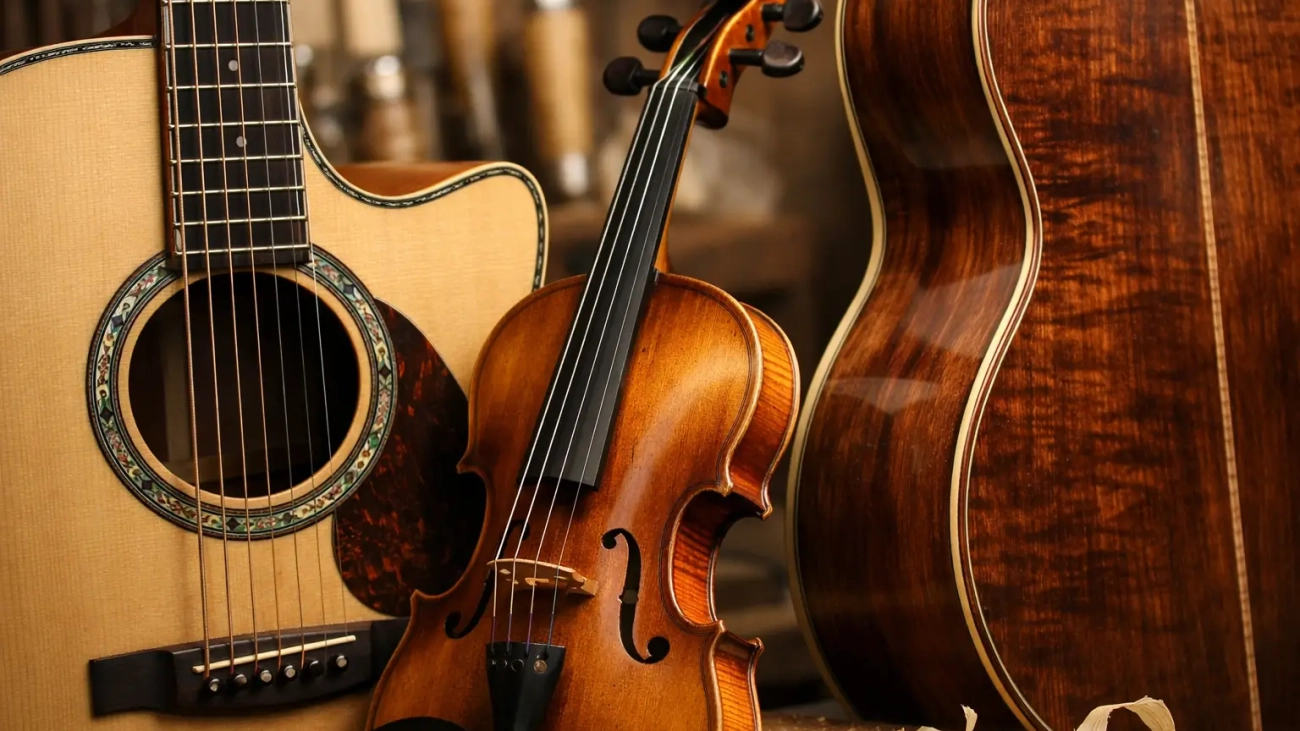
A great guitar reveals itself in the smallest musical decisions: the pressure required to form a barré, the way a rest stroke carries beyond the note, the color that remains when a chord has nearly faded. This guide to master grade acoustic instruments is for players who have reached the point where a generic instrument no longer answers the full character of their hands.
A master-grade guitar is not defined by ornament alone, nor by a dramatic piece of rosewood or a label inside the body. It is the result of materials, proportion, voicing, and finish brought into agreement by an experienced maker. More than that, it is an instrument made with a particular player in mind – their repertoire, touch, physical requirements, and idea of sound.
What Makes a Master-Grade Acoustic Instrument Different?
The distinction begins before the first piece of wood is shaped. Factory instruments are designed around consistency, efficiency, and broad appeal. A fine custom instrument is designed around a musical question: What should this player hear and feel when they begin to play?
That question affects every decision. A classical guitarist may seek a singing treble with clear separation in polyphonic music. A flamenco player may need immediacy, dry attack, and a percussive response that remains articulate at speed. An archtop player may favor projection, warmth, and the complex bloom of a voiced carved top. These are not cosmetic preferences. They require different structural balances and different relationships between the top, back, sides, bracing, bridge, neck, and finish.
Master-grade work also demands restraint. The most beautiful instrument is not necessarily the one with the most decoration. Purfling, rosettes, bindings, and inlay should serve the visual language of the guitar without competing with its voice. Elegance often comes from proportion, precision, and the quiet confidence of materials selected at their peak.
The Woods Are the Beginning, Not the Answer
Players often begin their search by asking which tonewood is best. There is no universal answer, because wood is only one part of a living acoustic system. Still, exceptional materials give the maker a greater range of possibility.
A responsive spruce top can offer clarity, headroom, and a broad dynamic range. Cedar may bring an earlier sense of warmth and immediacy, often appealing to players who value a mature, lyrical response from the outset. Within either species, individual sets differ profoundly in stiffness, weight, grain structure, and tap tone. The maker listens to the wood before deciding what it can become.
Back and side woods shape the way the guitar supports the top. Indian rosewood is admired for its depth, overtone richness, and powerful low register. Maple can provide quick response, focus, and a more transparent note structure. Cypress remains central to traditional flamenco construction, contributing dryness, speed, and the distinctive character many players associate with the genre.
The trade-off is always musical. More overtones can create grandeur and color, but may be less desirable for a player who needs each line of a Bach fugue to remain sharply defined. A highly immediate instrument can feel thrilling under the fingers, while a guitar with greater headroom may reward a stronger, more deliberate right hand. The aim is not to chase a specification. It is to find the tonal territory that supports the player’s music.
Why Seasoning and Selection Matter
Master-grade wood must be stable as well as beautiful. It needs proper seasoning, careful storage, and selection for the particular demands of its role. A top must possess enough stiffness to carry string energy without becoming heavy or resistant. A neck must remain dependable through seasonal change. A back must contribute resonance while offering structural security.
These considerations are largely invisible in a finished guitar, but they are felt for decades. The finest materials do not remove the need for skill. They make skilled voicing possible.
Voicing Is Where the Guitar Finds Its Voice
Voicing is the patient adjustment of the instrument’s acoustic structure. Through the shaping of braces, graduation of the soundboard, refinement of the bridge area, and control of mass, the luthier guides the guitar toward its intended response.
This is not a formula that can be copied from one instrument to the next. Two tops from the same tree may ask for different treatment. One may be light and exceptionally stiff; another may require a different bracing profile to achieve comparable balance. The experienced maker works with the evidence of the material, not against it.
For the player, voicing becomes tangible as balance and expression. The bass should have authority without swallowing the middle register. The trebles should sing without becoming thin. Notes should begin cleanly, develop naturally, and release with grace. Across the fingerboard, the guitar should feel coherent rather than divided into strong and weak regions.
A master-grade instrument should also respond to changing intent. Play softly, and it should offer nuance rather than disappearing. Ask for volume, and it should expand without hardening. This capacity for dynamic language is one of the clearest signs that an instrument can remain compelling long after its novelty has passed.
Playability Is an Acoustic Decision, Too
A beautiful voice is incomplete if the instrument does not invite the player to use it. Neck shape, nut width, string spacing, scale length, fretwork, action, and setup all influence technique and endurance.
These choices deserve an honest conversation. A wider fingerboard may give the classical player more room for clean articulation, yet feel unfamiliar to someone coming from a narrower-necked guitar. A longer scale can provide tension, definition, and projection, but may not suit every hand or every repertoire. Lower action can feel effortless, though it must be balanced against the player’s attack and need for clean tone.
For left-handed musicians, a true left-handed build is more than a reversed outline. The internal architecture, compensation, bracing orientation, and ergonomic details should be considered from the beginning. A personalized instrument respects the way the player actually approaches the guitar rather than asking the player to adapt to a standard.
At Scharpach, this dialogue is central to the commission process. A serious instrument should begin with listening: to the player’s sound, their repertoire, their physical needs, and the musical future they imagine for themselves.
Finish, Aging, and the Patience of Fine Work
Finish protects the guitar, but it also participates in its sound. A heavy finish can restrain vibration; an overly delicate finish may not offer sufficient protection for a working instrument. The goal is a thin, carefully applied surface that allows the wood to speak while honoring the guitar’s life in the world.
Varnish also shapes the visual experience. It can heighten the depth of a figured back, lend warmth to spruce or cedar, and give the instrument a surface that becomes more personal with use. The finest finishes do not look synthetic or separate from the wood. They seem to belong to it.
A master-grade guitar is not static once it leaves the workshop. As the wood responds to string energy and the instrument settles into regular playing, its voice can open in subtle and rewarding ways. This is not magic, nor is it a promise that every guitar will change in the same manner. It is the natural continuation of an instrument built from resonant organic material.
Care supports that development. Sensible humidity control, a well-fitted case, and professional attention when needed protect the work without turning ownership into anxiety. These instruments are made to be played, not preserved as distant objects.
Choosing a Master-Grade Instrument With Clarity
The right commission begins with better questions than “What is the best guitar?” Consider the music you play most often, the rooms in which you perform, the response you need under your hands, and the sounds that have stayed with you over years of listening.
Bring specificity to the conversation. Describe whether you want a dry, direct flamenco attack or a long, orchestral sustain. Explain whether you play with nails, fingertips, or a plectrum. Mention old injuries, hand size, travel needs, recording work, and whether the guitar must carry in an ensemble. Even aesthetic preferences matter, because an instrument that feels deeply yours is more likely to become part of your daily musical life.
There are occasions when a fine existing guitar is the right choice. A player who needs an instrument immediately, or who has not yet formed clear tonal preferences, may benefit from spending time with several exceptional examples before commissioning. A custom build becomes most meaningful when it answers a need that cannot be met by compromise.
The lasting value of a master-grade acoustic instrument lies in this intimacy between craft and player. It should not merely produce admirable sound across the room. It should make you want to return to the chair, place your hands on the strings, and say something only you can say.