
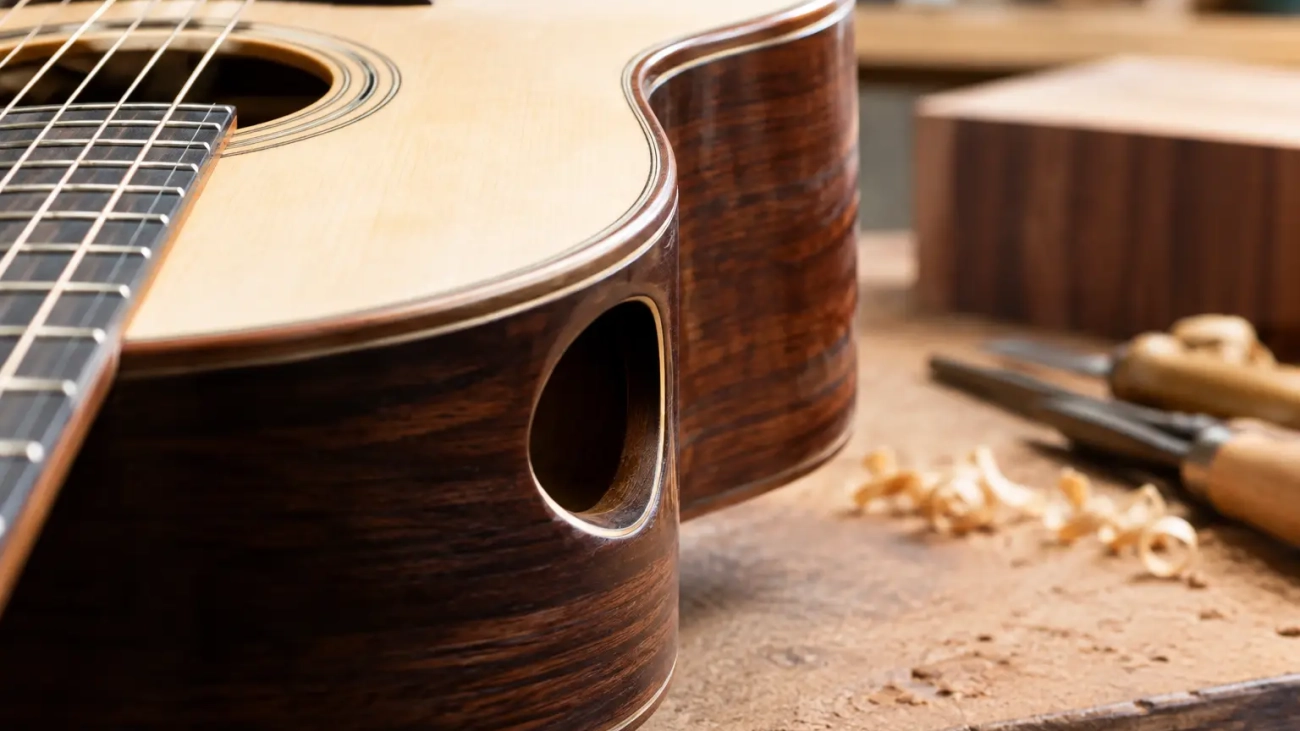
A soundport is a small opening placed in the guitar’s side, usually on the upper bout facing the player. It can appear modest beside the drama of a finely voiced top, a graceful arch, or a luminous varnish finish. Yet for the guitarist holding the instrument, it can change the intimacy of the musical experience. This guide to guitar soundports considers what that opening truly does, what it does not do, and when it deserves a place in a serious handmade guitar.
The central appeal is immediate: a conventional soundhole projects much of the instrument’s voice away from the player, while a side soundport allows some of that sound to reach the player directly. For the classical guitarist shaping long phrases, the flamenco player listening for the edge of an attack, or the archtop artist balancing a chord melody, that closer connection can be deeply persuasive. But a soundport is not a shortcut to a louder or better guitar. It is one design choice within a living system of wood, air, structure, and touch.
What a Guitar Soundport Changes
The body of an acoustic guitar is an air chamber as well as a wooden instrument. When the strings set the top in motion, the top, back, sides, and enclosed air all participate in producing sound. The primary soundhole is part of this acoustical system. Altering the total opening area by adding a soundport can influence how the air resonance behaves, particularly in the lower register.
In practical terms, the player often hears a more present, immediate version of the guitar’s voice. This is less about an increase in overall room-filling volume than a change in listening position. A performer may perceive greater clarity in bass lines, more detail in the separation of voices, and a more vivid sense of the instrument’s dynamic response beneath the ear.
That distinction matters. The person in front of the guitar may not hear the same increase the player hears. Depending on the size, position, and shape of the port, an audience can hear a subtly different balance, while the player experiences a much more substantial shift. A soundport is therefore best understood as a feature for communication between instrument and musician, not as a guarantee of greater projection into a hall.
Why the Effect Is More Than Volume
A fine guitar asks the player to listen closely. The relation between a fingertip and the first instant of tone, between a rest stroke and the bloom that follows it, is where interpretation takes shape. A soundport can make this feedback feel more direct.
For classical players, this can be particularly valuable in repertoire with independent inner voices and refined dynamic contrasts. Hearing the sustain and color of a note at close range may encourage more confident phrasing. Some players describe the experience as if the instrument has moved closer to the body, not physically, but musically.
Flamenco guitarists may value the sharper perception of articulation, rasgueado texture, and percussion from the top. Here, however, the desired result depends greatly on the instrument. A flamenco guitar lives on speed, dryness, controlled compression, and a quick answer to the hand. The soundport must support that character rather than soften its urgency or overemphasize low-frequency energy.
For an archtop, the question is different again. An archtop already has its own relationship to air movement, carved plates, f-holes, and amplified use. A side port can offer a useful monitoring perspective in an acoustic setting, but its acoustic contribution must be considered alongside the instrument’s intended musical role and resistance to feedback.
Player Perception and Audience Projection Are Not the Same
This is the point most often lost in casual discussion of soundports. The opening faces the player, so the benefit is naturally directional. It may allow the musician to hear more, but it cannot replace a guitar that has been designed for projection, balance, and carrying power from the outset.
A beautifully built instrument sends sound forward through the coordinated work of its top, bracing, body geometry, materials, and setup. If a guitar is weak in the room, cutting a hole in the side is not the proper remedy. The goal is never to create an impressive effect at the player’s ear while compromising the integrated voice heard by others.
A Guide to Guitar Soundports: Design Choices That Matter
There is no universal soundport shape or dimension. Circular, oval, leaf-shaped, and more sculptural forms can all be successful, but the visual outline is only the beginning. The total area of the opening, its location, the thickness of the side, the reinforcement around it, and the relationship to the main soundhole all affect the result.
Placement is often high on the bass-side upper bout, where the player can hear the port without obstructing normal posture. Some builders prefer a smaller opening for a restrained effect; others use a larger port to create a more pronounced sense of air and proximity. Neither approach is inherently superior. The right choice depends on the body size, scale length, top stiffness, bracing concept, and the player’s tonal priorities.
Structural work deserves equal respect. The guitar side is not decorative trim. It contributes to the enclosure, supports the rim of the instrument, and must remain stable through years of seasonal movement and use. A soundport should be cleanly reinforced and sensitively integrated so that it does not invite weakness, distortion, or an awkward interruption of the instrument’s lines.
On a master-grade guitar, the port’s interior treatment also matters. The edge should feel finished to the hand, the grain should be honored, and the opening should appear native to the design rather than added as an accessory. Simplicity is often the more demanding path.
The Trade-Offs Worth Considering
A soundport is not for every guitarist. Some players prefer the familiar, unified response of a traditional closed side and find that a port makes the instrument feel too immediate or too exposed beneath the ear. Others love the added connection at home, in a recording environment, or on a quiet stage, but have little need for it in a loud ensemble.
There can also be tonal trade-offs. Increasing the effective opening area can affect the body’s air resonance. If this is not accounted for in the design, the lowest register may change in ways the player does not want. The outcome can be a looser bass, a shift in warmth, or a redistribution of perceived balance. In a well-conceived custom instrument, these consequences are anticipated rather than corrected after the fact.
A port may also influence the player’s sense of volume enough to change how they perform. Because the guitar sounds fuller at the ear, a player may instinctively use less force. That can be a gift for control and nuance, but it is worth evaluating honestly. The finest choice is the one that serves the player’s actual musical environment, not merely the first impression in a quiet room.
Who Benefits Most From a Soundport?
A soundport often suits guitarists who spend significant time alone with the instrument: composers, recording artists, advanced students, and concert players who require precise feedback while refining a program. It can be especially compelling for musicians who feel that a conventional guitar gives its best voice to the audience while withholding some of its complexity from the person creating the music.
It may be less essential for players whose work is primarily amplified, heavily accompanied, or centered on established traditional specifications. That does not make it inappropriate. It simply means the decision should begin with repertoire, technique, venue, and listening habits.
In a custom commission, this is why the conversation matters as much as the feature itself. A builder should ask how the musician sits, where the guitar will be played, whether the desired voice is intimate or expansive, dry or overtone-rich, and how much traditional visual language the player wishes to preserve. At Scharpach, those questions belong to the instrument’s conception, alongside the selection of tonewoods, scale, neck profile, bracing, and finish.
Listening Before Deciding
When evaluating a soundport, play slowly before playing loudly. Listen to a single bass note decay. Listen to whether a melody remains distinct above accompaniment. Notice whether the port reveals more of the guitar’s color or merely more sound. Then have another guitarist play the instrument while you listen from several feet away.
The right soundport does not call attention to itself for long. After the initial discovery, it becomes part of the player’s relationship with the guitar: a quiet source of information, breath, and reassurance. When it is conceived with the whole instrument in mind, it can make a finely built guitar feel not louder, but closer to the musician who gives it voice.