
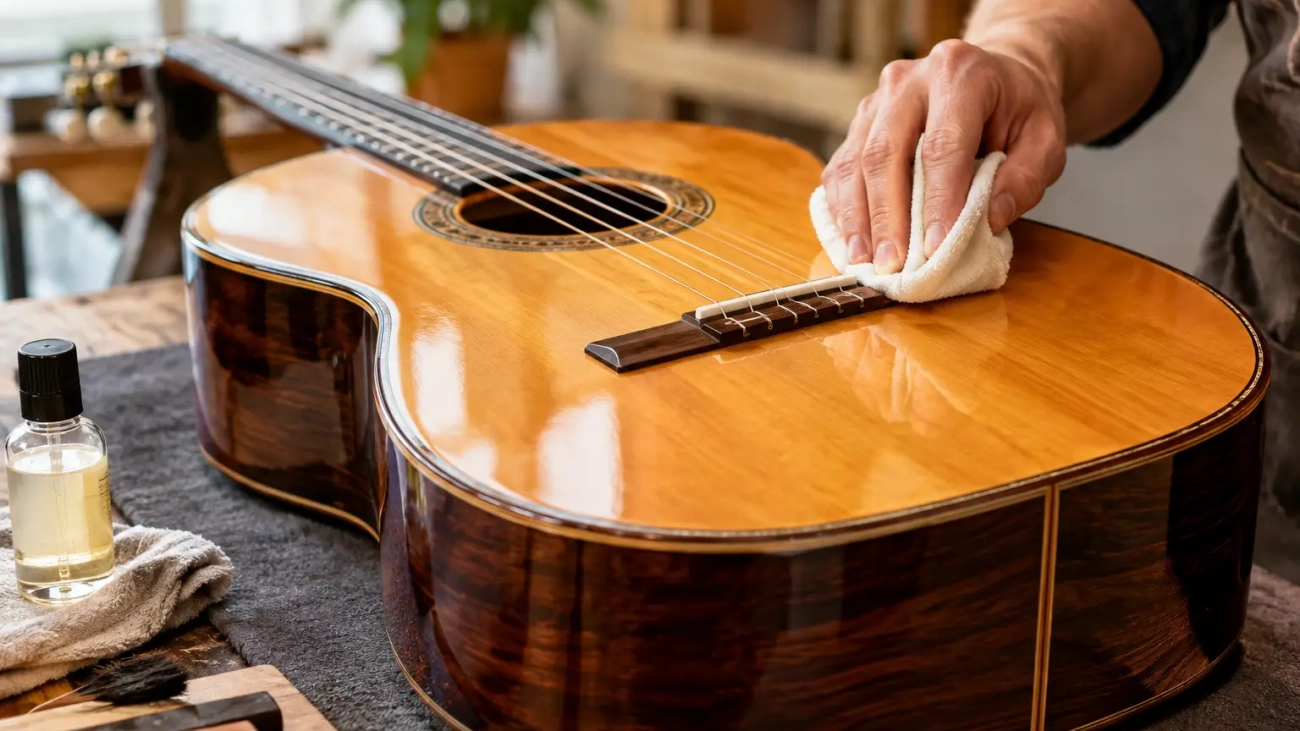
A French-polished guitar does not ask to be treated like a fragile ornament. It asks for discernment. Caring for French polish guitars means understanding that the luminous surface beneath your hand is not a thick industrial barrier, but a finely built shellac finish with a living relationship to the wood, the air, and the music made upon it.
At its best, French polish gives a fine classical, flamenco, or archtop guitar remarkable immediacy. It is exceptionally thin, acoustically sympathetic, and capable of a depth of light that seems to come from within the wood. That sensitivity is part of its beauty. It also means that a few thoughtful habits will serve the instrument far better than aggressive cleaning products or casual storage.
Why French Polish Requires a Different Kind of Care
French polish is traditionally built from many extremely thin applications of shellac, worked by hand until the surface becomes clear, level, and reflective. Unlike the heavy polyester finishes found on many factory instruments, it does not attempt to entomb the guitar beneath a hard plastic-like coat. It allows the wood and its acoustic character to remain closer to the player.
The trade-off is honest and straightforward: shellac is more vulnerable to heat, alcohol, sweat, and abrasion than modern catalyzed finishes. A belt buckle, a shirt button, a watch clasp, or a careless wipe can leave evidence. Yet French polish also has a virtue that matters to owners of fine instruments: it is highly repairable in skilled hands. A master luthier can often restore areas that would be far more difficult to address on a thick synthetic finish.
Small marks are not always damage. On an instrument that is played seriously, a subtle softening of the surface at the armrest or a faint trace near the golpeador area may become part of its personal history. The goal is not to preserve an untouched museum object. The goal is to preserve the guitar’s health, responsiveness, and beauty over a lifetime of music.
Caring for French Polish Guitars Day to Day
The simplest routine is usually the right one. After playing, lightly wipe the strings, neck, and body with a clean, dry microfiber cloth reserved for the instrument. This removes perspiration, skin oils, and dust before they have time to settle. Use a light hand. Rubbing hard in one small area creates friction and heat, neither of which benefits shellac.
A dry cloth is enough for most occasions. If there is a stubborn fingerprint or a trace of residue, first try breathing gently onto the area and wiping it immediately with the microfiber cloth. This small amount of moisture is often sufficient. Do not wet the cloth, and do not allow water to collect near the bridge, rosette, fingerboard extension, or binding seams.
Avoid commercial guitar polishes unless your luthier has specifically recommended one for shellac. Many products contain silicone, petroleum distillates, alcohol, or cleaning agents designed for tougher finishes. They may cloud the surface, soften it, leave a residue, or complicate a future repair. Household cleaners, furniture polish, and glass cleaner have no place near a French-polished guitar.
A player’s clothing deserves attention as well. Remove rings, watches, bracelets, and large belt buckles before playing whenever possible. Long sleeves with hard buttons, metal zippers, or decorative hardware can also mark the lower bout. These precautions may seem modest, but on a finely finished instrument they make a visible difference over years rather than weeks.
Let the Finish Rest After Playing
Shellac responds to warmth. After a long practice session, particularly in a warm room, give the guitar a few minutes to cool in its open case before closing it. This is not ceremony for its own sake. A finish that is warm from contact with the player is temporarily more susceptible to imprinting against plush case lining or a strap.
Never leave a French-polished guitar on a stand in direct sunlight, near a radiator, in a parked car, or close to an air-conditioning vent. High heat can soften shellac quickly, while abrupt temperature changes can stress both finish and wood. A guitar may survive one such episode, but fine instruments should not be asked to endure avoidable risks.
Humidity Is Part of the Instrument’s Care
The finish is only one part of the story. The wood beneath it is the true voice of the guitar, and wood responds constantly to humidity. For most handmade acoustic guitars, a stable relative humidity of roughly 45 to 55 percent is a sensible target. Stability matters as much as the number itself.
In dry conditions, the top can lose moisture and contract. Action may drop, fret ends can become more noticeable, and in severe cases the instrument may develop cracks or structural stress. Excessive humidity can raise the action, soften the response, and encourage swelling in joints and braces. A French-polished surface can also appear different as the wood beneath it moves.
Keep a reliable hygrometer where the guitar lives or inside its case. During a dry winter, a properly maintained case humidifier can be valuable. In a persistently humid climate, a climate-controlled room or suitable dehumidifying solution may be necessary. The right method depends on the local environment, the season, and how often the guitar travels.
Avoid placing a humidifier directly against the instrument or overfilling any case device. The aim is gentle environmental balance, not concentrated moisture. If the guitar has been exposed to extreme dryness or humidity, allow it to acclimate gradually in its case before making any judgment about playability.
Storage and Travel Without Unnecessary Risk
A fitted hard case remains the safest home for a French-polished guitar when it is not being played. It protects the instrument from sudden changes in humidity, accidental contact, dust, and the ordinary hazards of a busy household or studio. A stand is useful during a session, but it is not long-term protection.
Before closing the case, make sure no tuner handle, strap end, cable, sheet music, or accessory can rest against the finish. A soft cloth may be placed loosely over the top for travel if it cannot shift or trap moisture. Do not store cleaning products, loose capos, or metal accessories in direct contact with the instrument.
For travel, allow extra time. A guitar arriving from a cold trunk, a hot airport transfer, or a dry aircraft cabin should remain in its closed case until its temperature has moderated. Opening the case immediately invites condensation and a sudden environmental shock. Patience is less expensive than restoration.
Air travel introduces its own variables. When a fine instrument must fly, a high-quality flight case and clear arrangements with the carrier are prudent. Even then, the guitar should be assessed after arrival for changes in humidity, setup, or finish condition. Do not attempt to correct a new buzz or altered action on the spot if the instrument has just crossed climates. Let it settle first.
When to Leave the Finish Alone
One of the most refined forms of care is knowing when not to intervene. A small scuff, light surface haze, or faint playing mark does not automatically require polishing. Repeated attempts to erase every trace can remove material, alter the sheen unevenly, or create more conspicuous problems than the original mark.
If the finish becomes sticky, cloudy, deeply scratched, or marked by an accidental spill, stop using cleaners and consult an experienced luthier. Alcohol-based substances, including hand sanitizer, fragrance, and some insect repellents, can damage shellac quickly. A prompt, restrained response is usually wiser than an enthusiastic home remedy.
The same principle applies to cracks, loose bindings, lifting frets, or a sudden change in action. These are not cosmetic concerns alone. They may signal a humidity issue or a structural adjustment that deserves professional attention. A fine guitar rewards careful observation.
French polish is not a compromise made for appearance. It is a deliberate choice for the player who values delicacy, resonance, and a finish that belongs to the musical life of the instrument. Treat it with clean hands, a stable climate, and a little patience, and the surface will continue to hold its quiet radiance while the guitar finds an ever more individual voice.