
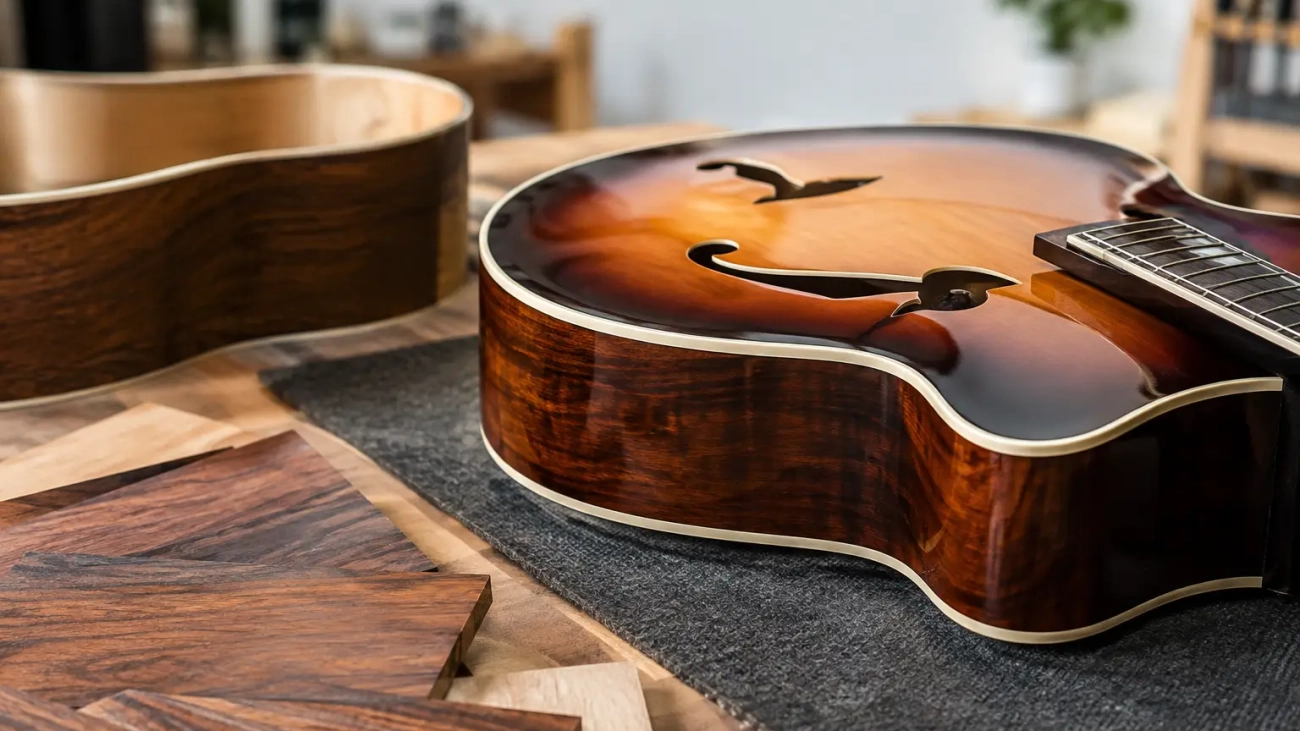
A fine archtop announces its character before the first note is played. Its outline suggests elegance, but its depth tells another story: how the instrument will sit against the body, how the air inside it will move, and whether its voice will favor intimate detail, broad warmth, or a commanding acoustic presence. This guide to archtop body depth considers the dimension that is often reduced to a specification, yet has a profound influence on the living response of the guitar.
Body depth is not a number to choose in isolation. It belongs to a conversation between the player’s touch, the carved top and back, the air volume of the body, the scale length, the bridge, the strings, and the musical setting. On a handcrafted instrument, those relationships are considered together, because a beautiful measurement on paper can be the wrong answer in the hands.
Why Archtop Body Depth Matters
An archtop’s rim depth establishes the volume of air enclosed by its top, back, and sides. More air generally gives the instrument a fuller low-midrange foundation and a greater sense of breadth around the note. A shallower body usually responds with more immediacy, a tighter bass register, and a focused attack. Neither approach is inherently superior. The right depth is the one that serves the music without asking the player to fight the instrument.
Depth also affects the way a carved top is perceived. A responsive spruce top may offer quick articulation at several body depths, yet a deeper chamber can lend that articulation more bloom after the pick or finger has released the string. In contrast, a shallower archtop may place the beginning of the note more clearly in the foreground. For a player who values rhythmic precision, that directness can feel exceptionally satisfying.
The back matters just as much. A carved maple back, properly voiced, reflects energy into the system with a distinct clarity and authority. Its interaction with the air cavity changes as the body becomes deeper. The result is not simply “more bass.” It may be a richer lower register, a different balance between fundamental and overtones, and a longer, more dimensional decay.
A Guide to Archtop Body Depth by Musical Purpose
A shallow archtop, often around 2 1/2 to 2 3/4 inches deep, tends to appeal to players seeking speed, definition, and physical ease. It rests closer to the body and can feel especially natural for a seated player who spends long hours reading, rehearsing, or recording. Its voice may be dry in the most flattering sense: articulate, quick to separate notes, and less inclined to fill every silence with lingering resonance.
This profile has long suited electric archtop work, particularly where an amplifier supplies the final scale of the sound. A more compact air chamber can help retain clarity as volume rises, although feedback resistance is never determined by depth alone. Top thickness, bracing, pickup placement, stage volume, and the player’s position relative to the amplifier all have a say.
A medium-depth body, often in the neighborhood of 2 3/4 to 3 1/4 inches, is a remarkably versatile middle ground. It retains much of the direct feel associated with a thinner instrument while allowing the acoustic voice to develop with more color and substance. For the guitarist who moves between solo playing, small ensembles, studio work, and modest amplification, this balance can be compelling.
A deeper archtop, commonly 3 1/4 inches and beyond, offers a more generous acoustic chamber and a stronger sense of physical presence. The notes may carry more air, warmth, and lower-register authority. Chord melodies can feel orchestral, while single notes acquire a roundness that invites a slower, more vocal approach to phrasing. A deep body can be magnificent for unamplified playing, acoustic jazz, and players who want the guitar to contribute a substantial voice before amplification enters the picture.
Yet depth brings trade-offs. A larger instrument may feel less comfortable under the right arm, particularly for players of smaller stature or those accustomed to a flat-bodied electric. Its resonance can be more eager to interact with stage volume. And if the rest of the design is not carefully controlled, extra air volume can obscure rather than enrich the musical message.
Depth Is Only One Part of the Resonant System
It is tempting to treat body depth as a shortcut to tone. A deep body is warm; a thin body is bright. There is a grain of truth in that shorthand, but it does not describe a serious archtop.
The height and shape of the arch influence stiffness and the manner in which the plates flex. The graduations of the spruce top determine where it yields and where it resists. Parallel tone bars, an X-braced design, or another bracing approach changes the distribution of energy across the top. A lightly built guitar may be open and immediate at a given depth, while a more substantial build of the same dimensions may be focused, controlled, and capable of greater dynamic headroom.
Wood selection adds another layer. Sitka spruce, European spruce, and Adirondack spruce each bring different tendencies in elasticity, attack, and reserve power. Maple can range from crystalline and quick to warmly complex, depending on its density, figure, and cut. The sides are not merely structural walls. Their stiffness helps define how much energy remains in the vibrating plates and how much is absorbed by the body.
Then there is finish. A thin, finely applied varnish or lacquer allows the wood to speak with fewer restraints than a heavy coating. Over years of playing, the instrument continues to settle into its own voice. A properly conceived body depth gives that process a worthy foundation, but it cannot replace sensitive voicing at the bench.
Comfort Is a Tonal Consideration
The finest sound is of limited value if the player cannot reach it freely. Body depth changes the angle of the picking arm, the position of the wrist, and the way the instrument meets the ribcage. A deep archtop can encourage a relaxed, enveloping posture for one guitarist and cause fatigue for another. This is why measurements should be experienced, not merely compared.
Consider how and where you play. A seated soloist may welcome the acoustic richness of a deeper body. A standing performer using a shoulder strap may prefer a slimmer profile that stays close and balanced. A player who alternates between fingerstyle texture and pick articulation may value the adaptability of a medium-depth design. Left-handed players, in particular, deserve the same careful attention to ergonomics rather than a simple mirrored version of a standard guitar.
Neck set, bridge height, cutaway shape, lower-bout width, and the player’s own anatomy all influence the verdict. In a custom commission, these details can be refined together. At Scharpach, body depth is approached not as an isolated feature but as part of the instrument’s intended relationship with its musician.
Choosing the Right Depth for Your Voice
Begin with sound rather than convention. Do you hear a clear, compact note with a defined edge? Or do you hear a note that expands after the attack, carrying warmth and a generous halo of resonance? Think also about the role the guitar must play. An archtop intended for intimate solo performance asks different questions than one built for amplified ensemble work.
Be candid about feedback. If the guitar will regularly meet loud drums, stage monitors, and high-gain amplification, a shallower body or a thoughtfully managed acoustic design may be sensible. If the instrument will spend most of its life in the studio, at home, or in acoustic settings, the larger air chamber of a deeper body may offer pleasures worth embracing.
Most importantly, allow room for the builder’s judgment. The goal is not to chase a familiar specification from a celebrated vintage model. It is to create proportion: a body deep enough to support the desired resonance, shallow enough to remain comfortable and controlled, and voiced with sufficient refinement that every register belongs to the same musical family.
The right archtop depth should disappear once you begin to play. What remains is the sensation that the guitar answers with the weight, color, and intimacy your music has been asking for all along.