
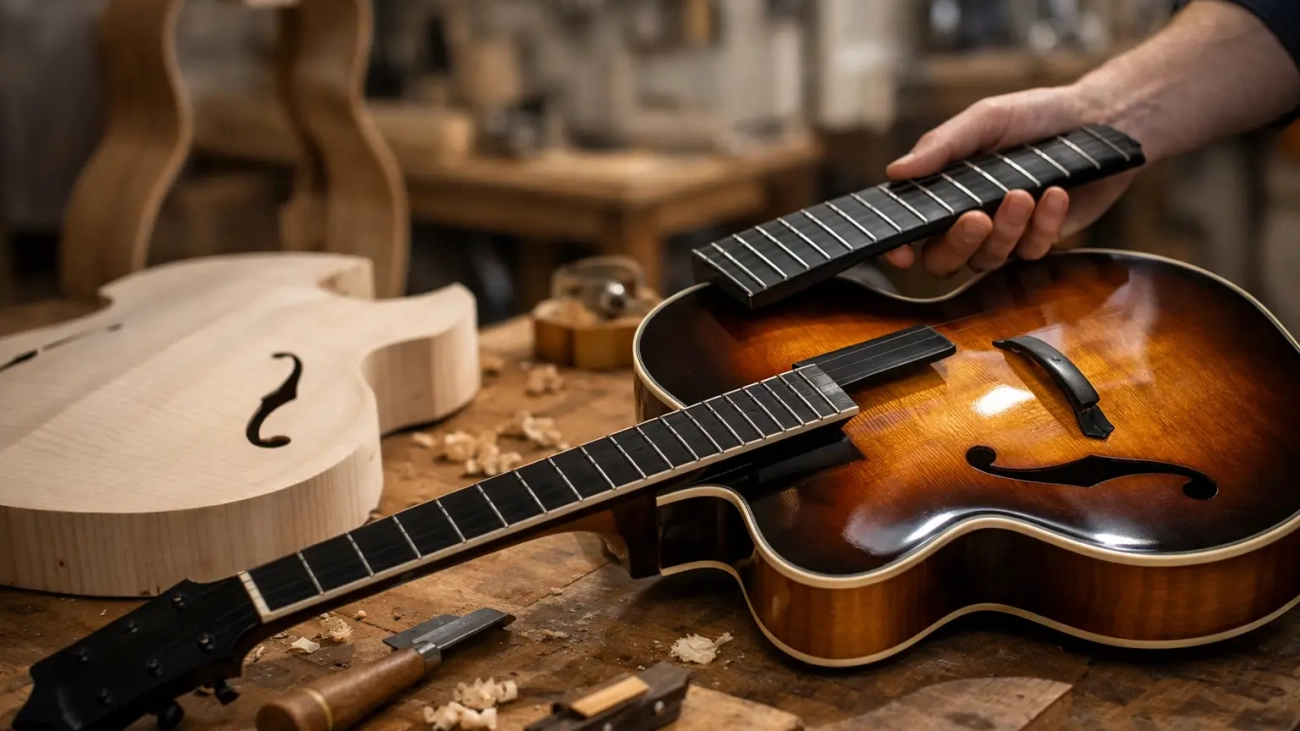
A fine archtop reveals itself in the first held note: the way the top begins to move, the quickness of the attack, the bloom behind the fundamental, and the quiet authority of a chord left to decay. A guide to commissioning an archtop guitar begins there, not with a catalog of options. The purpose of a bespoke instrument is to give a player a more faithful means of expression – one shaped around the music, the hands, and the sound they hear before they play.
A commissioned archtop is a conversation between musician and luthier. It asks for clarity, patience, and a willingness to distinguish what is attractive from what is truly useful. The most memorable instruments often possess both, but their beauty grows from a coherent musical purpose.
Begin With the Music You Want to Make
Before discussing woods, finishes, or appointments, consider the role the guitar must serve. A player working primarily in small acoustic settings may seek a dry, immediate response with a strong midrange voice and enough projection to carry unamplified. A jazz musician playing through a floating pickup may prefer a warmer, more rounded fundamental, controlled sustain, and resistance to feedback. Someone who moves between chord melody, solo playing, and ensemble work may need greater dynamic breadth than either extreme.
References are useful, but they should be treated as a vocabulary rather than a prescription. Bring recordings that demonstrate the qualities you admire: perhaps the woody clarity of a rhythm part, the vocal density of a single-note line, or the open, orchestral character of a solo instrument. Describe what you hear in plain language as well as technical terms. A skilled luthier can translate words such as “dark,” “quick,” “airy,” or “focused” into decisions about arching, graduation, bracing, scale length, and setup.
Your own playing is equally revealing. Pick attack, string gauge, repertoire, and whether you play with a plectrum or fingers all affect the instrument’s ideal response. An archtop built for a light, precise touch should not be forced to behave like one designed for hard-driving ensemble rhythm.
Define the Voice Before Choosing the Wood
Wood matters profoundly, but it is only one part of an interdependent design. A carved spruce top may offer clarity, headroom, and a broad palette of color. Cedar can bring an earlier, more intimate response for certain players. Maple backs and sides are prized for their definition, projection, and articulate separation, while other tonewoods can introduce different degrees of warmth, overtone content, and visual character.
The vital question is not simply, “Which wood is best?” It is, “Which material, in this instrument, supports the voice I need?” The density and stiffness of an individual set of wood matter more than a species name alone. Master-grade material is selected not just for flame or figure, but for its acoustic potential, seasoning, structural integrity, and ability to mature gracefully over decades.
A conscientious luthier will also consider the relationship between the top and back. The top initiates much of the guitar’s immediate response; the back and body help shape how that energy is reflected, sustained, and colored. The result should feel unified. A beautiful back with no musical partnership with the top is decoration, not instrument making.
The architecture beneath the surface
An archtop’s carved plates, recurve, f-holes, and bracing form an acoustic system. Small changes can alter the balance between warmth and cut, sustain and immediacy, openness and control. That is why two guitars made from similar woods can speak so differently.
Bracing deserves particular attention. Parallel bracing is often associated with a direct, punchy response and strong projection suited to traditional jazz rhythm and lead work. X-bracing can offer a wider, more open character that may appeal to players seeking a more acoustic, versatile voice. Neither is categorically superior. The right choice follows the musical brief and the builder’s understanding of how the entire structure will respond.
Fit Is Part of Tone
A guitar that asks the player to compensate for its dimensions cannot fully become an extension of the body. In a commission, ergonomics are not an afterthought added once the visual design is complete. They are foundational.
Discuss scale length, nut width, string spacing, neck depth, fingerboard radius, and body dimensions with precision. A longer scale may provide tension, clarity, and a firmer response, while a shorter scale can feel more supple beneath the fingers and offer a different tonal elasticity. A wider nut can give the fretting hand greater room for complex voicings; for another player, it may create unnecessary fatigue.
Neck shape is especially personal. Measurements are valuable, but sensation matters more than a number. If you own an instrument whose neck feels right, provide those dimensions and explain why it works. If you experience hand pain, play left-handed, have unusually large or small hands, or use demanding extended voicings, say so early. These are not minor preferences. They directly inform a guitar’s usefulness over a lifetime of playing.
Body depth and lower-bout width also involve trade-offs. A larger body may produce more air movement and low-end presence, but can be less comfortable for some seated or standing players. A slimmer instrument may feel more immediate and manageable, especially on stage, while giving up some of the physical breadth of a larger acoustic body.
Electronics Must Serve the Acoustic Instrument
If amplification is part of your work, decide how central it will be. A floating pickup preserves the integrity of the carved top and is a natural choice for many jazz players. It can deliver a warm, clear amplified sound while allowing the guitar to retain its acoustic identity. Other systems may be appropriate for players who need a different level of volume, tonal flexibility, or stage practicality.
The choice affects more than output. Pickup placement, control configuration, hardware weight, and the need for an access panel all influence the instrument’s design. Ask how the electronics will interact with the guitar acoustically, how easily they can be serviced, and whether the layout will remain elegant and unobtrusive. The best solution is often the one that does its work without drawing attention away from the guitar’s natural voice.
Let the Visual Language Follow the Instrument
The visual elements of a bespoke archtop should feel inevitable rather than accumulated. Binding, purfling, headstock shape, tailpiece, fingerboard inlay, and finish can express a player’s character, but they should also honor the proportions and acoustical purpose of the instrument.
A restrained guitar can possess enormous distinction through exceptional wood, refined lines, and flawless execution. More elaborate ornament can be deeply appropriate when it carries personal meaning or belongs to the design as a whole. The distinction lies in coherence. A master luthier understands when an inlay enriches a guitar’s identity and when it competes with the grace of the form.
Finish is both visual and acoustical. A thin, carefully applied finish allows the wood to remain responsive while protecting it from the ordinary demands of use. Its color, transparency, and sheen should complement the material beneath it. Consider how the instrument will age as well. A guitar of this level should acquire character through playing, not merely preserve a showroom appearance.
What a Serious Commission Process Should Include
A well-led commission provides enough structure to make significant decisions calmly. The early consultation should establish your musical aims, physical requirements, visual preferences, and practical needs. From there, the luthier can propose a coherent specification rather than presenting an overwhelming menu of isolated choices.
Expect the conversation to evolve. A scale length may become clearer after discussing string tension. A preferred body size may change once you weigh projection against comfort. This is not indecision. It is the natural refinement of an instrument whose details must work together.
Ask direct questions about the build timeline, deposits and payment schedule, case, shipping, warranty, future setup support, and the process for approving final specifications. It is also reasonable to ask how the builder voices an archtop, what distinctions they hear between their models, and how they approach serviceability. A commission is a relationship as much as a transaction. With more than four decades of luthiery experience, Scharpach approaches that relationship as a shared search for the player’s individual sound.
Patience is part of the value. Hand-carved instruments cannot be rushed without compromising the attentive work that gives them their character. Wood must be assessed, plates must be voiced, and the final setup must bring the separate parts into a living whole. When the guitar arrives, its voice will continue to settle and deepen through regular playing.
Commission With Enough Honesty
The most useful brief is not the most elaborate one. It is the most honest. Tell the luthier what frustrates you about your current guitar, where your hands tire, what sounds disappear in a band, and which musical moments you want to make more possible. Mention the visual details that genuinely matter to you, but leave room for the builder’s judgment where structure and tone are concerned.
A commissioned archtop should not imitate an idealized instrument from someone else’s hands. It should invite you to play longer, listen more closely, and recognize your own voice with greater certainty every time the top begins to speak.