
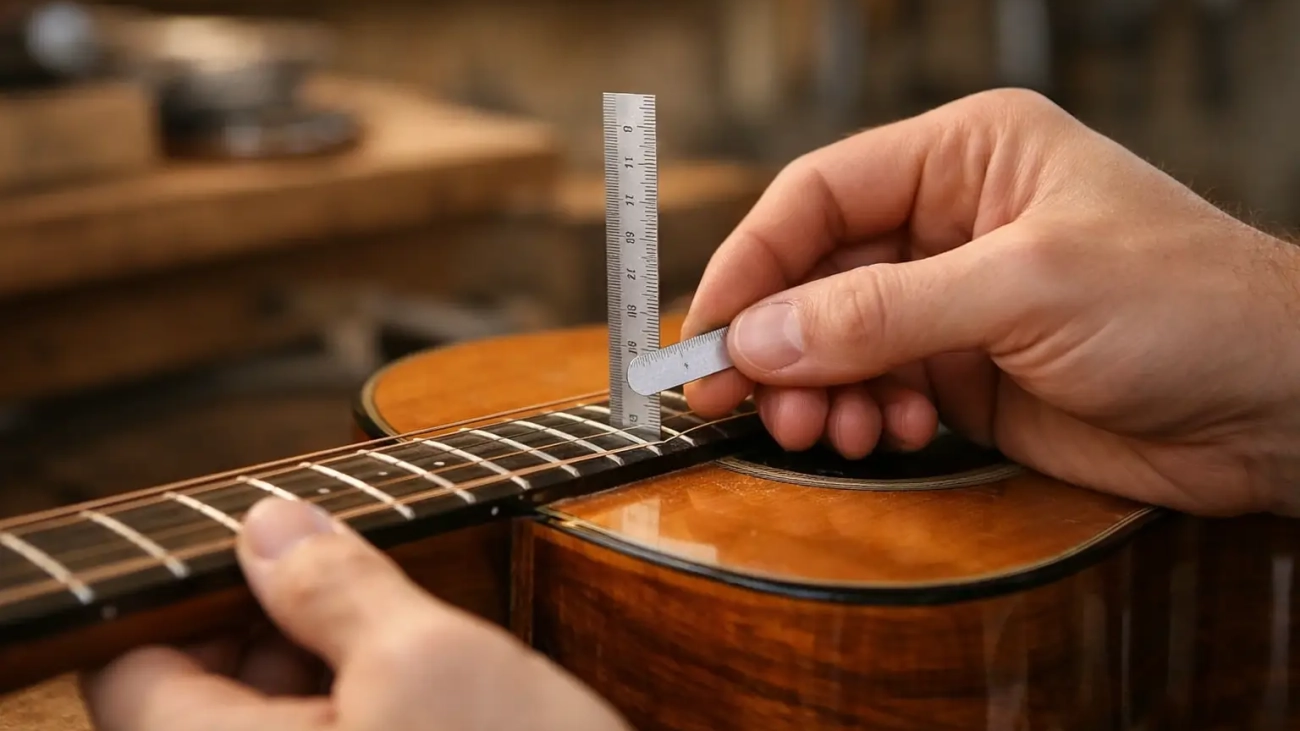
A difference of half a millimeter can change the conversation between a player and a guitar. It can determine whether a phrase arrives with effortless fluency, whether a rasgueado has the necessary authority, or whether a hard-driven bass note remains clear beneath the hand. Knowing how to specify guitar action preferences is therefore not a matter of requesting “low action” or “easy playability.” It is a way of describing how you want the instrument to respond to your touch.
On a commissioned guitar, action is part of a larger design language. It sits alongside scale length, neck profile, fretwork, string tension, top responsiveness, and the music you intend to make. The right specification is personal, but it should also be practical: an instrument must serve your hands without asking it to abandon the tonal character and headroom that drew you to a fine handmade guitar in the first place.
What Guitar Action Actually Describes
Guitar action is the distance between the underside of a string and the top of a fret, usually measured at the 12th fret. A builder may quote separate measurements for the sixth and first strings because a bass string needs more room to vibrate than a treble string. The measurement is commonly given in millimeters, although players accustomed to American factory specifications may also use sixty-fourths of an inch.
That definition is simple. Its effect is not. Lower action generally reduces the effort required to fret notes, shift positions, and sustain long passages without fatigue. Higher action gives the strings more clearance, allowing a player to attack with greater force before buzz or rattle enters the sound. It can also support a more substantial, open response when the guitar is voiced for power and projection.
Action alone does not create playability. A guitar with moderate action and beautifully shaped frets, a well-cut nut, correct neck relief, and a comfortable neck can feel more accommodating than one with lower measurements but imperfect geometry. For this reason, a serious discussion should begin with your playing rather than a number.
How to Specify Guitar Action Preferences by Feel
The most useful first statement is not “I want 3 millimeters.” It is “I want this guitar to feel like this when I play.” Describe the physical experience you are seeking. Perhaps your current instrument feels tiring during extended barre passages. Perhaps you want resistance under the right hand because you play with a forceful rest stroke. Perhaps you need a refined, quiet touch for chamber work, recording, or intricate contrapuntal music.
Then give your builder a point of reference. If you own a guitar whose setup feels especially natural, have its action measured professionally and share those numbers. Also explain what you like about it and what you would change. A familiar instrument is valuable evidence, but it should not become an inflexible blueprint. Its scale length, fret condition, string set, neck relief, and structural condition may be very different from those of the new guitar.
It is equally helpful to name the moments where your present guitar resists you. Do notes choke when you play aggressively above the seventh fret? Do the trebles feel too high when you work on legato? Does the low E string buzz only during strong apoyando strokes? These details allow a luthier to distinguish between a broadly unsuitable action and a localized issue caused by frets, relief, nut height, or technique.
Share your repertoire and right-hand attack
A classical player devoted to nuanced color and long-form repertoire may favor an action that supports comfort, precision, and dynamic shading. Yet even within classical guitar, preferences vary greatly. A player with a light, controlled touch may be content with a lower setup than an artist who draws a large sound from the instrument with a pronounced right-hand attack.
Flamenco requirements deserve their own conversation. A flamenco guitar is often set closer to the frets to facilitate speed, immediacy, and percussive expression. Some controlled, musical sizzle may be welcome, especially under vigorous rasgueados and golpes. But “flamenco low” is not a universal prescription. The desired degree of dryness, clarity, and audible fret contact depends on the player, the strings, and whether the guitar is intended for solo performance, accompaniment, or both.
On an archtop, action may be shaped around pick attack, chord work, amplified use, and the need for clean articulation across the fingerboard. A player who composes dense jazz harmony may value a setup that feels smooth under the left hand, while a player with a powerful acoustic pick attack may need more clearance to preserve note definition.
Tell the builder whether you play primarily with nails, fingertips, or a pick; whether you use alternate tunings; and whether your touch is light, moderate, or assertive. These are not minor preferences. They reveal how the strings move, which is what action must accommodate.
Use Numbers as a Starting Point, Not a Verdict
For many nylon-string guitars, a measured action around 3.5 to 4 millimeters at the sixth string and 2.5 to 3 millimeters at the first string can offer a useful reference range. Classical players often settle toward the middle or upper part of that range, while flamenco players may prefer a lower setup. Steel-string archtops are typically discussed in different ranges and with different priorities.
These figures are reference points, not promises. Two guitars with identical measurements can feel distinctly different. A longer scale length increases string tension and can make the same action feel firmer. A fuller neck profile may provide support for one hand and fatigue another. String gauge and material alter both tension and vibration width. Even the top’s responsiveness influences how much a player feels invited to dig in.
Ask for both bass and treble action, and clarify the measurement point. The standard is usually the 12th fret, measured from the top of the fret to the underside of the string. That shared language prevents confusion. It is also wise to discuss the action at the first fret, where nut height has a profound effect on the comfort of first-position chords and barre work.
Consider the Trade-Off Between Ease and Headroom
Every action preference asks the instrument to make a compromise. Very low action can feel immediate and elegant under the left hand, but it leaves less room for a broad, forceful attack. If you later develop a heavier touch or play in a louder ensemble, the setup may feel restrictive. Higher action can reward energy with depth, projection, and greater tonal stability, but it may demand more from the hand during difficult repertoire.
The ideal is not the lowest possible setting. It is the lowest setting that preserves the musical freedom you require. A concert player who needs a large dynamic ceiling may choose slightly more action than a player whose priority is intimate recording work. A guitarist returning from hand strain may sensibly choose a more forgiving setup, while recognizing that technique, posture, and neck shape also matter.
A custom builder can often establish a thoughtful middle ground: clean and comfortable for ordinary playing, with enough reserve for the passages where you ask the guitar to speak at full voice. That balance is more enduring than chasing an extreme measurement.
Separate the Build Specification From the Final Setup
A handmade guitar changes as it settles into string tension and responds to its environment. Wood is alive to humidity and seasonal movement, and a fine instrument deserves a period of attentive observation after it is completed. For that reason, action should be understood as both a construction target and a final setup decision.
During the commission, communicate your preferred range and the reasons behind it. The builder can then design the neck angle, fingerboard geometry, bridge, and saddle relationship with that intended setup in mind. At completion, the final saddle adjustment can refine the action for the actual instrument, the chosen strings, and your playing response.
This is especially significant for an heirloom-quality guitar. An excessively low saddle may limit future adjustment, while a well-considered saddle height preserves room for thoughtful maintenance over the life of the instrument. At Scharpach, this longer view belongs naturally to the work: the guitar must not simply feel convincing on its first day, but remain a responsive artistic partner through years of playing.
Arrive at the Consultation With Useful Observations
Before speaking with a builder, spend several days noticing your hands rather than judging your guitar only by its measurements. Pay attention to where fatigue begins, which strings buzz, how hard you attack during performance, and whether your preferences shift between home practice and a hall. Record yourself as well. A setup that feels comfortable in a quiet room may reveal insufficient headroom when you play with concert-level energy.
Bring the discussion back to music. Say whether you need rapid picado, expressive vibrato, dense chord voicings, sustained lyrical lines, or the freedom to play hard without apology. A master luthier can translate those intentions into dimensions, materials, and adjustments. Numbers complete that conversation; they do not replace it.
The best action is the one that disappears beneath your hands, leaving only the sensation of the instrument answering with clarity, color, and confidence.