
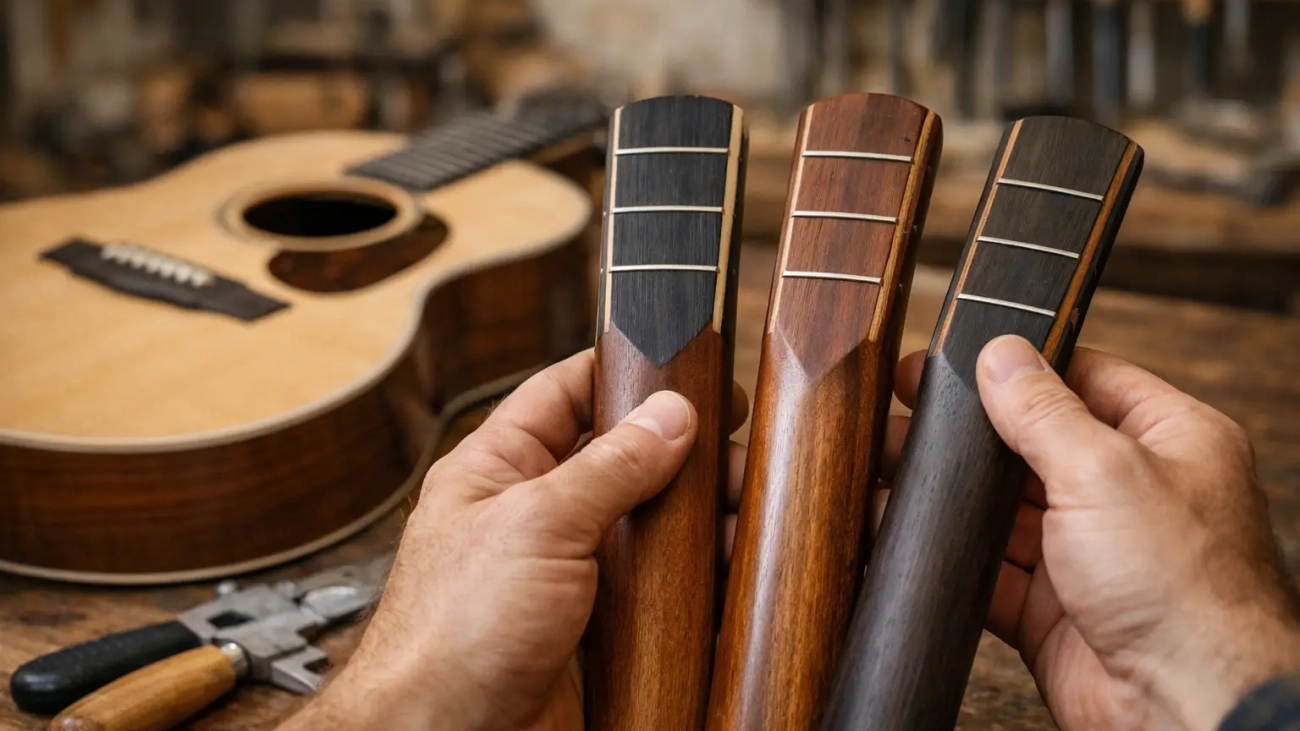
A guitarist can fall in love with a voice, a finish, even a silhouette – and still set the instrument down after ten minutes because the neck does not belong in the hand. That is why how to choose guitar neck profile is not a minor comfort question. It is central to control, endurance, and the quiet sense that the instrument is meeting you rather than resisting you.
For serious players, neck profile is never only about preference in the casual sense. It shapes left-hand fatigue, thumb position, vibrato, shifting confidence, barre stability, and the subtle relationship between tension and freedom. A beautiful guitar that asks the wrong thing of the hand will always remain slightly distant. The right neck, by contrast, disappears. It allows technique and sound to speak without interruption.
What guitar neck profile really means
Neck profile refers to the shape of the back of the neck – the contour your fretting hand feels as it wraps around the instrument. Players often describe profiles with familiar shorthand such as C, D, U, soft V, or hard V. These labels are useful, but they are only a starting point. Two necks both called C can feel entirely different depending on depth, shoulder shape, width at the nut, taper as the neck moves upward, and the overall geometry of the instrument.
This is where many players make an expensive mistake. They assume neck profile is a single specification, when in reality it is a family of measurements working together. Depth without shoulder can feel sleek. Moderate depth with full shoulders can feel substantial. A flatter fingerboard can change the sensation again. The hand does not experience measurements in isolation. It experiences a complete form.
How to choose guitar neck profile for your hand
The most useful place to begin is not with terminology but with your own physical reality. Hand size matters, but it does not determine everything. A player with smaller hands may still prefer a fuller neck because it offers a stable point of contact and reduces strain from over-gripping. Another player with large hands may want a more moderate shape for agility and cleaner thumb placement.
The better question is this: where does your hand naturally want support?
If you tend to wrap the thumb over the neck, play with a relaxed wrist, or like a slightly anchored feeling in the palm, a rounder or fuller profile often feels more settled. If you play with classical left-hand discipline, keep the thumb centered behind the neck, and prioritize quick position shifts, a slimmer or more gently contoured shape may feel more responsive.
Hand fatigue is a particularly honest guide. If a neck makes you squeeze, flatten the wrist, or work to maintain position, the shape is asking for compensation. That compensation may be subtle at first. After an hour, it becomes technique. Over months, it becomes limitation.
Depth, shoulders, and why labels are not enough
Depth is the front-to-back thickness of the neck. Shoulders describe how much material remains at the sides before the profile falls away. Many players focus on depth because it is easy to measure, but shoulders often decide whether a neck feels generous or cramped.
A neck with moderate depth and full shoulders can feel larger than a deeper neck with softer edges. Likewise, a slim neck with pronounced shoulders may still feel awkward if your hand prefers a smoother roll into the palm. This is one reason custom work matters so much at the highest level. The best neck is not a generic category. It is a finely judged contour.
Match the profile to your technique, not just your taste
A neck should serve the music you actually play. Classical, flamenco, and archtop players often ask very different things of the left hand, and those differences influence what feels correct.
For classical repertoire, where thumb placement, finger independence, and clean positional movement are essential, the neck often benefits from clarity and balance rather than excess bulk. The hand must articulate contrapuntal lines, extended stretches, and subtle shifts without tension accumulating at the base of the thumb.
For flamenco, speed and attack become more prominent. Rapid changes, cejillas, and percussive energy can make a neck feel either alive or obstructive. Some players want a shape that feels immediate and compact. Others prefer a little more substance to stabilize forceful left-hand work. The right answer depends on whether your technique is built around economy, leverage, or a mixture of both.
For archtop players, especially those moving through jazz voicings, the equation changes again. Complex chord shapes, partial grips, and long sessions of harmonic movement can make profile and shoulder shape especially important. A neck that supports the hand through chordal playing without encouraging tension can preserve both precision and stamina.
Repertoire changes what “comfortable” means
A neck that feels pleasant during scales in a showroom may feel quite different during a demanding tremolo passage, dense jazz harmony, or an evening of accompaniment. Comfort is not passive softness. It is functional ease under the actual stresses of your repertoire.
That is why a proper assessment should include the movements you repeat most. Play barres. Shift into upper positions. Sustain vibrato. Hold difficult stretches. The neck should still feel composed when your hand is working, not only when it is resting.
Width, scale length, and setup all influence neck feel
Players sometimes say they dislike a neck profile when the real issue lies elsewhere. Nut width, string spacing, scale length, fingerboard radius, fret height, and setup can all reshape the experience of the neck.
A wider nut may be ideal for articulation and right-hand clarity, but it can make the neck feel larger even when the back profile is relatively slim. A longer scale increases string tension and slightly changes how the left hand perceives resistance. A high action can make any neck feel less forgiving. Even finish matters. Some players prefer the silky, open sensation of a less glossy neck because it reduces the sense of drag during shifts.
This is why expert consultation matters more than isolated specs. The hand responds to an integrated design, not a checklist.
How to test a guitar neck profile properly
If you are trying to decide between neck shapes, avoid making the decision in the first two minutes. First impressions can be misleading. A very slim neck may feel instantly easy but become tiring because the hand never finds enough support. A fuller neck may feel unusual at first, then prove remarkably natural once the hand settles.
Spend enough time with each instrument to notice what your body does unconsciously. Does your thumb keep searching for a better resting point? Does your wrist lock? Do you feel pressure in the web between thumb and index finger? Do upper-position shifts become hesitant? These signals are more valuable than labels.
It is also wise to test necks when you are not fully fresh. A profile that remains cooperative after an hour tells you far more than one that flatters the hand briefly.
When a custom neck profile becomes essential
For many serious guitarists, especially those who perform, record, or play for long hours, standard neck profiles are only approximations. They may be acceptable, but acceptable is not the same as personal.
A custom neck becomes especially valuable if you have an established technique, physical sensitivities, left-handed requirements, unusually large or small hands, or a clear sense of what has and has not worked on past instruments. In those cases, the neck should not be treated as a stock component. It should be carved as part of the instrument’s expressive architecture.
At that level, the conversation becomes more refined. Not simply slim or full, but where the neck should carry mass, how quickly it should taper, how the shoulders should soften, and how the shape should support your repertoire over decades of playing. This is where artisanal building distinguishes itself from production logic. The goal is not to fit the player into a model, but to shape the instrument around the player.
A workshop such as Scharpach approaches that process with the understanding that comfort, sound, and identity are connected. The neck is not an isolated ergonomic feature. It is part of how an instrument becomes yours.
The best neck profile is the one that disappears
There is no universally best answer to how to choose guitar neck profile because hands, techniques, and musical lives differ. What matters is not whether a profile sounds impressive on paper, but whether it allows freedom without instability, support without excess, and control without strain.
When the shape is right, you stop thinking about it. The thumb rests where it should. Shifts arrive quietly. Chords settle cleanly. Hours pass with less effort spent managing the instrument and more effort devoted to color, timing, and touch. That is the standard worth pursuing – not novelty, not fashion, but the rare and lasting fit between hand and voice.