
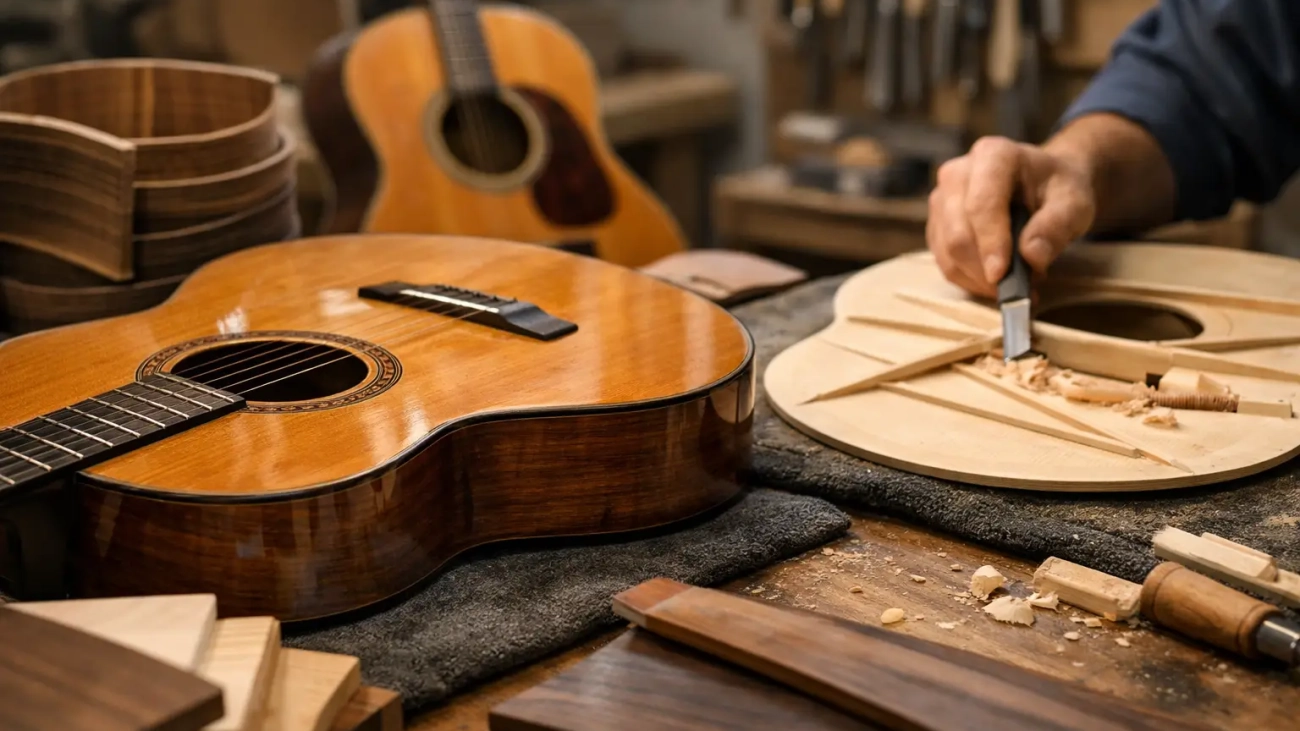
A fine guitar can possess beautiful wood, impeccable joinery, and a distinguished name, yet still fail to speak in the voice a player hears within. That distance between a good instrument and a personal instrument is where a guide to custom acoustic specifications begins. The purpose is not to add options for their own sake. It is to make every structural and artistic choice serve the player’s hands, repertoire, touch, and musical ambition.
For a commissioned guitar, specifications are not a checklist completed before the work begins. They are a conversation about sound. A flamenco player who needs immediate attack and dry separation asks different questions of an instrument than a classical artist seeking a broad, singing treble or an archtop player shaping a warm, articulate line through an ensemble. The finest result comes from understanding those distinctions before a single piece of wood is selected.
Begin With the Sound You Are Trying to Find
Tone is often described in broad terms: warm, bright, dark, loud. Those words are useful beginnings, but they are not yet specifications. A player and luthier must go further. Does “warm” mean a round fundamental with restrained upper partials, or a richly complex sound that retains color far into the decay? Does “projection” mean sheer volume under the ear, or the ability for a note to carry its identity across a hall?
Consider the behavior of the note from its first instant to its final release. Some players want a quick, clean attack with little resistance. Others prefer a measured response that allows them to lean into the string and shape the beginning of each phrase. Sustain may be prized in a concert classical guitar, while a flamenco instrument may benefit from a more concise decay that preserves rhythmic clarity. Neither approach is superior. Each belongs to a musical language.
Repertoire is equally revealing. A guitarist devoted to Spanish romantic music may seek lyrical separation between melody and accompaniment, with a treble that blooms without becoming sharp. A player of Baroque music may value transparency, balance, and a controlled bass response. Jazz archtop players frequently look for a focused center to the note, enough warmth to feel human, and sufficient definition for chords to remain clear.
Recordings of your own playing can be more helpful than a list of admired instruments. They reveal the pressure of your right hand, the weight of your attack, the range of dynamics you actually use, and whether your natural voice tends toward brilliance, darkness, compression, or openness. A custom guitar should refine that voice, not disguise it.
A Guide to Custom Acoustic Specifications: The Structural Choices
The top is the primary diaphragm of the instrument, and its species, cut, thickness, bracing, and voicing establish much of the guitar’s character. Spruce is often chosen for clarity, headroom, and a focused response that can mature with remarkable complexity over time. Cedar commonly offers an immediate, colorful voice with a sense of warmth and readiness under a lighter touch. These are tendencies, not fixed rules. Individual sets of wood differ profoundly, and the hand of the maker matters as much as the name of the species.
Back and side woods shape the way the body reflects and colors the energy of the top. Indian rosewood may offer depth, overtone richness, and a generous bass foundation. Maple can bring speed, separation, and a more direct, transparent quality. Cypress is central to the traditional flamenco vocabulary, lending dryness, immediacy, and percussive character. Mahogany can be eloquent and fundamental-forward, with an intimacy that rewards nuanced playing.
It is tempting to assign each wood a simple tonal label. In reality, the relationship between top, back, sides, air volume, body depth, and bracing is what creates the finished voice. A master luthier selects materials as an ensemble, listening for how their properties may complement one another rather than treating wood as a menu of isolated effects.
Bracing deserves particular attention because it determines how the top moves. Its architecture and fine tuning govern responsiveness, balance, dynamic ceiling, and the relationship between bass and treble. A lighter system may offer exceptional sensitivity, but it must be calibrated with care to preserve structural integrity and avoid a sound that becomes unfocused under force. A more restrained system can provide stability and clarity, though excessive stiffness may deny the player the living response that makes an acoustic guitar compelling.
Body dimensions are also acoustic decisions. A larger air cavity can support depth and power, while a more compact body may feel immediate and controlled. Depth affects low-frequency presence, but more depth is not automatically more musical. The ideal proportion depends on the player’s physical comfort, preferred repertoire, and desired balance across the register.
The Player’s Body Is Part of the Design
An instrument cannot fully express its potential if it asks the player to work against it. Ergonomic specifications should be treated with the same seriousness as tonal ones, especially for musicians who practice, perform, or record for long hours.
Scale length influences string tension, left-hand reach, and the sense of elasticity beneath the fingers. A longer scale can bring firmness, projection, and clarity, while a slightly shorter scale may offer ease, warmth, and a more relaxed feel. The best choice depends on hand size, technique, string preference, and how much resistance the player wants from the instrument.
Neck profile is equally personal. Measurements matter, yet a neck is experienced as a shape in motion rather than a number on paper. Nut width, string spacing, fingerboard radius where appropriate, neck depth, and shoulder shape should work together. Classical and flamenco players may have different expectations, and a left-handed commission should be designed as a true mirror of the intended instrument, not treated as a standard guitar turned around as an afterthought.
Action is a carefully judged compromise between comfort, tonal freedom, and the player’s attack. Very low action can feel effortless, but it may reduce the margin needed by a forceful player or a flamenco technique that relies on controlled, expressive edge. A little more height can allow the strings to speak with authority, provided the setup remains inviting. A thoughtful commission anticipates how the player will use the guitar rather than chasing a universal measurement.
Finish, Appearance, and the Life of the Instrument
A guitar’s visual character should never be separated from its acoustical life. Finish is a protective layer, but it also affects how freely the soundboard can move. A carefully applied thin finish allows the wood to remain responsive while protecting it from the ordinary demands of use. The choice between a traditional spirit varnish and other refined finish systems involves practical and artistic considerations: visual depth, repairability, feel, maintenance, and the desired contribution to the instrument’s voice.
Aesthetic details deserve their own patience. The rosette, purfling, binding, headstock, bridge design, and choice of tuners create an identity that should feel coherent rather than ornamental. Restraint often carries greater authority than decoration without purpose. Still, an heirloom instrument may rightly include personal materials, a meaningful motif, or a visual language that honors its owner’s musical history.
Collectors sometimes prioritize rare or highly figured woods. Their beauty is real, but visual rarity alone does not guarantee exceptional sound. The most compelling material is the one that serves the instrument’s tonal architecture and will remain stable, graceful, and alive through decades of playing. Responsible selection also considers availability and long-term stewardship of precious tonewoods.
Prepare for the Commission Conversation
The most productive consultation begins with candor. Bring the guitars you have loved, as well as the ones that nearly worked but did not. Describe what happens when you play softly, what frustrates you at volume, whether your hands tire, and which notes or registers never quite satisfy you. A skilled maker listens not only to preferences but to the language behind them.
It helps to define priorities. If projection, comfort, traditional appearance, and a particular tonal color all matter, which must lead when trade-offs arise? Every serious instrument balances competing virtues. A guitar designed for maximum power may not offer the same intimate delicacy as one voiced for subtle salon playing. The aim is not theoretical perfection. It is a rare degree of rightness for one musician.
At Scharpach, this process is grounded in the belief that craftsmanship begins with listening. After more than four decades at the bench, the essential question remains simple: what must this guitar allow its player to say?
The finished instrument will continue to reveal itself. Fine wood responds to playing, seasons, and time; its voice settles into the life of the musician who owns it. Choose specifications with care, but leave room for that future. The most enduring guitar is not one that merely fulfills a brief on the day it is delivered. It is one that continues to invite a deeper conversation each time it is played.