
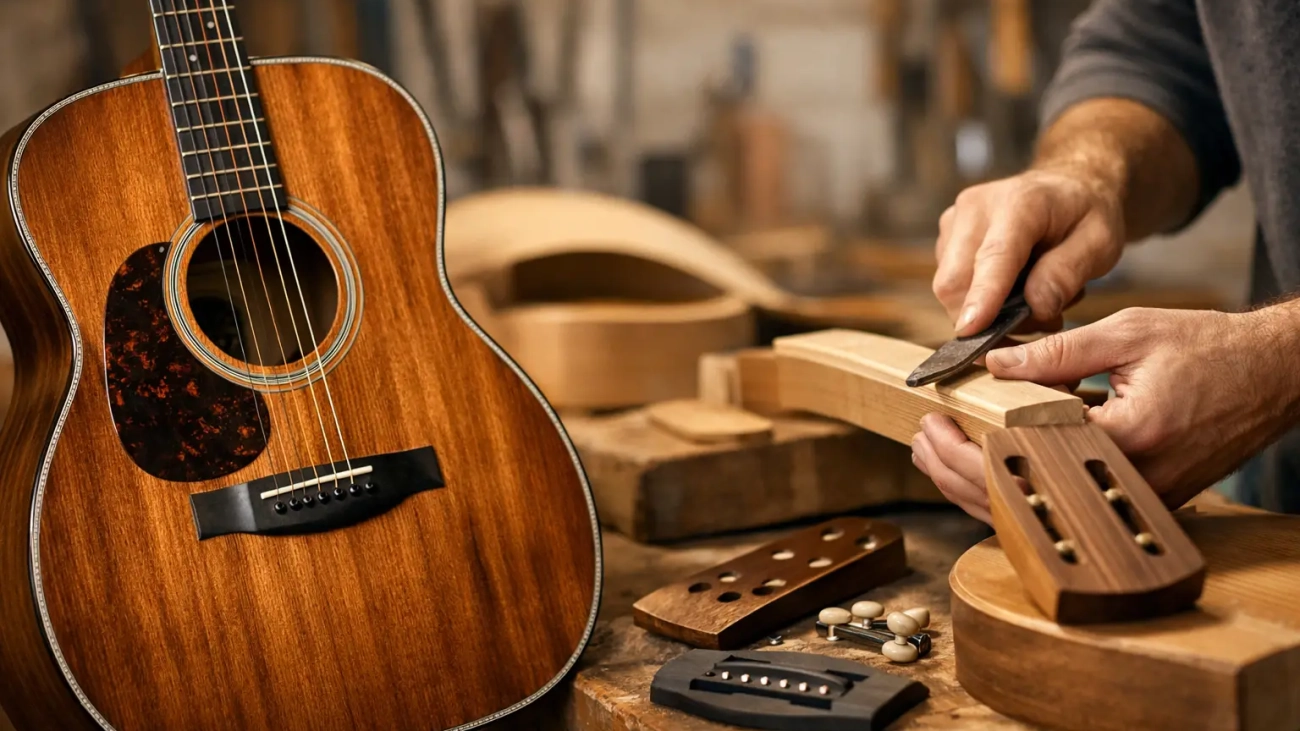
A left-handed guitarist knows the compromise before the first note is played. The neck profile feels almost right, the balance is acceptable, the controls sit where they can be tolerated, and the market quietly suggests adaptation is part of the job. A true guide to left handed custom guitars begins there – with the refusal to treat compromise as normal when the instrument is meant to become an extension of the player.
For serious musicians, handedness is not a minor specification. It affects posture, attack, phrasing, comfort, and long-term freedom at the instrument. When a guitar is built from the beginning for a left-handed player, the result is not simply a mirrored version of a standard model. It is a more complete response to the way that player hears, touches, and shapes sound.
Why left-handed players so often outgrow standard options
The left-handed market has long been served unevenly. Factory instruments are often produced in limited runs, with fewer body styles, fewer scale options, and fewer meaningful setup choices. Even when the guitar is well made, the player is still choosing from a narrow field shaped by production logic rather than musical identity.
That matters more as a guitarist develops. An advancing player begins to notice how quickly the instrument responds under the right hand, how the neck supports shifts in position, how the body rests against the torso over long sessions, and how the voice of the instrument holds together under a subtle touch. These are not luxury concerns. They are central to technique.
A custom build answers a different question than a retail purchase. Instead of asking, “Which of these available instruments can I live with?” the player asks, “What kind of instrument would allow my best playing to emerge?” For left-handed musicians, that distinction is especially significant.
A guide to left handed custom guitars starts with the player
The finest custom instruments are not designed backward from a catalog. They begin with the player’s body, repertoire, and ear. That is why the consultation phase matters so deeply.
A serious luthier will want to understand how you play before discussing decorative details. Classical and flamenco players need very different kinds of attack, projection, and immediacy. Archtop players may be listening for warmth, note separation, and a certain elasticity in the response. Some musicians need clarity for recording, while others want a broad, singing voice that fills a room with little effort.
For a left-handed commission, the ergonomic conversation becomes even more important. Neck shape, nut width, scale length, string spacing, body depth, upper-fret access, and overall balance should all be considered from the perspective of your natural movement. A well-built custom guitar does not fight your mechanics. It supports them so quietly that your attention returns to music.
What “custom” should really mean
There is a difference between a left-handed option and a left-handed custom guitar. The first often means an existing design has been mirrored. The second means the instrument is being conceived as a whole.
That distinction affects nearly every part of the build. The top must respond to the player’s touch, not to a generic standard. The voicing has to reflect the intended tonal character and dynamic range. The neck carve should suit the hand that will spend thousands of hours on it. The body dimensions should encourage ease rather than fatigue. Even visual details have a role, because the instrument should feel coherent in the player’s hands and eyes.
This is where experienced craftsmanship becomes visible in less obvious ways. Wood selection is not just about appearance or prestige. Different tops, backs, and sides contribute to the instrument’s speed of response, overtone profile, warmth, dryness, sustain, and projection. A mature builder chooses materials not by trend but by how they interact with one another and with the player’s musical aims.
Tone woods, voicing, and the left-handed build
In any guide to left handed custom guitars, tone cannot be treated as an afterthought. The entire purpose of a bespoke instrument is to bring the player closer to a personal voice.
For classical and flamenco guitars, the soundboard is often the heart of that conversation. Cedar may offer warmth, richness, and a quicker sense of fullness under the fingers. Spruce often brings clarity, headroom, and a more gradual tonal opening over time. Neither is inherently better. It depends on repertoire, attack, and what the player wants to hear in the room.
Back and side woods shape the character around that core. Rosewood can bring depth, harmonic complexity, and a broad palette of color. Cypress may offer dryness, immediacy, and the percussive directness many flamenco players cherish. Maple, often associated with archtops, can produce definition and transparency that suits articulate lines beautifully.
Yet wood names alone do not determine the final voice. Voicing, thicknessing, bracing, and the judgment of the luthier matter just as much. This is one reason a master-built instrument carries such authority. The maker is not assembling ingredients mechanically. He is guiding resonance.
Ergonomics are not secondary to sound
Some players hesitate to ask for ergonomic refinements because they fear sacrificing tonal beauty. In a thoughtful custom build, that is the wrong choice to be forced into. The best instruments reconcile comfort and sound through intelligence, not compromise.
A left-handed guitarist may benefit from subtle adjustments that would be difficult to find in a stock instrument: a neck profile that reduces tension in the thumb joint, a body depth that sits more naturally in performance posture, a scale length that suits repertoire and hand size, or string spacing that supports confidence in the right hand. Small changes can have a profound musical effect because they alter how freely the player can phrase, articulate, and sustain concentration.
This becomes even more important over years of use. A guitar built for your natural physical relationship to the instrument tends to invite longer practice, steadier technique, and less fatigue. That is not merely about comfort. It is about preserving expressive control.
The trade-offs worth considering
Custom work is not instant, and it should not be. A serious left-handed commission takes time because time is part of precision. Woods must be chosen carefully. The instrument has to be built, refined, and adjusted with patience. For many players, the waiting is rewarded by decades of musical companionship.
Cost is another honest consideration. A bespoke guitar sits in a different category from production instruments because the process is entirely different. You are investing in knowledge, time, individual attention, and an instrument made to carry your musical life forward. That investment makes the most sense for players who already know what they value, or who are ready to discover it through a close dialogue with an expert maker.
There is also the question of specificity. A highly personalized instrument can be more meaningful than a broadly adaptable one, but only if the build decisions are grounded in real self-knowledge. This is why the consultation matters so much. The goal is not to customize for its own sake. It is to create coherence between player and instrument.
How to choose the right maker
Not every luthier who offers left-handed builds approaches them with the same seriousness. Ask whether the maker treats left-handed work as a true part of the practice or as an occasional accommodation. Look for depth of experience, a refined point of view on sound, and a willingness to discuss playing style in detail.
The right builder listens for more than specifications. He listens for intent. He wants to know what you hear when you imagine your ideal trebles, what kind of resistance you prefer under the fingers, how the guitar should respond when played delicately and when pushed. That level of dialogue is often what separates an expensive instrument from a meaningful one.
For discerning players, this is where an atelier approach becomes so valuable. In the hands of a master such as Scharpach, the process is not transactional. It is interpretive. The instrument is shaped around the musician’s artistic identity, with craftsmanship serving expression at every step.
Living with a custom left-handed guitar
The most satisfying custom guitars reveal themselves over time. At first, there is often a sense of relief – the instrument simply fits. Then comes something deeper. Technique begins to settle. Nuance becomes easier to access. The guitar starts to answer with less persuasion.
That is the real promise behind a left-handed custom build. Not novelty, and not exclusivity for its own sake, but alignment. When proportions, materials, voicing, and setup are all chosen with care, the guitar stops feeling like an obstacle to work around. It becomes a partner in thought, touch, and sound.
If you have spent years adapting to instruments that were never fully meant for you, it may be time to ask a better question than what is available. Ask what is possible when the instrument begins with your hand, your ear, and your music.