
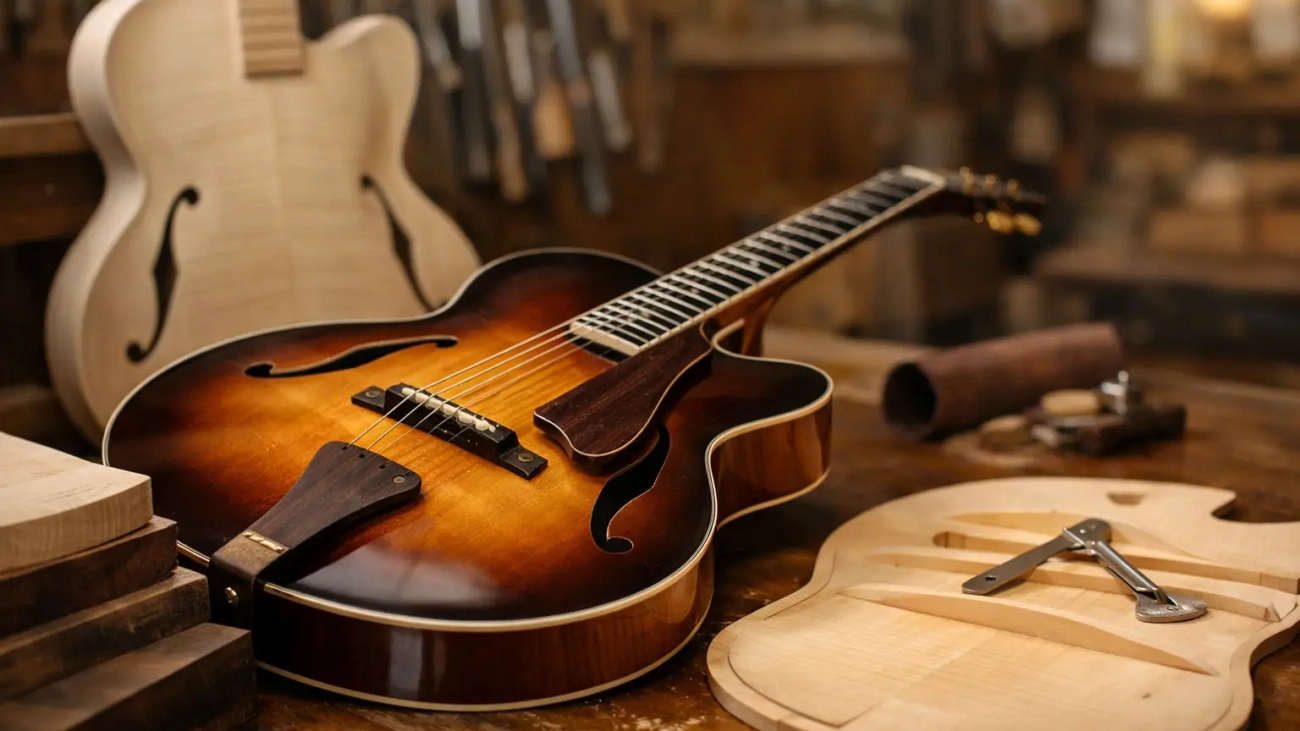
A serious archtop begins long before the first shaving of spruce falls to the bench. It begins with a player hearing something missing – a quicker response under the right hand, a drier attack for swing comping, a broader singing line above the 12th fret, a neck that finally feels inevitable rather than tolerated. That is how to order a bespoke archtop in the right spirit: not by selecting luxury for its own sake, but by defining the musical voice the instrument must serve.
A custom archtop is not a menu item. It is a conversation between player, repertoire, touch, and builder. The finest results come when the commission is approached with honesty and precision. You do not need to know every construction detail, but you do need to know how you play, what you hear, and where your present instrument falls short.
Start with the sound, not the specifications
Many players begin with wood species, tailpiece style, or finish color. Those choices matter, but they matter after the central question is answered: what should the guitar do when it is in your hands?
An archtop can lean in very different directions. Some players want a dry, focused voice with quick note separation, ideal for traditional jazz rhythm and articulate ensemble work. Others want more bloom, more overtone content, and a rounder singing quality for chord melody or solo playing. Some need projection in an acoustic setting. Others are building around amplified performance, where feedback resistance, pickup pairing, and stage balance become part of the design brief.
When speaking with a luthier, describe the music first. Mention the settings you play in, the strings you prefer, whether you play with a heavy pick or a lighter touch, and how much dynamic range you ask of the instrument. A good builder listens for patterns behind your preferences. The goal is not to impress with technical language. The goal is to reveal the kind of response your hands and ears are seeking.
How to order a bespoke archtop with useful references
Reference instruments help, but only when used carefully. Saying you love the warmth of one guitar, the immediacy of another, and the neck shape of a third is far more useful than expecting a direct replica. Every archtop is a system. Scale length, arching, plate graduation, air volume, neck geometry, setup, and materials all influence one another.
The most productive references are sensory and specific. Say that your current guitar feels stiff under the left hand. Say that bass notes dominate too much in a trio. Say that trebles thin out when you dig in. These observations give a master builder something concrete to interpret.
This is also where restraint matters. If you ask for maximum warmth, maximum projection, maximum sustain, and maximum attack all at once, you are asking for competing outcomes. Bespoke work is not about getting everything. It is about deciding what matters most.
The consultation is where the instrument takes shape
The consultation is not a formality. It is where the commission becomes real. A thoughtful luthier will ask about your repertoire, right- and left-hand technique, body comfort, previous instruments, and even the physical tensions you may have adapted to over years of playing. For some players, ergonomic refinement is as important as tone.
Body dimensions, scale length, neck profile, nut width, fingerboard radius, and setup should all be discussed in relation to your hands, posture, and technique. A larger body may offer a certain authority and air movement, but it may not be ideal if you play seated for long sessions or need intimate control at lower volume. A slimmer neck may feel fast to one player and insubstantial to another. There is no universal best choice – only the right choice for a particular musician.
For left-handed players, or those with unusual setup preferences, custom work becomes even more meaningful. The point is not accommodation as an afterthought. It is to build the instrument correctly from its inception, so nothing feels compromised.
Woods, voicing, and the character of the instrument
Once the musical and physical goals are clear, material choices begin to carry real meaning. In a master-grade archtop, woods are never mere decoration. They shape response, color, weight, and the pace at which the instrument reveals itself over time.
The top wood is central to the guitar’s voice. A finely selected spruce top can offer sensitivity, headroom, and complexity, but the result depends on far more than species alone. Density, stiffness, cut, seasoning, and the way the plate is carved and tuned all matter. The back and sides influence reflection, support, and tonal contour. Maple is often favored for clarity and definition, yet even within maple there is a wide range of character.
Then there is the question of visual figure versus acoustic priority. Highly figured wood can be stunning, but appearance should never outrank the musical purpose of the instrument. In the finest ateliers, beauty follows integrity. The same is true of finish. Varnish and finish thickness affect vibration. A refined finish should protect and honor the wood without smothering its movement.
Hardware and electronics should serve the design
On an archtop, hardware is not secondary. Tailpiece weight, bridge design, tuners, fretwork, and pickup choice all influence the final experience. A floating pickup may preserve more of the acoustic top’s behavior, while a built-in solution may suit another kind of stage use. One player wants uncompromised acoustic liveliness. Another needs dependable amplified performance under lights and monitors. Both are valid, but the instrument should be designed accordingly from the start.
This is where honesty saves disappointment. If most of your playing is amplified in a quartet, say so. If you want the guitar to speak beautifully in a quiet room first and foremost, say that too. The right bespoke archtop is not built for an abstract ideal. It is built for the life you intend to give it.
Understand the timeline and the value of patience
A commission of this level takes time because judgment takes time. Wood must be selected with care. Carving, voicing, fitting, finishing, and setup all demand concentration. Nothing truly important in luthiery is improved by haste.
When ordering, ask about process rather than just delivery date. Will there be checkpoints? How are design decisions confirmed? What happens if a builder believes one requested feature may work against the tonal goal? These questions tell you whether you are entering a genuine craft relationship or simply placing a premium order.
Patience also matters after the instrument arrives. A bespoke archtop often reveals itself gradually. As it settles into tension and begins to respond to your playing, nuance deepens. The best guitars are not consumed quickly. They are learned.
Price should be understood in terms of authorship
A handcrafted archtop at this level is expensive, and it should be. You are not paying for ornament alone. You are paying for experience, ear, restraint, material knowledge, hand skill, and the rare ability to translate a player’s language into a living instrument.
The real question is not whether a bespoke archtop costs more than a factory guitar. It is whether you want an instrument built to satisfy averages or one built around your musical identity. For the committed player or collector, that distinction is not cosmetic. It changes the entire relationship.
At Scharpach, that relationship is treated with the seriousness it deserves. The guitar is not approached as a product to configure, but as an individual voice to be brought into form.
What to prepare before you place the order
Before the first conversation, spend some time listening to your own habits. Notice where you fight your current instrument and where it supports you. Record yourself. Pay attention to balance across the strings, comfort over an hour of playing, clarity in complex harmony, and how the instrument reacts when you play softly versus when you press it harder.
Bring those observations into the discussion. A few clear truths are more valuable than a long list of vague wishes. If your highest priority is a dry, articulate midrange, say so. If your hand tires because the neck shoulder feels wrong, say so. If visual elegance matters deeply to you, that matters too – provided it remains in conversation with the instrument’s purpose.
The best commissions are marked by trust on both sides. The player arrives with seriousness. The luthier responds with listening, guidance, and conviction. Out of that exchange comes an archtop that feels less like a purchase and more like recognition.
If you are ready to order one, begin with the courage to be specific. The more truthfully you describe your sound, your hands, and your musical life, the more naturally the right instrument can emerge.