
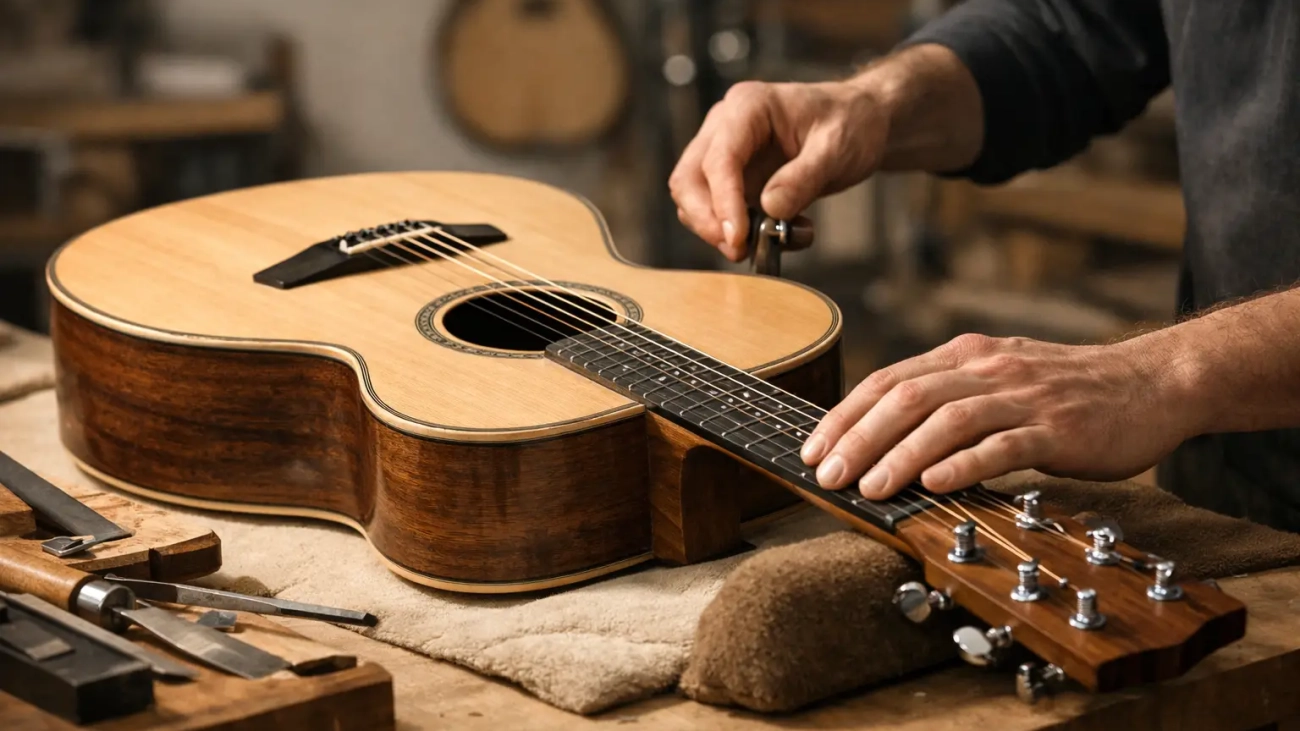
A signature guitar should reveal itself before it announces itself. In the first phrase, the player should feel a familiar resistance beneath the right hand, a neck that disappears into the palm, and a voice that carries the particular colors they have spent years trying to find. That is how to design a signature guitar with real meaning: not by collecting decorative options, but by translating a musician’s touch, repertoire, and imagination into wood, proportion, and sound.
For a serious player, this process is less like ordering an instrument and more like composing one. Every decision affects another. A deeper body may offer greater breadth in the bass, but it can change how the guitar rests against the body. A more immediate attack may serve flamenco brilliantly, while a classical player seeking long, singing lines may prefer greater sustain and tonal bloom. The finest result comes from understanding these relationships before choosing a rosette, a wood set, or a finish.
Begin with the music, not the specifications
The most useful first question is not, “What woods should I choose?” It is, “What do I need to say when I play?” A signature instrument begins with the music that matters most to its owner.
Consider the repertoire that lives under your fingers. A concert classical guitarist may need separation between voices, an even response across registers, and enough reserve to carry through a hall without forcing the sound. A flamenco player may want a fast, dry attack, controlled sustain, and the percussive clarity that makes rasgueados speak. An archtop player may search for a focused fundamental, warmth at lower dynamics, and enough definition for a chord to remain intelligible under a microphone.
Then consider your technique. Do you draw sound from the string with a heavy, deliberate stroke or a light, efficient touch? Do you play close to the bridge, seeking edge and projection, or nearer the fingerboard, where the sound becomes rounder and more veiled? A guitar cannot replace technique, but a thoughtfully designed one can meet a player’s natural approach rather than asking them to fight it.
It helps to describe sound in musical terms rather than vague approval. “Warm” can mean a dark treble, a generous lower midrange, or simply less metallic attack. “Loud” can mean immediate projection at close range, headroom under a strong stroke, or the ability to carry a line through other instruments. Bring recordings of playing you admire, but also explain what you hear in them. A skilled luthier listens for the language behind the adjectives.
How to design a signature guitar around your hands
Ergonomics are often the difference between a beautiful instrument and a lasting companion. A guitar may sound extraordinary in another player’s hands yet become tiring after forty minutes of your own playing. The goal is not a universally comfortable guitar. It is a guitar that feels inevitable to you.
Neck profile, nut width, string spacing, scale length, fingerboard radius, and action work together. A wider nut and generous spacing can give the right hand clean access to individual strings, especially in classical repertoire, but players with smaller hands may find the left-hand reach demanding. A shorter scale length can reduce tension and make extensions more forgiving, though it may also alter the firmness and projection a player expects. There is no correct measurement in isolation.
The same is true of body dimensions. A smaller-bodied instrument can feel intimate, responsive, and easy to hold. A larger body may develop more air movement and a broader bass foundation. Yet the player’s posture, torso length, shoulder comfort, and preferred playing position all matter. Arm bevels, rib contours, elevated fingerboards, and carefully considered cutaways are not ornamental luxuries when they solve a real physical need. They should serve the player’s relationship with the instrument, not distract from it.
Left-handed players deserve the same level of attention. A true left-handed build is more than reversing strings. Bracing, voicing, compensation, pickguard placement where relevant, and the visual balance of the design should be conceived for the instrument’s actual orientation from the beginning.
Choose materials for character, not mythology
Master-grade tonewoods are remarkable precisely because they are not interchangeable. Each set carries its own stiffness, density, grain structure, and potential voice. The art lies in selecting and shaping those materials so their qualities serve the musical intention.
Spruce often offers clarity, speed, and a wide dynamic range. It can reward a player who wants articulation and a guitar that continues to open over many years. Cedar is frequently valued for its immediacy, warmth, and complex color at softer dynamics. Neither is inherently superior. A forceful player may bring out a cedar top beautifully; a delicate player may make spruce speak with great intimacy. The choice depends on the individual set of wood and the hands that will awaken it.
For the back and sides, rosewood can lend depth, overtone richness, and a spacious bass response. Maple often brings a quicker, more transparent character with strong note separation. Other woods can offer their own compelling balance of warmth, focus, and visual distinction. A responsible builder will also consider long-term stability, responsible sourcing, and whether a particular wood’s behavior suits the intended construction.
Beauty belongs in this conversation, but it should be honest beauty. A dramatic figure in the back and sides can be captivating. A restrained set with exquisite grain and color can be equally moving. The most convincing aesthetic choices are those that feel connected to the guitar’s voice and the player’s temperament, rather than applied as an afterthought.
Shape the voice through construction and voicing
The visible choices are only part of a signature guitar. Much of its personality is decided in the hidden architecture: the top thickness, the bracing pattern, the carve and graduation of the plates, the bridge design, and the final voicing of the instrument.
This is where experience matters most. A top cannot simply be made thin for responsiveness or thick for power. It must be tuned to the particular wood, its stiffness, its weight, and the desired balance between immediacy, headroom, sustain, and structural longevity. Bracing shapes how the top moves. Varnish influences how freely it can respond. The smallest refinements can change the relationship between bass and treble, or between the sound under the ear and the sound that reaches the listener.
A player should be clear about priorities. Do you value a guitar that offers instant color at low volume, or one that keeps expanding when played hard? Do you want a dry, direct response, or a more reverberant field of overtones? Do you need a pronounced, lyrical treble for melody, or exceptional equality for contrapuntal music? These are useful questions because every tonal quality has a companion trade-off.
At Scharpach, the dialogue between musician and maker is central to this work. The guitar is refined not toward an abstract ideal, but toward the musical identity of the person who will live with it.
Let visual details carry personal meaning
A signature guitar does not need to be extravagant to be unmistakable. Often, the most enduring designs are defined by proportion, restraint, and a few details that hold private significance. A rosette may echo architecture from a beloved city. A purfling line may reference a family instrument. A headstock shape, tuner choice, or subtle inlay may give the guitar its own quiet authority.
The best visual decisions respect the instrument’s form. Decorative work should not compromise vibration, add needless weight, or turn the guitar into an object that is admired more than played. A fine finish should protect the wood while allowing its texture and depth to remain alive. In this sense, simplicity is not an absence of imagination. It is the discipline to let each element earn its place.
Allow the design to mature before it is fixed
A commission benefits from patience. Initial preferences are valuable, but they become more useful when tested against familiar instruments. Notice what happens after a long rehearsal. Notice whether a guitar still inspires you at low volume, whether its treble becomes thin under pressure, and whether your left hand tightens during difficult passages. These observations are more revealing than a quick impression in a showroom.
Bring this evidence into the consultation. Describe what your current guitar gives you and what it withholds. If possible, compare several instruments rather than searching for one perfect reference. One may have the bass you want, another the neck shape, and another the visual restraint. A signature guitar can gather those lessons into a unified whole, while remaining faithful to the realities of acoustics and handcraft.
The final design should leave room for the instrument’s future. Fine woods settle, finishes cure, and a well-made guitar develops through years of playing. Choose the voice that invites you to return tomorrow, not merely the one that impresses in the first minute. A signature guitar earns its name when, with time, it sounds less like a possession and more like the clearest extension of your own musical voice.