
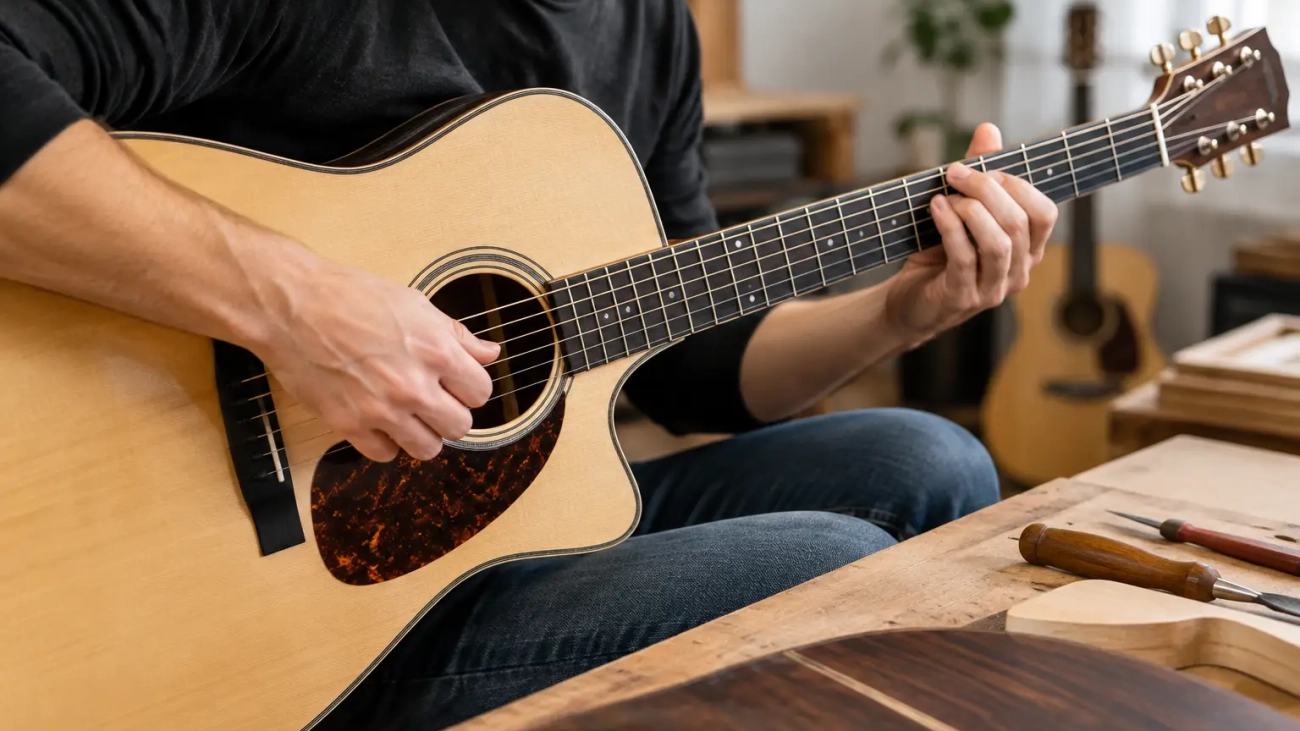
A beautiful guitar should never ask the player to fight it. Yet many accomplished musicians quietly accommodate an instrument that is too deep at the body, too broad at the neck, too long in the scale, or simply wrong for the way they sit, stand, and phrase a line. Guitar ergonomic adaptation is the art of resolving that conflict. It brings the instrument’s physical form into closer accord with the player’s body, technique, and musical intent.
For a serious guitarist, this is not a matter of adding comfort as an afterthought. Ease of movement affects timing, articulation, endurance, and the freedom to listen while playing. When the hands and shoulders are occupied with compensation, attention leaves the music. When the guitar rests naturally against the body, the player can give full presence to color, attack, silence, and expression.
Guitar Ergonomic Adaptation Begins With the Player
A custom guitar begins with observation rather than a catalogue of specifications. Height and arm length matter, but they are only the beginning. The way a player holds the instrument reveals more: the angle of the neck, the rotation of the wrist, the height of the right elbow, the tendency to lean forward, and the places where tension quietly gathers during difficult passages.
Classical and flamenco players often spend long periods seated, where a difference of a few millimeters in body depth or waist placement can change the relationship between the fretting hand and the shoulder. An archtop player may work standing for an entire set, making balance, strap position, and upper-fret access especially consequential. A left-handed musician should not have to accept a mirrored compromise in an instrument conceived principally for another orientation. The guitar must be designed from the player outward.
The aim is not to impose a single ideal posture. Bodies, repertoires, and technical traditions differ. One guitarist may favor a raised left leg and a more vertical neck; another may need the instrument to sit low and stable while standing. Some players have broad hands but prefer a shallow neck. Others require a little more substance behind the thumb to feel secure in powerful shifts. Good ergonomic work accepts these distinctions without treating them as defects to be corrected.
The Neck Is a Conversation Between Hand and Music
Neck shape is among the most personal decisions in a guitar commission. Its profile, width, depth, taper, and shoulder geometry determine how the hand meets the fingerboard over thousands of movements. A neck that feels agreeable in a brief trial may become tiring after an hour of rehearsing Bach, accompanying dance, or voicing dense jazz harmony.
There is no universally superior profile. A flatter, more open shape can offer room for certain left-hand approaches, while a more rounded profile may provide a natural point of support for another player. Nut width must also serve the repertoire. Classical players often value generous string spacing for independent voices and clean right-hand access. Flamenco players may prefer a response that favors rapid position changes and direct attack. The correct choice lies in how the dimensions work together, not in any isolated measurement.
Scale length deserves the same care. A longer scale can bring tension, projection, and a particular clarity to the voice, but it also asks more of the left hand. A shorter scale may ease stretches and barre chords while changing the feel and response of the strings. The best answer depends on tuning, string choice, technique, and the tonal character the player seeks. Ergonomics without acoustical judgment is incomplete. A guitar must remain a musical instrument first.
Body Design, Balance, and Breathing Room
The body is where acoustics and physical contact meet most directly. Its outline, depth, arm position, and relationship to the ribcage influence both comfort and resonance. A smaller-bodied instrument can be remarkably generous in sound when its proportions, materials, and voicing are intelligently considered. Conversely, a larger body may be exactly right for a player whose frame and musical setting call for greater air movement and presence.
Body depth is often underestimated. Even a subtle reduction can relieve pressure at the right shoulder and make the guitar feel closer to the player, particularly for those with shorter arms or limited shoulder mobility. But reducing depth changes the air chamber and can alter low-frequency behavior. This is where the experience of the luthier matters: an ergonomic adjustment should be integrated into the architecture of the instrument, not treated as a subtraction with no tonal consequence.
The contour at the armrest can be equally transformative. A carefully shaped edge reduces the compression that occurs when the forearm rests against the top, allowing the right arm to settle without forcing the shoulder upward. Done poorly, such a feature can feel ornamental or interrupt the guitar’s visual line. Done with restraint, it becomes nearly invisible to the eye and immediately persuasive to the body.
Balance matters as much as contact. A guitar that slides, tilts, or pulls away from the player creates continual micro-adjustments. Those adjustments may appear insignificant, yet over a long practice session or concert they drain concentration. The placement of the waist, the geometry of the lower bout, the neck-body relationship, and the player’s chosen support or strap all contribute to a stable, unforced position.
Designing for Injury Prevention Without Designing Around Fear
Players sometimes seek adaptation after discomfort has become persistent. Hand fatigue, neck strain, shoulder tension, and irritation around the wrist are signals worth respecting. An instrument cannot replace appropriate medical advice, patient technical work, or a sensible practice routine. It can, however, remove unnecessary obstacles that make good playing harder than it needs to be.
The objective is not a guitar so diminished in tension or dimension that it loses authority. It is a guitar that lets the player use strength where music requires it and release strength where it does not. The distinction is profound. A responsive instrument rewards a controlled touch; it does not demand force simply to speak.
For this reason, the most useful consultation includes candid discussion of physical history as well as musical ambition. A player recovering from strain may benefit from a more manageable scale, a different neck transition, or a lighter setup. Another player may have no pain at all but wish to preserve ease through decades of performance. In both cases, the work is preventive, practical, and deeply personal.
Materials and Voicing Still Lead the Story
Ergonomic refinement should never flatten an instrument’s character. The choice of spruce or cedar, rosewood or maple, the graduation of the top, the stiffness of the bracing, and the application of varnish all shape the guitar’s living voice. A guitar may be exquisitely fitted to the body and still fail to move the ear. That is not enough.
The finest commissions hold comfort and sound in the same hand. They preserve clarity under a light touch, sustain a singing line, and offer enough reserve for the player’s strongest musical moments. A slightly altered body depth, a refined neck, or a considered scale length must be voiced into the whole. The result should feel inevitable, as though the guitar could have been made no other way.
At Scharpach, this philosophy recognizes that a player’s physical relationship with an instrument is inseparable from artistic identity. The guitar is not merely held. It is inhabited over years of study, performance, and discovery.
The Value of a Guitar That Disappears
The most successful ergonomic adaptation rarely announces itself. It does not turn the guitar into a technical object to be admired for its accommodations. Instead, it recedes. The left hand finds positions without hesitation. The right arm rests without pressure. The instrument remains balanced through a long phrase. The player stops negotiating with wood, strings, and gravity.
That quiet disappearance is valuable because it creates room for interpretation. A guitarist can shape a pianissimo without guarding the shoulder, hold a difficult chord without bracing the thumb, or remain alert to an ensemble without worrying about fatigue. The physical design becomes a form of trust.
Before commissioning a guitar, pay attention to the moments when your present instrument asks for compensation. Notice what happens after forty minutes, not only in the first five. Observe your shoulders during shifts, your wrist during barres, and your posture when the music becomes demanding. Those details are not minor preferences. They are the beginning of an instrument that can remain a willing artistic partner for a lifetime.