
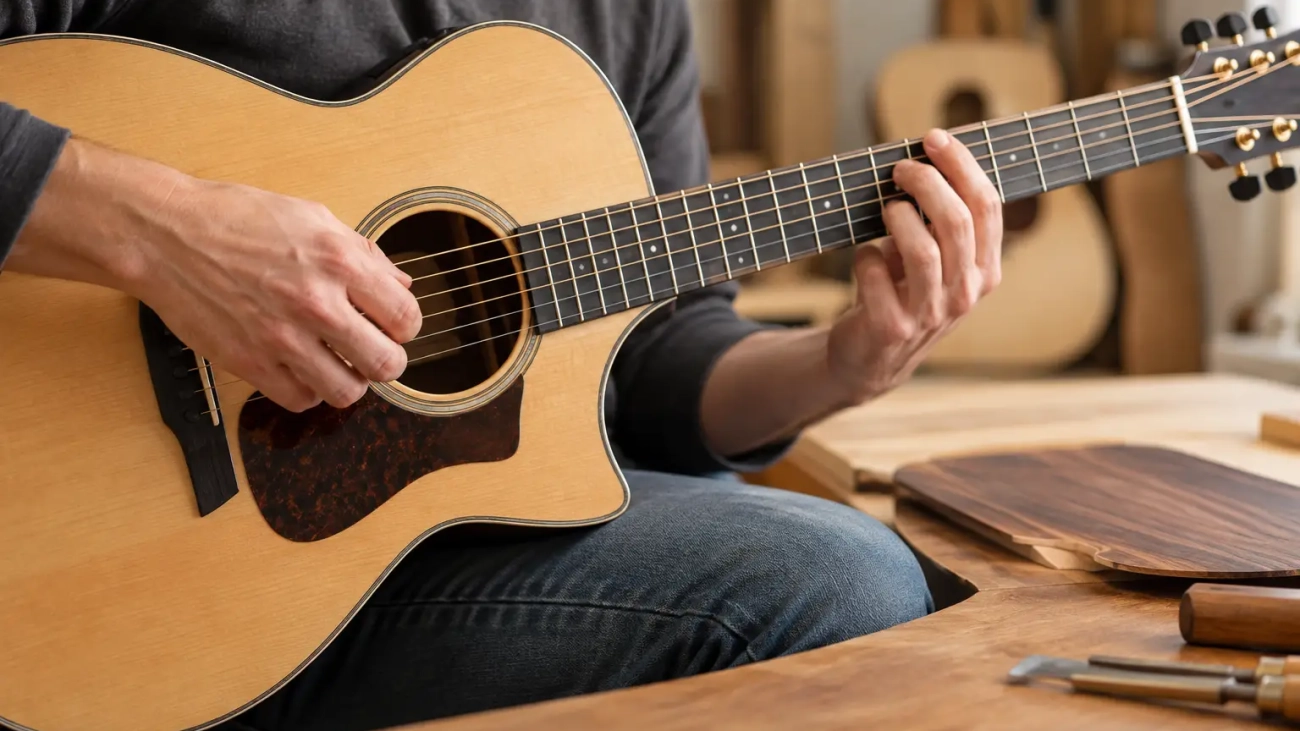
A fingerstyle guitarist does not simply hold an instrument. The body, arms, hands, and breath all enter into a quiet negotiation with it. If the upper bout presses into the rib, the fretting wrist is forced into a sharp angle, or the picking hand cannot arrive naturally over the strings, musical thought begins to compete with physical correction.
That is why ergonomic guitar design for fingerstyle players is not a matter of cosmetic comfort. It is part of the instrument’s musical architecture. A guitar that settles naturally into the player’s body encourages relaxed hands, a wider dynamic range, cleaner articulation, and the confidence to remain with a phrase until it has fully spoken.
Ergonomics Begin Before Measurements
Many discussions of guitar ergonomics begin with specifications: nut width, scale length, body depth, and string action. These are essential, but no single measurement can define comfort. The player experiences the guitar as a whole form, in motion and over time.
For a fingerstyle player, seated position often reveals more than a brief trial standing with a strap. The classical position, casual leg-crossed posture, and elevated-foot support each place the instrument differently in relation to the torso. A body that feels modest in depth can keep the right shoulder low and free. A carefully considered waist can bring the neck toward the player without forcing the fretting arm to reach. Small changes in contour may appear subtle to the eye, yet they can transform a two-hour practice session.
The most successful ergonomic instruments do not feel engineered for attention. They disappear. The player notices the phrase, the color of a stopped note, the release of a bass line, rather than the effort required to reach them.
Body Shape, Depth, and Contact Points
A large-bodied guitar can offer breadth, projection, and a generous bass foundation. It can also require the player to extend the right arm farther across the upper bout. For some musicians, particularly those of smaller stature or those managing shoulder tension, this reach gradually narrows the hand’s freedom.
Body depth presents a similar trade-off. More air volume may support a sense of authority and low-end presence, but an excessively deep body can push the instrument away from the torso and alter the angle of both arms. A slimmer body may feel more intimate and immediate, with quicker response under a light touch, though it may not deliver the same cavernous reserve at high volume.
An arm bevel, softened edge, or thoughtfully shaped rib can reduce pressure where the forearm meets the guitar. These features should serve the player without interrupting the visual coherence of the instrument. Fine craftsmanship is often most evident where utility and beauty become indistinguishable.
The Neck Is the Player’s First Point of Trust
For the left hand, comfort depends on more than a neck being described as slim or substantial. Its shape must suit the player’s thumb placement, hand span, repertoire, and preferred degree of resistance. A fingerstyle guitarist may move from open-position voicings to extended harmonies, partial barres, and wide intervallic shapes within a few measures. The neck should support that movement rather than impose a single fixed hand position.
Nut width and string spacing deserve careful attention. A wider string layout can give the right hand more room to distinguish individual voices, especially when alternating bass, melody, and inner accompaniment must remain independent. Yet width that is excessive for a player’s hand may make the first-position stretches tiring. There is no universal ideal. A player with broad fingers and a classical approach may welcome spaciousness, while another may value a slightly narrower field that permits fluid transitions and secure reaches.
Scale length also affects the conversation between hand and string. A longer scale can increase tension, clarity, and headroom, often rewarding a firm attack with definition. A shorter scale may feel more yielding under the fretting hand and can bring warmth and suppleness to the voice. Neither is inherently superior. The appropriate choice depends on tuning, string gauge, repertoire, and the player’s own relationship to resistance.
Action must be considered with the same restraint. Very low action can feel effortless until a vigorous thumb stroke causes the strings to rattle against the frets. Higher action may preserve greater dynamic latitude but can demand more from the left hand. The finest adjustment is one that allows a musician to play softly, forcefully, and truthfully without anticipating the instrument’s limits.
The Right Hand Needs Space to Speak
Fingerstyle tone is shaped at the point of contact. The right hand may move from the warmth near the fingerboard to the focused clarity closer to the bridge. It may use fingernail, flesh, or both. It may need a stable reference point for the little finger, or complete freedom for a classical hand position. An ergonomic guitar must make room for these choices.
The relationship between bridge placement, body proportions, and soundhole location influences how naturally the arm falls. A player should be able to approach the strings without lifting the shoulder or collapsing the wrist. This is particularly significant for musicians who work with nuanced control of nail angle and fingertip release. When the hand is comfortable, subtle changes in touch become repeatable. That repeatability is the foundation of a personal voice.
Responsiveness belongs to ergonomics as well. A top that speaks quickly under a light stroke allows the player to use less physical force. This does not mean every fingerstyle guitar should be delicate or lightly built. Some players need greater reserve for concert performance or assertive rhythmic work. The art lies in voicing the soundboard, bracing, and body so the instrument offers both immediacy and composure.
Ergonomic Guitar Design for Fingerstyle Players Is Holistic
It is tempting to treat a cutaway, bevel, raised fingerboard, or soundport as an ergonomic solution in itself. Any of these features can be valuable, but each must belong to a larger design. A cutaway improves access to upper positions, for example, yet it changes the body’s air volume and may influence the balance of the voice. A raised fingerboard can make higher notes more accessible, but it must be integrated with neck geometry and top structure so that playability does not come at the expense of tonal unity.
Likewise, a soundport may offer the player a more immediate sense of the instrument’s presence. Some musicians love this intimacy; others prefer the traditional directionality and visual restraint of a closed side. Good design does not collect features. It chooses the few decisions that honor the player’s body and the guitar’s intended character.
Posture remains part of the equation. Even a beautifully fitted guitar cannot entirely compensate for tension carried in the shoulders, a chair that is too low, or a habit of twisting toward the fretboard. Still, an instrument built with the player’s natural position in mind removes unnecessary obstacles. It permits healthier habits to take root.
A Bespoke Instrument Turns Preference Into Knowledge
A serious custom commission begins with listening. The useful questions are not limited to, “What wood do you prefer?” They include: Where does fatigue begin? Which chords feel cramped? How do you sit when you play for an hour? Do you favor altered tunings? Is the instrument expected to whisper in a recording room, carry in a hall, or do both?
At Scharpach, such details are not peripheral to the build. They guide it. A left-handed guitarist, a player with a smaller reach, a performer who lives above the twelfth fret, and a musician who draws orchestral texture from open tunings may all require different answers from the same set of materials.
The luthier’s task is to translate those answers into proportion, neck geometry, top voicing, and the quiet precision of setup. Master-grade woods and fine varnish matter deeply, but they achieve their fullest purpose when the player can meet them without strain. Resonance is not only heard. It is felt through the hands, chest, and attention.
Comfort That Deepens With Time
A guitar should not merely feel impressive during its first few minutes in the hands. Its value becomes clearer across long rehearsals, changing repertoire, aging hands, and years of musical discovery. A well-conceived ergonomic design protects stamina while leaving room for the player to grow.
The right instrument does not make technique unnecessary. It rewards technique by allowing it to remain relaxed, direct, and alive. When a fingerstyle guitar fits with that degree of intelligence, comfort becomes more than relief. It becomes the quiet condition in which a musician can listen more closely and say more with every note.