
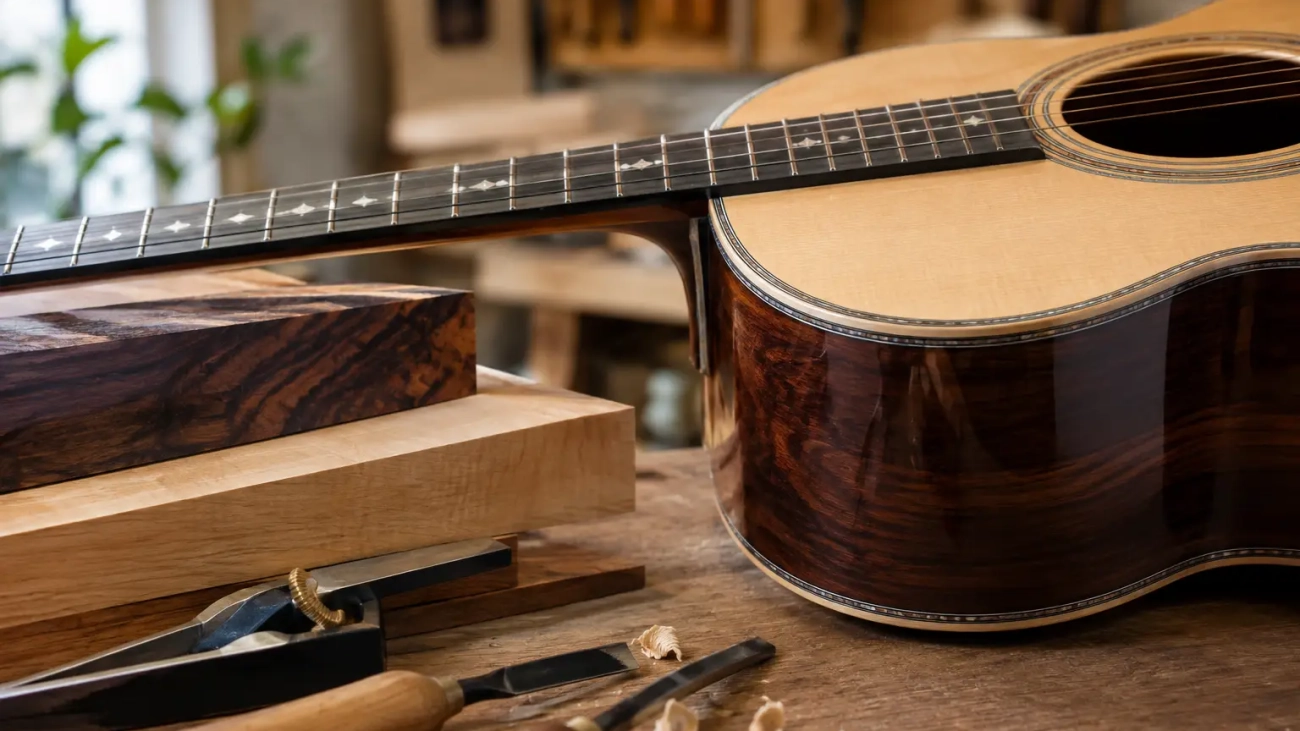
A guitar can be made from beautiful wood, finished with immaculate care, and still fail to become a meaningful instrument. The difference is heard in the first notes: the ease with which a player shapes a phrase, the color available beneath the fingers, the balance between immediacy and depth. That is where handcrafted guitar value begins – not as an abstract promise of exclusivity, but as a relationship between material, maker, musician, and time.
For a serious player or collector, price alone cannot explain why one instrument becomes indispensable while another remains merely impressive. A fine handmade guitar is valued for what it allows the musician to say, and for how faithfully it continues to say it through years of playing.
Handcrafted Guitar Value Begins With the Maker’s Ear
The most consequential work in a guitar is often invisible. Before a finish is applied or a rosette is set, the luthier must make decisions about thickness, bracing, arching, stiffness, weight, and proportion. Each decision changes the way the instrument receives energy from the strings and releases it as sound.
This is why two guitars built from the same species of spruce and rosewood can possess entirely different voices. One may be quick, dry, and percussive, suited to flamenco articulation. Another may offer a broader palette of sustain and overtone complexity for classical repertoire. An archtop may favor a focused, singing midrange that holds its place in an ensemble. There is no universally superior tonal profile. Value comes from intention, and from the maker’s ability to realize that intention consistently.
An experienced luthier does not simply follow measurements. He reads each piece of wood: its grain, tap tone, density, elasticity, and response to the hand. This sensitivity is developed over decades. It cannot be reduced to a factory specification because wood is not uniform, and neither are players.
Voicing Is Not Decoration
Voicing is the art of bringing the soundboard, back, and body into a responsive relationship. It is often discussed as though it were mysterious, but its result is plain to an attentive guitarist. The instrument speaks with less effort. Notes carry a clear center. Dynamic changes feel available rather than forced. A light touch can still produce presence, while a stronger attack does not cause the sound to harden or collapse.
For the advanced player, this responsiveness has practical value every day. It can support cleaner articulation in fast passages, greater control of pianissimo, more tonal contrast in a concert hall, and less physical strain over a long practice session. The finest handmade instruments do not make technique unnecessary. They reward technique with a wider expressive return.
Materials Matter, but Selection Matters More
Master-grade tonewoods deserve their reputation, yet species names alone do not establish worth. A set of aged European spruce, cedar, maple, or rosewood is only the beginning. The question is whether it is appropriate for the desired voice and whether it has been selected and prepared with patience.
A soundboard must have the right combination of stiffness and lightness for its role. Back and side woods influence projection, reflection, warmth, and overtone content, while the neck must remain stable without feeling lifeless in the hand. Even small choices – the cut of the wood, the orientation of the grain, the method of joining, the seasoning period – can affect the future of the instrument.
The same discernment applies to varnish. A finish protects the guitar, but it also participates in its acoustics. An excessively heavy finish can inhibit vibration; an overly fragile one may demand impractical caution. A well-considered varnish respects the wood and allows the instrument to mature gracefully. Its beauty is not separate from its function.
This is one reason handmade guitars cannot be judged only by visual luxury. Exotic materials, elaborate inlay, and dramatic figure may add aesthetic appeal, but they do not automatically create a deeper musical instrument. In a truly refined build, ornament remains in service to proportion, sound, and the player’s experience.
The Value of a Guitar Built for One Player
A factory instrument is designed around a useful average. A commissioned guitar begins with a person.
Hand size, posture, repertoire, touch, preferred string tension, tonal ideals, and performance setting all inform the build. A left-handed guitarist should not have to accept a compromised adaptation. A classical player who values tonal separation and lyrical sustain may need something very different from a flamenco player seeking explosive attack and controlled decay. An archtop guitarist moving between solo work and amplified ensemble performance will have another set of priorities.
Ergonomics may seem secondary beside sound until a player spends three hours with an instrument that does not fit. Neck profile, nut width, scale length, string spacing, body depth, arm contour, and balance can transform the physical experience of playing. When these elements are considered carefully, the guitar feels less like an object held against the body and more like a natural extension of musical intention.
That degree of personal fit also protects long-term value in a less obvious sense: it encourages use. The guitar that is comfortable, inspiring, and tonally trustworthy is the guitar a musician reaches for. Its history becomes inseparable from the player’s artistic development.
Why Time Changes a Fine Guitar
A handmade acoustic guitar is not static. As the wood experiences vibration, changes of season, and years of attentive playing, its voice may open, settle, and gain complexity. This development is not guaranteed in exactly the same way for every instrument, nor should it be romanticized as automatic. Proper construction, sound wood, appropriate humidity, and thoughtful care all matter.
Still, a well-made guitar has the potential to reveal more of itself over time. The fundamental may become richer, the response more immediate, the tonal colors more integrated. For musicians accustomed to disposable goods, this is a different idea of ownership. The instrument is not exhausted by the day it is purchased. It becomes more familiar and, at its best, more eloquent.
Longevity also depends on repairability. Traditional construction methods, carefully fitted components, and a maker who understands the instrument’s architecture can make future maintenance more straightforward and sympathetic. A fine guitar should be cared for, not treated as untouchable. Frets wear. Setups evolve. A player’s needs may change. Thoughtful service preserves both musical usefulness and structural integrity.
Provenance, Reputation, and the Honest Meaning of Rarity
The market value of a handcrafted guitar includes factors beyond sound: the reputation of the maker, the quality of documentation, the condition of the instrument, rarity, and its association with significant players or performances. These considerations are real, particularly for collectors. Yet they should be understood clearly.
Rarity without merit is only scarcity. A limited number of instruments does not make each one compelling. Conversely, an exceptional guitar by a respected maker may command attention because its quality can be heard and felt, not merely because it is difficult to acquire.
For commissioned work, provenance begins at the first conversation. Notes about the player’s requirements, the woods selected, the design decisions, and the instrument’s completion create a meaningful record. When a guitar has been built with care by a maker of established experience, this record adds confidence for future custodians. It also gives the owner a deeper understanding of what rests in their hands.
At Scharpach, the commission process is grounded in this principle: a guitar should reflect a musical life, not a production schedule. The aim is not to imitate a familiar sound at a higher price, but to create an instrument whose resonance, feel, and visual restraint belong together.
When the Investment Makes Sense
A handcrafted guitar is not the right choice for every situation. A student may benefit more from a dependable, well-set-up instrument that leaves room for lessons and practice. A touring musician who faces extreme travel conditions may prefer a rugged secondary guitar for certain engagements. Even an advanced player may find that a factory model serves a specific musical role perfectly well.
The investment becomes compelling when a musician has developed a clear ear and a clear need. Perhaps standard neck dimensions cause fatigue. Perhaps the player cannot find the desired balance of projection and warmth. Perhaps years of study have revealed an individual sound that no existing instrument quite supports. At that point, commissioning a guitar is not simply buying a finer object. It is choosing a more exact artistic tool.
The most enduring value is revealed slowly: in the phrase that finally speaks with the intended color, in the confidence to play more quietly, and in the quiet knowledge that the instrument has been made for a life in music.