
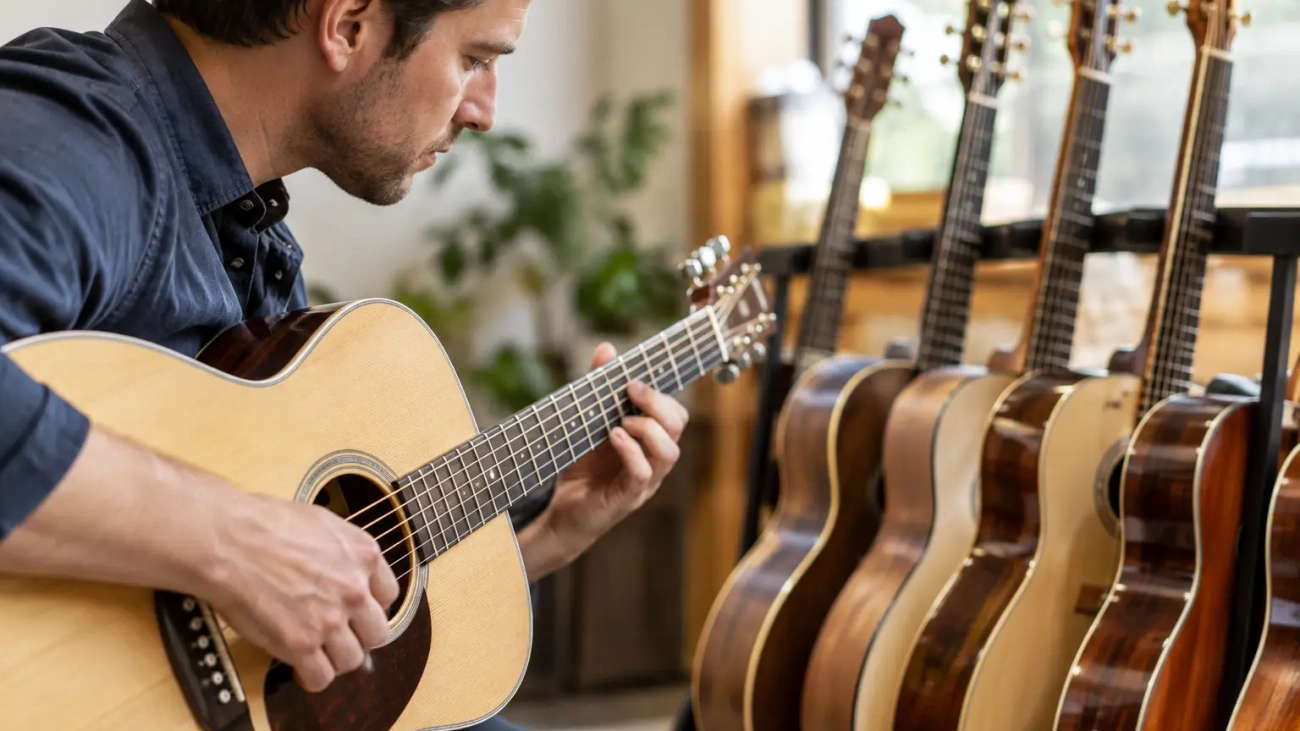
A concert guitar reveals itself most clearly in the first few notes played without haste. The question of how to audition concert guitars is not simply whether one instrument is louder, brighter, or more beautiful than another. It is whether the guitar meets your hands, your repertoire, and your musical imagination with enough clarity to become a lasting artistic partner.
A fine handmade guitar can be impressive immediately. Its voice may carry, its finish may possess rare elegance, and its materials may be exceptional. Yet a true audition asks for more patience than first impressions allow. The instrument must be heard from several distances, played through changes of touch and dynamic, and felt over enough time for its character to emerge.
Begin With Your Own Musical Voice
Bring the music that tells the truth about your playing. A few familiar passages are far more revealing than an elaborate demonstration piece learned for the occasion. Choose music with contrasting demands: a singing melodic line, a passage of rapid articulation, broad arpeggios, firm rest strokes, and quiet campanella or legato work.
A classical player might bring Sor, Tárrega, Bach, or a movement from the Spanish repertoire that exposes voicing and sustain. A flamenco guitarist should test rasgueados, alzapúa, picado, and golpes at both restrained and full performance intensity. The essential point is to use material whose technical and emotional demands you know intimately.
Do not begin by trying to make the guitar sound like another instrument you admire. Listen instead for whether it gives greater definition to your own phrasing. A concert guitar should not erase the identity of the player. It should make that identity more audible.
How to Audition Concert Guitars Beyond First Impressions
Start with a single open note, then let it disappear completely. Listen not only to the length of sustain but to its life. Does the note bloom after the attack? Does it retain a coherent center as it fades? Is there an appealing complexity in the overtones, or does the sound become diffuse?
Repeat this across the register. The first string should sing without becoming thin or brittle. The basses should offer depth and shape rather than mere weight. In the middle register, where much of the guitar’s musical conversation occurs, listen for warmth, separation, and a sense that chords remain intelligible.
Then play softly. This is one of the most useful tests in a serious audition. Many guitars can produce a strong sound when driven hard. Fewer retain color, focus, and responsiveness at a whisper. A refined instrument often gives the player an unusually wide range between the quietest expressive gesture and the strongest supported attack.
Finally, ask the guitar for more energy. Do not strike it aggressively for the sake of a test, but play with the force required in performance. Does the sound open freely? Does it compress, become harsh, or lose tonal order? Every guitar has a threshold, and the ideal threshold depends on the player. A musician with a powerful right hand may need greater headroom; a player of intimate salon repertoire may value immediate response at low effort.
Listen From the Other Side of the Room
The sound beneath the player’s ear is only one part of the experience. Have another musician play the guitar while you listen several feet away, then from the back of the room. If possible, ask them to play the same short passage on each instrument under consideration.
Projection is not only volume. A guitar may seem modest at close range yet carry with remarkable authority because its fundamental voice remains clear within the room. Another may sound enormous to the player but lose distinction at a distance. The most compelling concert instruments tend to preserve their identity as space is added around them.
Listen for directional clarity as well. Does the melody arrive with presence? Can you hear individual voices within a chord? Is the treble line supported by the bass, or covered by it? These questions matter especially for performers, but they also matter in a private studio. A guitar that organizes sound beautifully invites better listening from everyone in the room.
Judge Color, Not Just Volume
Volume is easy to notice and easy to overvalue. Tonal color is subtler, and often more enduring. A great concert guitar may offer a luminous treble, a dry and percussive flamenco edge, a dark and orchestral bass, or a transparent balance that favors contrapuntal music. None of these qualities is universally superior.
The useful question is whether the color remains convincing as you alter your right-hand position. Play near the bridge, over the soundhole, and toward the fingerboard. A responsive instrument should offer genuine shades of expression rather than a single attractive sound repeated at different volumes.
Pay attention to the transition between notes. Some guitars have a quick, clean attack that suits rhythmic precision. Others allow the note to unfold with a more vocal, rounded entrance. Both can be exquisite. The choice depends on repertoire, technique, and the kind of musical sentence you wish to speak.
Feel the Neck, Setup, and Physical Conversation
An instrument may have a magnificent voice and still be wrong for a particular player. The neck profile, nut width, string spacing, scale length, action, and body depth all shape the physical relationship between musician and guitar.
Play long enough to move beyond the novelty of the first minute. Shift through positions, form extended chords, reach difficult stretches, and notice the right shoulder as you play. A guitar that causes strain in a brief audition rarely becomes more forgiving over years of use.
At the same time, do not confuse a familiar setup with the only setup you can play. Fine guitars are often adjustable within sensible limits, and a slight difference in action or string choice can transform the experience. Neck geometry and body ergonomics are more fundamental than a minor setup preference. If the instrument feels fundamentally balanced in the hands, details can be refined.
For left-handed players, this consideration deserves particular care. A purpose-built left-handed guitar is not simply a reversed visual arrangement. Bracing, voicing, compensation, and structural decisions should support the instrument’s intended musical direction.
Look Closely, but Let Craft Serve Sound
Examine the guitar with the same attention you bring to its voice. The joinery, purfling, fretwork, finish, bridge, and interior work should show discipline and sensitivity. On a master instrument, visual refinement is not decoration applied after the fact. It reflects a builder’s command of material, proportion, and time.
Still, beautiful wood alone does not guarantee musical depth. A dramatic set of rosewood or figured maple can be captivating, but the finest choice is the one that supports the guitar’s voice and the owner’s relationship with it. Cedar and spruce, shellac and modern finishes, lighter or denser construction – each involves trade-offs in response, color, protection, and development over time.
Ask how the instrument is expected to mature. A living wooden guitar changes with playing, humidity, and years of vibration. Some open quickly; others reward patient ownership with increasing complexity and freedom. The builder’s experience with a particular design is invaluable here.
Give Yourself Permission to Wait
The strongest audition is rarely rushed. If two guitars speak to you, return to them after a break. Your ear resets, and the qualities that initially felt dramatic may give way to those that feel truthful. Record brief passages if appropriate, but do not allow a microphone to make the final decision. Recordings flatten the physical exchange between player and instrument.
A concert guitar is chosen not only for the sound it makes on the day it is played, but for the work it invites over the years ahead. The right instrument leaves you with more than admiration. It leaves you wanting to sit down tomorrow, listen more closely, and say something only you can say.