
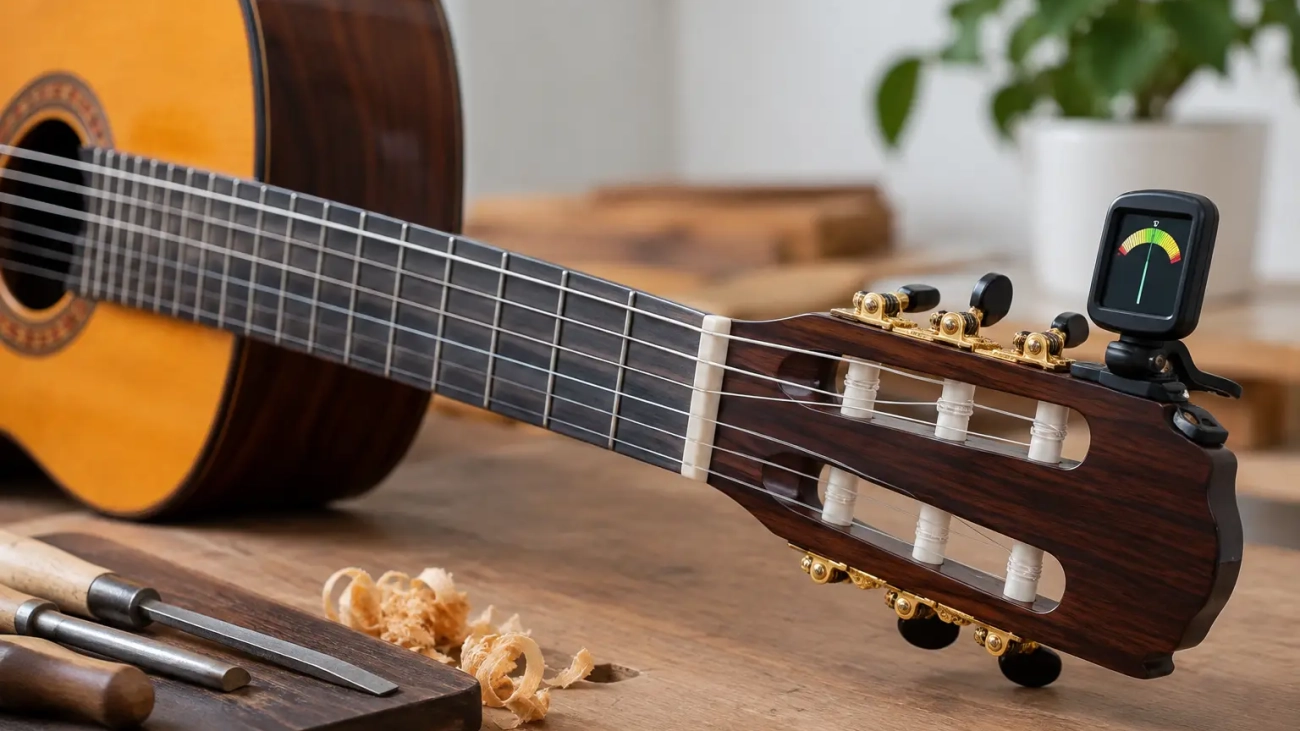
A classical guitar can possess a singing trebles, a deep and lucid bass, and a responsiveness that seems to anticipate the player’s hand. Yet if its tuning machines are imprecise, stiff, or visually out of sympathy with the instrument, that experience is diminished at the headstock. The best classical guitar tuners are not an accessory in the casual sense. They are a mechanical partnership between the player, the strings, and the instrument’s voice.
For a serious player, the right machines make tuning calm and exact before a performance, stable through a long rehearsal, and satisfying in the hand for years. For a luthier, they must also suit the headstock’s proportions, the guitar’s balance, and the character of the build. A beautiful set of tuners should never call attention to itself through friction, backlash, or unnecessary weight. It should simply do its work with quiet authority.
What separates the best classical guitar tuners?
Classical guitar machines work differently from the compact sealed tuners common on steel-string instruments. Their worm-and-gear mechanism is mounted on plates, usually with a barrel or roller that carries the string. This arrangement offers fine control, provided it is made with close tolerances and fitted well.
The most revealing quality is smoothness under tension. When the button is turned, the roller should respond immediately and evenly, without a dead area before the string begins to move. That lost movement, often called backlash, makes fine adjustment frustrating. On a sensitive nylon-string guitar, where pitch can shift with a small change in tension, precision matters.
Gear ratio matters as well. A higher ratio gives more gradual pitch adjustment, which many concert players appreciate when setting intonation carefully or tuning in a noisy backstage environment. But a very high ratio can feel slow. There is no universal ideal. The best choice depends on the player’s touch, the string tension, and whether the guitar is intended for concert classical repertoire, flamenco, or broader crossover work.
Material and construction deserve equal attention. Brass gears, strong steel worms, accurately drilled plates, and durable rollers contribute to a machine that remains composed over time. Decorative plating is secondary to this mechanical foundation, though it has an important visual role on a finely made instrument.
9 excellent tuner makers and styles to consider
Rather than searching for one winner, it is wiser to consider a small group of respected makers and configurations. Each has its own strengths, and the correct choice is always related to the guitar and its player.
1. Alessi
Alessi machines are prized by many builders and players for refined operation, elegant engraving, and the sense that every detail has been considered. Their higher-end sets can be specified with a remarkable range of plate shapes, finishes, buttons, and visual treatments. They are especially appropriate for concert instruments where traditional beauty and a highly polished mechanical feel belong together.
2. Sloane
Sloane tuning machines have long held a distinguished place in the world of fine classical guitars. They are known for precision engineering, a substantial feel, and understated visual authority. Their designs can suit a conservative concert guitar particularly well, though the added mass of certain models should be considered in relation to the headstock and the instrument’s overall balance.
3. Rodgers
Rodgers tuners are associated with meticulous construction and an exceptionally smooth turning experience. They are often chosen for guitars at the highest level of craftsmanship, where the player expects every contact point to feel resolved. A Rodgers set can be an excellent choice for a commission intended as a lifelong concert companion.
4. Rubner
Rubner offers a wide and respected range, from reliable professional-grade machines to more ornate options suitable for traditional Spanish-inspired instruments. They have a clear place in the classical and flamenco world because they combine dependable function with many plate and button styles. The exact model matters, however. Not every Rubner set offers the same degree of refinement or weight.
5. Schaller
Schaller has earned its reputation through solid engineering and consistency. For a player who values proven German manufacturing and a clean, functional aesthetic, its classical machines can be a sensible selection. They may not carry the bespoke visual language of a hand-finished boutique set, but they are capable, durable, and familiar to repair technicians.
6. Gotoh
Gotoh tuners are admired for their reliable machining and excellent value within professional-level hardware. Their classical sets are frequently selected for instruments where stable, smooth performance is essential without directing an outsized portion of the budget toward ornament. They are particularly compelling when a restrained modern look is desired.
7. Gilbert
Gilbert machines occupy a more specialized place among fine classical hardware. They are admired for beautiful detailing and a hand-finished presence that can complement a custom guitar with unusual grace. A player drawn to individual materials, engraved plates, or elegant button shapes may find that Gilbert offers the right visual vocabulary.
8. Der Jung
Der Jung has become a familiar choice for builders seeking dependable classical machines across several price levels. Their premium models can offer smooth action and appealing traditional styling, while the broader catalog makes it easier to match a tuner set to a particular instrument. They are a practical option, especially where serviceability and value are part of the decision.
9. Landstorfer
Landstorfer tuning machines are valued for careful workmanship and a distinctly artisanal character. They can be a compelling match for an instrument whose details have been shaped one by one rather than chosen from a standard catalog. For collectors and players who notice the feel of a button, the line of a plate, and the quiet accuracy of a gear, that distinction is meaningful.
How to choose tuners for a particular classical guitar
Start with the guitar itself, not the catalog. A lightly built concert guitar with a slender headstock may benefit from a tuner set that avoids excessive weight. More mass at the headstock can subtly affect how an instrument feels in playing position. Some players enjoy a grounded, substantial balance; others prefer the guitar to feel almost weightless at the neck.
The headstock layout is equally important. Roller spacing, screw positions, plate length, and barrel diameter must fit the existing drilling pattern or be planned into a new build from the beginning. Retrofitting tuners without careful measurement can leave visible holes, force an awkward plate position, or introduce stress around the slots. A change that looks simple on paper is not always simple on a finished headstock.
Button material changes the experience more than many players expect. Ebony and rosewood buttons offer warmth and visual continuity with a traditional instrument. Mother-of-pearl, bone-colored composite, ivoroid, or metal buttons can create a more formal or distinctive character. The practical question is comfort: a button should provide secure purchase without feeling sharp, slippery, or oversized.
For flamenco guitars, lighter machines are often attractive because immediacy and physical ease are central to the style. That does not mean choosing inferior hardware. It means choosing with purpose. A classical guitar designed for sustained color and concert projection may welcome a different balance than a blanca built for attack, dryness, and rhythmic clarity.
Installation is part of the result
Even exceptional machines can disappoint if installed poorly. The rollers must sit cleanly in the headstock slots, screws must be correctly sized and aligned, and the plates must rest flat without forcing the wood. Lubricants should be used sparingly and only where appropriate. A machine that binds after installation may not be defective at all; it may be under tension from a misaligned screw or an imperfectly sized slot.
This is why tuner selection belongs naturally in the conversation between player and luthier. At Scharpach, a commission is considered as a complete musical object: woods, scale length, neck profile, voicing, finish, ornament, and the small mechanical choices that influence the player’s daily relationship with the guitar. Tuning machines should support that unity rather than arrive as an afterthought.
The most suitable tuners will not make a guitar sound better in isolation. They do something subtler and no less valuable: they allow a fine instrument to remain exactly where the player needs it, in tune, in balance, and ready to speak without resistance. When the last adjustment before a performance feels effortless, the player can forget the mechanism and give full attention to the music.