
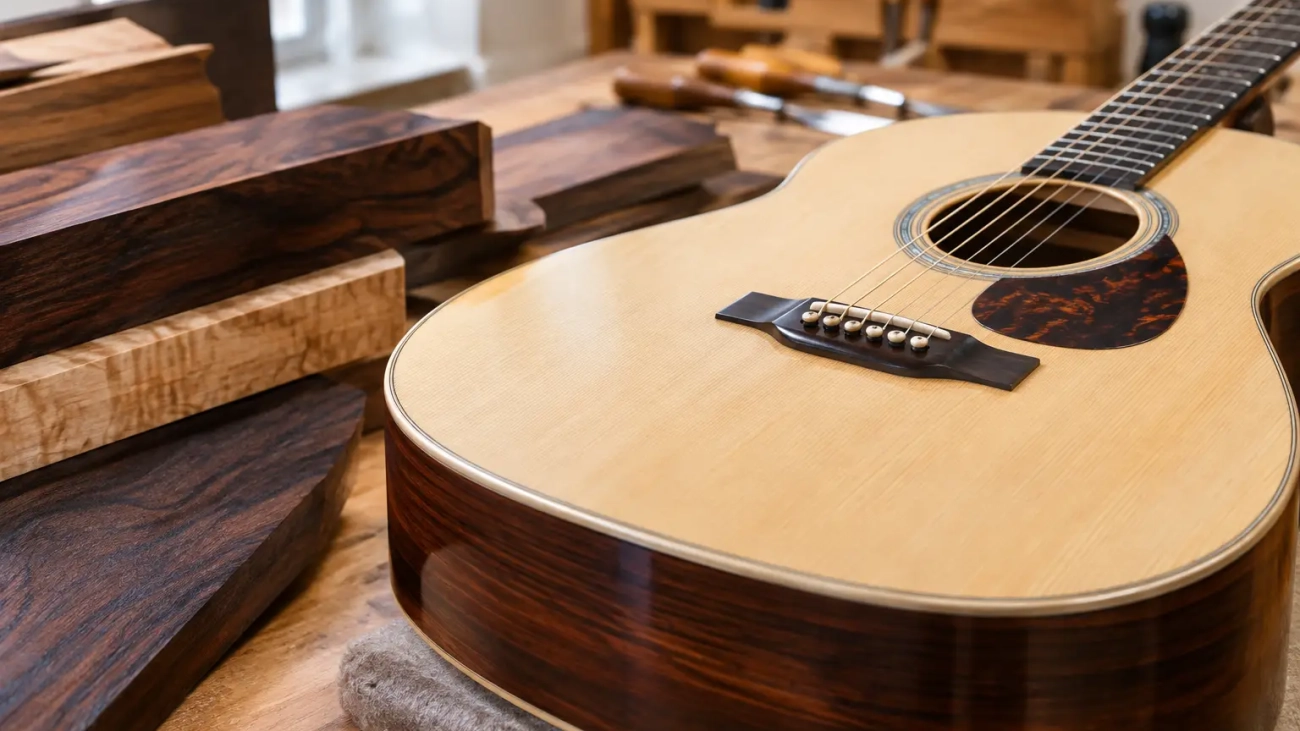
A concert guitar is asked to do something intimate and demanding: carry the smallest detail of a player’s touch to the farthest seat in the room. It must speak with authority without becoming hard, retain color without losing clarity, and remain responsive when a performance asks for both restraint and force. For the serious musician, this is not simply a question of volume. It is a question of whether the instrument translates intention.
The finest concert instruments are shaped around that translation. Their voice is not an accidental byproduct of expensive materials or elaborate ornament. It emerges from proportion, graduation, bracing, wood selection, varnish, and the practiced judgment required to bring those elements into balance. A guitar built for the concert stage must be alive beneath the hands, yet composed enough to hold its character under the pressure of performance.
What Defines a Concert Guitar?
The phrase can describe several traditions. In classical guitar, it generally suggests an instrument with the projection, tonal separation, dynamic range, and refinement required for recital work. In flamenco, the needs shift toward immediacy, attack, percussive clarity, and a quick, dry response. In archtop playing, a concert-ready guitar must project a focused voice with definition, whether it is heard acoustically or through a microphone.
What unites these instruments is not a standardized body size or a single recipe. It is musical capacity. A concert guitar must preserve the identity of a line as it rises above accompaniment, give chords enough internal order to remain intelligible, and offer the player a trustworthy response across the entire fingerboard.
This is why specifications alone never tell the whole story. Two guitars may share a scale length, soundboard species, and body outline, yet behave very differently in a hall. One may have an impressive first impression but compress when played hard. Another may seem reserved at close range while developing an expansive, carrying sound several rows away. Projection is not merely loudness. It is the ability of a voice to retain shape and presence in space.
Projection Is More Than Volume
A guitar that dominates a small room can sometimes feel tiring in a longer performance. Excess brightness may create the illusion of power, while an overly stiff top can produce volume without the pliancy that allows phrasing to breathe. Conversely, a guitar with abundant warmth but little definition can disappear when the musical texture becomes dense.
The most compelling concert voices hold several qualities in tension. There is a clear fundamental beneath each note, sufficient overtone content to create color, and enough separation for counterpoint to remain audible. The treble should sing without becoming thin. The bass should possess depth without blurring the rhythmic center. Between these poles lies the midrange, where much of the guitar’s human character resides.
A master luthier listens for this balance throughout the build. The soundboard is not treated as a fixed component but as a living acoustic surface with its own stiffness, weight, grain, and potential. Bracing is shaped in response to that particular piece of wood. Thicknesses are refined with care because a few small adjustments can alter the relationship between speed, sustain, warmth, and headroom.
The result should not be a guitar that imposes one color on every player. It should be an instrument capable of revealing the player’s own sound.
The Soundboard Sets the Conversation
For many classical concert guitars, spruce and cedar remain the most familiar soundboard choices. Each can produce extraordinary instruments, but neither should be reduced to a simple label.
Spruce is often valued for its clarity, dynamic reserve, and capacity to develop over years of playing. A fine spruce top can offer great transparency in complex repertoire, with an articulate attack and a broad range between pianissimo and fortissimo. Its character may mature gradually, rewarding the player who values long-term evolution.
Cedar is often associated with an immediate, warmer, more overtone-rich response. It can feel especially inviting under the right hand, offering color and a direct connection to the note. For a player whose musical language depends on nuanced shading and lyrical immediacy, cedar may be deeply compelling.
Yet the choice is never this simple. The individual set of wood matters more than the name stamped on it. Its density, elasticity, grain structure, and seasoning all influence the eventual result. The same is true of back and side woods. Rosewood may bring depth and a complex harmonic field; maple can offer a quicker, more transparent response; cypress serves flamenco with its distinct dryness and speed. The question is not which wood is best. It is which musical response belongs to the player.
Concert Guitars Must Fit the Musician
An instrument can be tonally exceptional and still fail its owner if the physical relationship is wrong. Fatigue changes technique. Tension narrows expression. A neck profile that seems only slightly too large, a fingerboard radius that does not support the player’s approach, or a body depth that strains the shoulder can become significant over a two-hour rehearsal or a full recital program.
This is one of the essential advantages of a commissioned instrument. The builder can consider scale length, nut width, string spacing, neck shape, action, body dimensions, and the needs of a left-handed player as parts of one coherent design. These decisions affect comfort, but they also affect sound. A player who can move freely and confidently will draw more from the guitar.
The repertoire should guide the conversation as well. The demands of Bach are not identical to those of Albéniz, contemporary works, Brazilian music, or flamenco. A musician who favors long, singing lines may prioritize sustain and tonal bloom. Another who performs intricate rhythmic music may seek quicker decay, decisive articulation, and a more immediate attack. Neither preference is superior. A concert instrument succeeds when its qualities serve the artistic work at hand.
The Quiet Work Behind a Responsive Voice
A handmade guitar is often judged by visible details: the rosette, purfling, polished finish, and elegance of the wood. These matter. They express care, proportion, and the personality of the maker. But much of the work that determines a concert guitar’s voice remains hidden inside the body or lies beneath a finish so thin it appears effortless.
The joining of the plates, the voicing of braces, the carving of the bridge, the fit of the neck, and the discipline of controlled humidity all shape the instrument’s future. Varnish deserves particular respect. A heavy finish can restrain vibration; an overly delicate finish may not offer adequate protection. The aim is a finish that preserves the wood while allowing the guitar to speak naturally.
This patience also applies to setup. A concert guitar needs action low enough to encourage fluency, but high enough to support clean tone and the player’s preferred level of attack. There is no universal measurement that serves every hand. The best setup is a musical decision, made in relation to technique, strings, repertoire, and desired response.
At Scharpach, this understanding begins with listening. Before a piece of wood is selected, the player’s touch, musical direction, ergonomic needs, and tonal imagination deserve close attention. A guitar gains distinction when it is built not for an abstract market, but for a particular musician.
Choosing for the Long Relationship
A serious guitar should inspire immediately, but it should also leave room to grow. Instruments of real substance reveal further detail as the player learns their balance points: where the sound opens, how the bass responds to rest stroke, how the treble changes near the bridge, and how much color is available when the right hand moves toward the fingerboard.
That relationship takes time. A newly completed instrument continues to settle as it is played and as its wood responds to vibration. This does not mean a fine guitar should require years before it becomes musically useful. It should already possess coherence, responsiveness, and beauty. But the best instruments retain an element of discovery.
When considering concert guitars, play beyond the familiar showpiece passage. Test a quiet scale, a sustained melody, a dense chord, and the strongest attack you would use on stage. Listen from across the room if possible, and ask someone else to play while you stand at a distance. The sound under the ear is essential, but it is not the whole performance.
Choose the instrument that invites better listening from you. Over time, that invitation becomes part of your musical voice.