
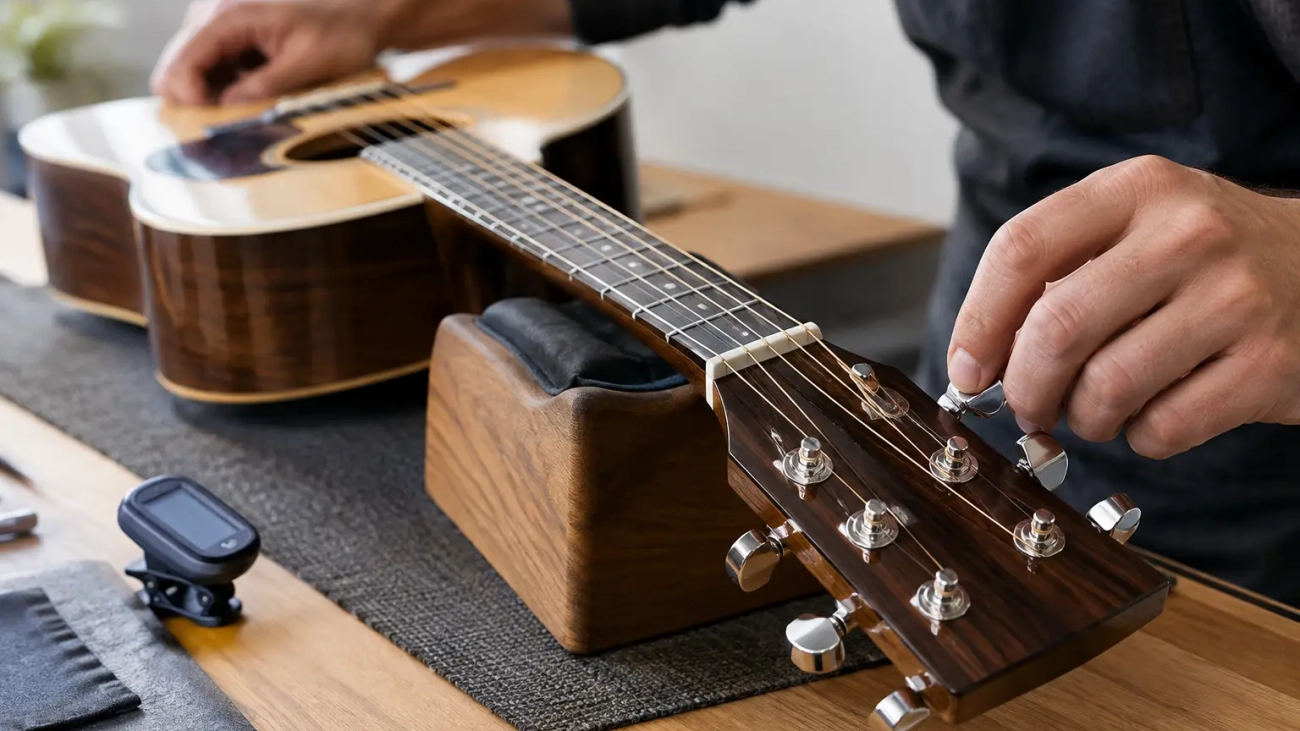
A guitar can feel wonderfully alive under the hands and still reveal a small but consequential flaw when chords rise beyond the fifth fret. If familiar shapes begin to sound tense, or a melody seems to argue with a piano or another guitar, it is time to learn how to test guitar intonation. The process is simple in principle: compare a string’s open pitch with its octave at the 12th fret. Reading what that comparison means requires a more patient ear.
Intonation is not merely a technical specification. It is the agreement between the musical scale laid onto the fingerboard and the vibrating length of each string. On a finely made acoustic instrument, it supports the clarity of a flamenco voicing, the purity of a classical cadence, and the focused harmony of an archtop line. When it is wrong, even beautiful tone can lose its ease.
What Guitar Intonation Actually Measures
A fretted guitar is a tempered instrument. Its frets divide the scale length according to a mathematical compromise that allows the player to perform in many keys. Strings, however, are not perfectly flexible. Their thickness, stiffness, height above the frets, and the pressure used to fret a note all affect pitch.
For this reason, a properly intonated guitar does not mean every note will be laboratory-perfect in every playing condition. It means the bridge and saddle compensation place each string in the best practical relationship with the fret scale. A sensitive player may still hear slight variations across the neck, particularly on a nylon-string guitar or with unusually forceful left-hand pressure. The question is whether those variations remain musical.
Before judging intonation, distinguish it from tuning. A guitar may be perfectly tuned open yet play sharp higher on the neck. Conversely, an instrument with sound intonation will still sound wrong if one or more open strings have drifted from pitch.
How to Test Guitar Intonation Accurately
Use a high-resolution chromatic tuner, preferably one that responds reliably to the fundamental pitch rather than overreacting to upper harmonics. Tune in a quiet room. A clip-on tuner can work well, while a professional strobe-style tuner offers a more revealing view of very small differences.
Begin with fresh or at least stable strings. Old strings develop uneven mass and false harmonics, especially in the wound basses. They can imitate an intonation problem that disappears as soon as the strings are replaced. Stretch new strings gently, retune them several times, and give them enough playing time to settle.
Establish the conditions first
Tune every open string carefully to pitch. Then play for a few minutes before testing. Wood, strings, and the player’s hands respond to temperature and humidity, and a guitar that has just arrived from a cold car or dry hotel room should be allowed to acclimate.
Check that the action feels normal for the instrument. High action asks the player to push the string farther toward the fingerboard, which stretches it sharp. A neck that has moved with seasonal humidity can therefore affect apparent intonation without anything being wrong at the saddle.
For the clearest result, test in normal playing position. Holding the guitar flat on a bench can slightly change neck relief or how a floating bridge settles on an archtop. It is a modest effect, but fine work lives in modest differences.
Compare the 12th-fret harmonic and fretted note
On the low E string, sound the natural harmonic directly above the 12th fret wire. Touch the string lightly and release your finger as the note speaks. This harmonic represents the string divided exactly in half, so it provides a useful reference for the octave.
Now fret the same string at the 12th fret. Use the pressure you would use in music, placing the fingertip just behind the fret rather than in the center of the space. Do not squeeze harder than necessary. Compare the tuner reading of the fretted note with the harmonic.
If the fretted note reads sharp, the vibrating length is effectively too short for that string. If it reads flat, the vibrating length is effectively too long. Repeat this comparison on all six strings, listening as well as watching. A tuner tells you the direction and degree of the discrepancy; your ear tells you whether it matters in the repertoire you actually play.
Test the 12th-fret note several times. A single hard attack can temporarily pull a note sharp, and nylon strings in particular may settle a fraction after being plucked. Let the pitch stabilize before judging it.
Confirm the result with musical notes
The 12th-fret comparison is the standard diagnostic, but it is not the final musical verdict. Check a few fretted notes in the areas you use most. Play an E major chord in first position, then a D or A shape around the fifth to seventh fret. On a classical guitar, try a passage with stopped thirds or sixths higher up the neck. On an archtop, compare unison lines or octave shapes with a reference instrument.
If the tuner suggests a minor discrepancy but chords remain calm and centered, there may be no practical issue. If the octave test appears acceptable while certain chord shapes consistently feel sour, look beyond intonation. Uneven fret wear, excessive nut height, a twisted neck, unsuitable strings, or playing pressure may be part of the story.
Reading Sharp and Flat Results
A sharp fretted 12th-fret note is common when the saddle sits too far forward, but that is not the only explanation. Excessive action is a frequent cause because fretting stretches the string. The same is true of a high nut, though nut height has its greatest influence in the first few frets rather than at the octave.
A flat fretted octave can indicate insufficient saddle compensation, a saddle positioned too far back, or a bridge-placement issue. On an adjustable archtop bridge, careful compensation may be possible as part of a considered setup. On most classical and flamenco guitars, the bone saddle is shaped and set within the fixed bridge design. Adjustment is a skilled task, not a casual turning of a screw.
Look for patterns. If every string is sharp at the 12th fret, the action or overall saddle position may deserve attention. If only the B string is conspicuously sharp, the compensation for that string, its gauge, or the way it is fretted may be the source. If the wound strings behave differently from the plain strings, inspect string condition and gauge before making any permanent judgment.
A few cents of variation is normal territory for an acoustic guitar. The acceptable threshold depends on the instrument, the strings, the action, and the player’s ear. A concert musician performing exposed ensemble work may require a narrower margin than a player whose music favors open strings and expressive bends. Precision matters, but so does context.
Do Not Adjust the Saddle Too Quickly
On a steel-string guitar with an adjustable bridge, players often assume that sharp means moving the saddle back and flat means moving it forward. That principle is correct, but it can become destructive when applied without diagnosing action, relief, fret condition, and string choice first.
On a handcrafted acoustic guitar, the saddle is not simply a part to be moved. Its height, break angle, material, fit in the slot, and shaped contact point all influence transmission into the soundboard. An indiscriminate alteration can solve one reading while diminishing clarity, balance, or response.
Classical and flamenco instruments deserve particular restraint. Their setup often lives within a refined relationship between low action, immediate attack, string choice, and the player’s technique. Filing a saddle lower to address sharp notes may reduce the symptom while introducing fret buzz or altering the guitar’s character. A qualified luthier should evaluate the complete geometry before changing compensation.
If you have changed to a dramatically different string tension or gauge, test again before assuming the instrument requires work. A guitar is voiced and set up around real physical forces. The most appropriate string set is part of its musical design.
When to Ask a Luthier
Seek professional assessment when accurate tuning and stable strings still leave a noticeable, repeatable octave error; when the action has changed; or when buzzing, fret wear, loose braces, a lifting bridge, or seasonal neck movement are present. For a valuable handmade instrument, early attention is almost always wiser than a home repair.
An experienced luthier will not begin by reshaping the saddle. They will inspect relief, nut slots, fret plane, saddle height, string break angle, bridge location, and the condition of the strings. The remedy may be a simple setup. In more complex cases, it may involve fretwork, a new saddle, or a careful correction of bridge compensation.
At Scharpach, the goal of such work is never a sterile tuner reading at the expense of the instrument’s voice. It is to preserve the relationship between player, string, and resonant body so that the guitar speaks truthfully across the fingerboard.
Test intonation whenever you fit a new string set, notice a seasonal shift, or begin preparing important music. Then return to the sound of real chords and real phrases. A fine guitar should not make you negotiate with pitch. It should leave you free to listen deeper.