
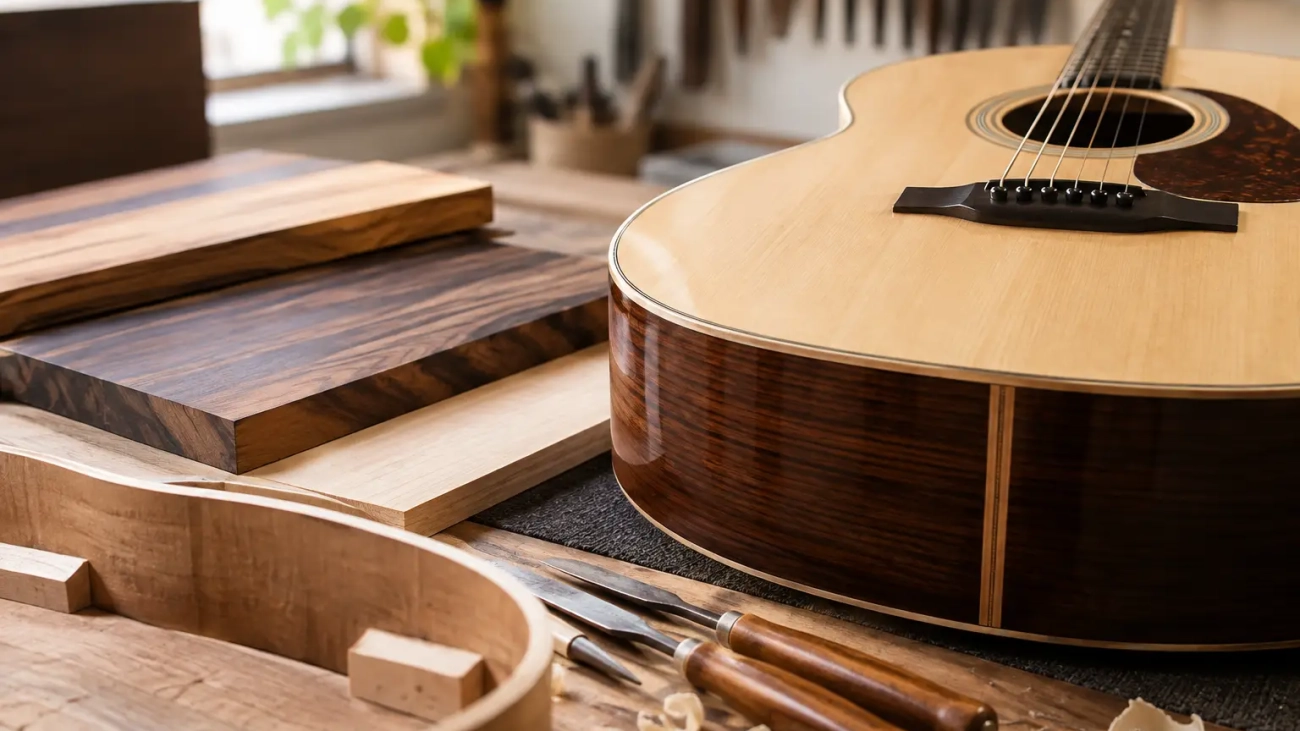
A fine guitar does not merely produce notes. It reveals the weight of a rest stroke, the edge of a flamenco rasgueado, the breath between phrases, and the color a player hears before the hand moves. The best custom guitar options begin with that reality: no two musicians ask the instrument to speak in precisely the same way.
For a serious player, choosing a custom guitar is less about adding decorative features than bringing the instrument into alignment with repertoire, technique, body, and musical intention. A great commission turns those considerations into a coherent whole. Woods, dimensions, voicing, finish, neck shape, and visual restraint all serve the same purpose: giving the player a more direct path to a personal sound.
What Makes a Custom Guitar Worth Commissioning
A factory instrument can be excellent. Its strength is consistency: a familiar model can be played, compared, and replaced with relative ease. A master-built guitar offers something different. It begins with a conversation rather than a specification sheet, and it allows the builder to make decisions around a particular musician instead of an average player.
That distinction matters most when a guitarist has developed clear musical needs. Perhaps the player wants a classical guitar with a singing upper register that stays composed under pressure. Perhaps a flamenco guitarist needs dry attack, rapid response, and a percussive voice that does not become harsh. Perhaps an archtop player needs projection and clarity for ensemble work without sacrificing warmth in a quiet room.
A custom instrument also addresses the physical relationship between guitarist and guitar. Nut width, string spacing, scale length, body depth, neck profile, and setup shape the experience of every practice session and performance. Small changes can have a profound effect. A neck that permits the left hand to remain relaxed may be as consequential as any choice of exotic wood.
The trade-off is that a commissioned instrument requires patience, trust, and a willingness to articulate what one hears and feels. The result should not be a guitar with the longest list of features. It should be an instrument in which every decision belongs.
The Best Custom Guitar Options Begin With the Player
The first question is not which wood is most beautiful or which model is most prestigious. It is how the guitar must function in music. Repertoire, touch, venue, recording needs, and ensemble context should guide the build from the beginning.
Classical guitars for color and refinement
A custom classical guitar is often chosen for its ability to balance clarity with complexity. Concert players may seek strong separation between voices, long sustain, and a broad dynamic range that remains controlled at pianissimo. Others may prefer a more intimate instrument, one that offers rich color beneath the fingers and encourages subtle phrasing.
Top wood is central to this decision. Spruce is frequently prized for headroom, articulation, and tonal evolution over time. Cedar can offer immediate warmth, a darker palette, and a responsive feel under a lighter touch. Neither is universally superior. A player with a powerful right hand and a need for projection may be drawn to one direction, while a color-focused soloist may respond more deeply to another.
Back and side woods further shape the voice. Indian rosewood often brings depth and overtone richness; maple can offer quick response and transparent note definition. The luthier’s voicing is what turns these raw materials into an instrument, however. Wood names alone cannot predict the final character of a guitar.
Flamenco guitars for speed, attack, and character
Flamenco construction follows a different musical logic. The sound must arrive quickly. Notes need a clean, immediate edge, while golpes and rhythmic articulation must remain alive beneath the melody. The ideal balance depends on whether the player favors traditional accompaniment, concert flamenco, or a modern style that asks for greater sustain and tonal breadth.
A blanca, traditionally built with cypress back and sides, is valued for its dry, lively, and percussive nature. A negra, often using rosewood, can bring added depth and sustain while retaining flamenco urgency when carefully voiced. Body dimensions, top thickness, bracing, action, and setup are especially consequential here. A flamenco guitar should never feel like a classical guitar adjusted downward at the bridge. It must be conceived around the rhythmic demands of the style.
Archtops for presence and nuance
A handcrafted archtop occupies its own world. Its carved top and back, arching, graduations, and f-hole design influence how the instrument projects, blooms, and separates notes. For some players, the goal is a dry, immediate sound that holds its place in an ensemble. For others, it is a warmer, more expansive voice suited to chord melody or unamplified solo work.
Scale length, body size, and depth all deserve careful thought. A larger body may offer greater acoustic presence, but it can also feel less comfortable over a long set. The right archtop is not defined by size alone. It is defined by how its response serves the player’s phrasing.
Tonewoods Are a Beginning, Not a Formula
Premium woods deserve reverence, but they should not be treated as a menu of guaranteed outcomes. Two sets of rosewood can differ greatly in density, stiffness, and acoustic behavior. A top that appears visually modest may possess extraordinary musical potential in the hands of an experienced luthier.
Material selection involves listening before the guitar exists. The maker assesses stiffness, weight, tap tone, grain, and structural character, then shapes the build accordingly. Bracing is adjusted to the individual top. Thickness is not chosen by a fixed number but by the wood’s response. This is one reason a handmade instrument cannot be reduced to a set of parts.
Finish is equally important. A thin, carefully applied finish permits the wood to move and vibrate more freely than a heavy coating. French polish remains treasured for its beauty, repairability, and delicacy of sound, though it requires thoughtful care. Other fine finishes may offer greater day-to-day durability. The best choice depends on whether the instrument will travel constantly, live mostly in a climate-controlled studio, or serve both roles.
Ergonomics Should Be Treated as a Musical Decision
Discomfort interrupts attention. When a guitarist compensates for a neck that is too large, a body that is too deep, or a scale that creates unnecessary tension, technique becomes guarded. A commissioned guitar allows the physical design to support freedom rather than demand adaptation.
Neck profile is more nuanced than simply thin or substantial. Shoulder shape, taper, depth at the first and ninth frets, and the transition into the heel all affect the left hand. Nut width and string spacing should reflect the player’s hand size, technical language, and preference for precision or room between strings.
Scale length is another meaningful choice. A longer scale can offer tension, projection, and clarity, while a shorter scale may provide ease of reach and a more yielding feel. Neither is a compromise by definition. The right scale places musical control within reach.
For left-handed guitarists, a true left-handed build is especially valuable. It is not merely a reversed instrument. Bracing, asymmetrical details, setup, and ergonomic considerations should be designed for the player from the outset.
Aesthetic Choices Should Serve Longevity
A bespoke guitar may be visually restrained or richly appointed, but its appearance should remain convincing decades after it leaves the workshop. Select purfling, rosette work, bindings, headstock design, and tasteful inlay can give an instrument a distinct identity without distracting from its form.
The finest visual details feel inevitable. They complement the proportions of the guitar, honor the material, and reward close attention. For many players, simplicity is the most luxurious choice because it allows the wood, the craftsmanship, and the music to remain at the center.
At Scharpach, this balance is approached as an artistic responsibility. A guitar’s visual language is considered alongside its voice and feel, so the finished instrument is unified rather than merely customized.
How to Prepare for a Custom Build Conversation
You do not need to arrive with technical vocabulary or final answers. A skilled builder should help translate musical impressions into practical decisions. Still, a useful conversation becomes richer when a player can describe the instruments they have loved, the limitations they have encountered, and the music they want to make next.
Bring specific references: a recording whose treble voice moves you, a guitar that felt too stiff, a neck that caused fatigue, or a concert hall where your current instrument disappeared. Be candid about how the guitar will be used. A delicate recital instrument and a frequently traveled performance guitar may call for different priorities.
The most helpful closing thought is simple: choose the custom guitar that makes you want to listen more closely to your own hands. That is where a lifelong instrument begins.