
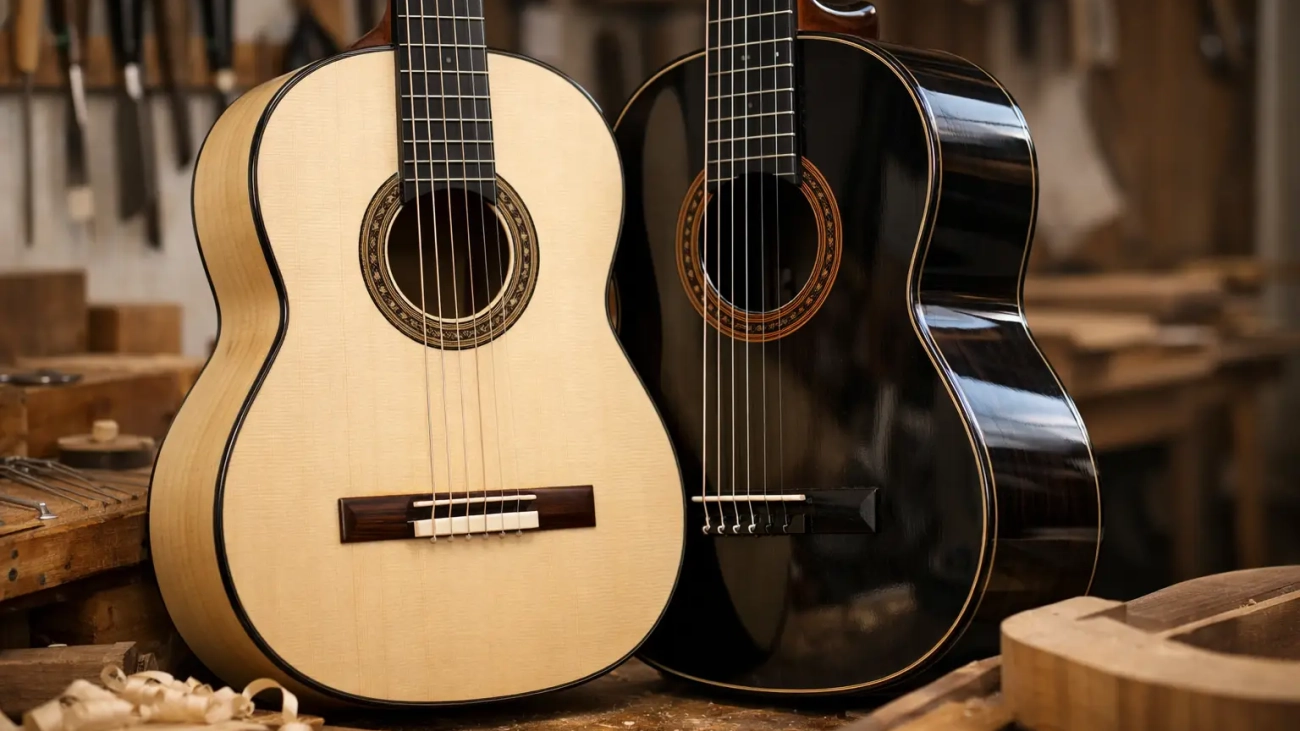
A flamenco guitar reveals itself in the first dry golpe, not in a catalog description. The question of flamenco blanca versus negra matters because these instruments invite different kinds of conversation between player, hand, and room. One may answer with a quick, percussive flash. The other may carry a darker bloom beneath the same falseta. Neither is inherently superior. The right choice is the one that gives greater truth to your compás, touch, and musical imagination.
For serious players, the distinction deserves more than the familiar shorthand of “bright” and “dark.” The woods are part of the story, but so are top thickness, bracing, body geometry, bridge mass, finish, action, and the individual character of the soundboard. A fine flamenco guitar is not defined by a checklist. It is defined by the balance of immediacy, projection, color, and control it places under the player’s hands.
Flamenco Blanca Versus Negra: The Traditional Difference
A traditional blanca is usually built with a European spruce or cedar top and back and sides of Spanish cypress. Cypress is light, stiff, and relatively low in overtone complexity. In a well-made guitar, those qualities contribute to a quick attack, a clear fundamental note, and the dry, rhythmic character so closely associated with traditional flamenco accompaniment.
The blanca often feels direct. Notes rise fast, separate readily, and leave space for the next gesture. Rasgueados can have a crisp edge; picado can speak with remarkable definition; golpes become part of the instrument’s voice rather than an interruption of it. For dancers and singers, that focused response can be deeply practical. The guitar supports the rhythm without spreading too broadly across the ensemble.
A negra traditionally substitutes rosewood for the cypress back and sides. Indian rosewood is common, while Brazilian rosewood, where legally appropriate and responsibly sourced, has long been revered for its exceptional complexity. Rosewood generally adds density, sustain, overtone content, and a deeper low register. The result can be a more expansive tonal field, with greater weight behind the note and a wider palette for solo repertoire.
Yet a negra should not be mistaken for a classical guitar with a golpeador. A true flamenco negra retains the decisive attack, low playing action, and rhythmic authority essential to the style. Its added color should serve flamenco phrasing, not soften it into vagueness. When the design is successful, the player hears both the dry punctuation of the flamenco tradition and a more resonant, shadowed body around it.
What the Player Feels in the Right Hand
The most useful distinction is often physical rather than theoretical. A responsive blanca tends to feel as if it gets out of the way. A light touch produces an immediate answer, and strong right-hand articulation remains sharply outlined. This can make it an extraordinary partner for players whose identity lies in compás, rapid passagework, traditional accompaniment, and the raw elegance of a close, present sound.
A negra may ask the player to listen differently. Its response can be just as fast, but the note may continue to develop after the initial attack. There is often more air around arpeggios, more depth in thumb work, and more tonal shading available when the player changes nail angle or position along the string. For a soloist shaping extended melodic lines, that extra reserve can be compelling.
There are trade-offs. Greater sustain is not always an advantage in flamenco. In fast rhythmic passages, too much lingering sound can blur articulation if the instrument has not been voiced with discipline. Conversely, a very dry blanca may feel limiting to a player who wants a large concert-hall presence or a broad range of colors in contemporary repertoire.
The player’s technique is central. A forceful accompanist and a subtle soloist may draw entirely different conclusions from the same guitar. So may two players with different nails, hand tension, or attack angle. This is why a choice between blanca and negra cannot be reduced to wood species alone.
The Role of Cypress and Rosewood
Cypress gives a blanca much of its historic identity, but not all cypress behaves alike. Spanish cypress, Mediterranean cypress, and carefully chosen alternatives can vary in density, stiffness, and visual character. A seasoned luthier selects each set not simply for appearance, but for the way it will work with a particular top and structural design.
The back and sides influence reflection and resonance, but the top remains the primary voice of the guitar. A stiff, lively spruce top can bring brilliance and headroom to either a blanca or negra. Cedar may offer an earlier sense of warmth and immediacy, though its success depends entirely on how it is voiced. The best choice is not a formula. It is a relationship among materials.
Rosewood brings another set of possibilities. It can give a negra a deeper bass response and a more luxurious envelope around the note, but excessive mass can restrain speed if the rest of the instrument is not sensitively balanced. The goal is never to make the guitar louder merely by making it heavier. It is to create a body that returns energy to the top in a musically useful way.
Finish also matters. A thin French polish or finely applied modern finish allows the wood to move with greater freedom than a heavy coating. On a flamenco instrument, where the player expects immediacy and nuance, that freedom is not a decorative detail. It is part of the response.
Repertoire, Stage, and Musical Direction
A blanca remains the natural choice for many players devoted to traditional toque. Its quick decay and dry authority can feel inseparable from certain forms of accompaniment. In an intimate tablao setting, it can provide exactly the right amount of cut without dominating the cante or dance.
A negra often appeals to concert artists, recording musicians, and players working at the border of traditional and modern flamenco. It can offer a more dimensional recorded sound, particularly when the music asks for lyrical contrast, rich bass lines, or a wider dynamic arc. On a large stage, the added body of a negra may be welcome, although projection depends far more on construction and player control than on rosewood alone.
Many advanced players eventually find a place for both. A blanca can sharpen the rhythmic instinct and expose every detail of the right hand. A negra can reward tonal exploration and bring another range of expression to solo work. Owning both is not necessary, but understanding the contrast can clarify what you want from a single commissioned instrument.
Why Construction Decides More Than Labels
The finest blanca can possess surprising depth. The finest negra can be dry, fast, and explosively percussive. Labels point toward a tradition, not a fixed result.
A builder’s decisions about the soundboard arch, fan bracing, bridge design, air resonance, neck angle, and overall weight shape the guitar’s character at least as profoundly as the wood named on its specification sheet. Even the setup changes the musical experience. Flamenco action must allow the player to drive the guitar, use controlled buzz as part of the language, and execute golpe and rasgueado freely. Too low, and the guitar can choke. Too high, and it loses the intimate, immediate feel that flamenco demands.
This is where a bespoke process has particular value. At Scharpach, the conversation begins with the player rather than with a preset model. A guitarist who loves the dry snap of cypress but needs more bass support may not need to abandon the blanca tradition. Another who desires rosewood’s color but fears losing rhythmic precision may be better served by a carefully restrained negra design. The instrument can be voiced around the player’s touch, repertoire, and sonic priorities.
Choosing the Voice You Will Return To
If you are drawn to fast response, clear rhythmic separation, and the elemental pulse of traditional flamenco, begin your search with a blanca. If you seek more sustain, deeper color, and a broader solo voice while keeping genuine flamenco attack, a negra may speak more directly to you.
But listen beyond the first impression. Play a slow arpeggio, then a demanding picado passage. Accompany a singer if possible. Strike a golpe at different dynamic levels. Notice whether the bass stays articulate when you lean into it, whether the trebles remain alive under a light touch, and whether the guitar gives you more music than you put into it.
The lasting choice is not between pale cypress and dark rosewood. It is between an instrument that merely produces flamenco sounds and one that makes you want to keep speaking through it.