
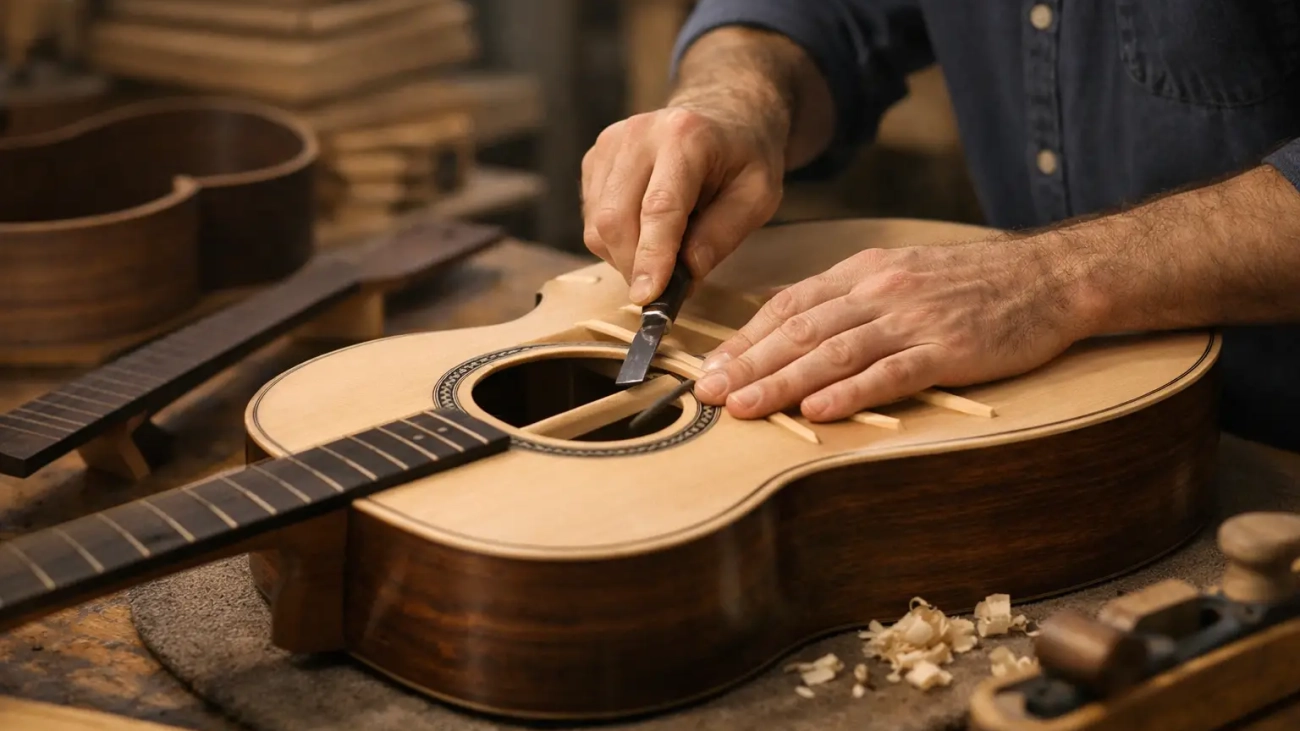
A fine guitar begins long before the first shaving falls from a plane. To understand how a handmade guitar is built is to understand a series of informed decisions: which piece of spruce can carry a player’s attack, how a back should reflect the top’s energy, where a neck should meet the body, and how much resistance the strings should offer the hand. The finished instrument may appear simple. Its simplicity is the result of hundreds of choices made in service of sound.
For a concert classical guitar, a flamenco instrument, or an archtop, the process is never merely a sequence of operations. Each family has its own demands. A classical guitar may seek depth, color, and an even response across the registers; a flamenco guitar may favor immediacy, dryness, and rhythmic bite; an archtop must balance projection, clarity, and a distinctively articulate voice. The builder’s task is to bring materials, structure, and player into agreement.
How a Handmade Guitar Is Built Starts With Listening
Before wood is selected, the maker must listen to the musician. A serious commission begins with questions that cannot be answered by a catalog specification alone. What repertoire does the player perform? Is the touch forceful or light? Does the guitarist need a broad tonal palette for the concert hall, a focused voice for recording, or fast, percussive response for flamenco? Does a left-handed player need a true mirrored build rather than a compromised adaptation?
Ergonomics belong to this conversation as much as tone. Scale length, nut width, string spacing, neck profile, fingerboard radius where appropriate, body depth, and arm comfort all affect the relationship between musician and instrument. A guitar that sounds magnificent but causes fatigue has not fully served its purpose. Conversely, an easy-playing instrument that lacks tonal substance will eventually leave an expressive player wanting more.
These decisions establish the architecture of the guitar. They also define the trade-offs. More mass may bring a certain solidity and sustain, but it can reduce the quickness of response. A longer scale can increase clarity and tension, yet may not suit every hand or technique. There is no universally perfect specification, only a coherent design for a particular musical voice.
Tonewood Is Chosen, Not Simply Ordered
The character of a handmade guitar is deeply tied to its woods, especially the soundboard. Spruce and cedar remain enduring choices for classical and flamenco guitars because each offers a distinctive balance of stiffness, weight, attack, and tonal development. Within either species, however, no two sets are identical. Grain, density, elasticity, cut, and seasoning all matter.
A luthier evaluates a top with the hands and ears as well as the eye. It is assessed for its stiffness along and across the grain, its weight, its tap response, and the promise it holds once brought to a refined thickness. A visually flawless top is not automatically the most musical one. The material must earn its place through its acoustic potential.
Back and side woods shape the way the guitar supports and returns energy from the soundboard. Rosewood may offer complexity, depth, and a long, enveloping sustain. Maple can bring separation, immediacy, and a more transparent fundamental. Cypress, traditionally associated with flamenco, contributes a direct and lively character. The right choice depends on the player’s desired response, not on fashion alone.
The neck, fingerboard, bridge, and internal reinforcement are selected with equal care. Stability is essential, but so is balance. Every component adds or redirects mass, and every gram can influence the way the instrument vibrates. Premium work is not defined by using the most exotic material in every location. It is defined by using the right material for the musical purpose.
The Body Takes Shape Through Controlled Precision
Once the woods have been prepared, the body begins to emerge. The soundboard and back are joined from matched halves, then brought gradually to their intended thicknesses. This is among the most consequential stages in the build. A difference that appears almost invisible to the eye can change the top’s flexibility, headroom, and capacity for color.
The sides are thinned, bent with heat, and fitted into the mold that establishes the guitar’s outline. The process requires patience. Wood has memory, and it must be guided rather than forced. A clean bend preserves both the material’s integrity and the graceful line of the instrument.
Rosettes, purflings, and bindings are then integrated into the work. These details protect vulnerable edges and define the guitar’s visual identity, but they should never become decoration at the expense of proportion. On a fine instrument, ornament follows the same principle as the construction: it should feel inevitable, harmonious, and lasting.
Bracing Gives the Soundboard Its Direction
Inside the guitar, the bracing is its hidden architecture. Struts of carefully shaped spruce support the top while allowing it to move. Their pattern, height, profile, and placement influence the balance between bass and treble, the speed of attack, sustain, dynamic range, and the way notes bloom after the initial stroke.
Bracing is not a fixed recipe. A builder may begin with a trusted structural language, but the individual top guides the final decisions. A particularly stiff top may need a different approach from a more flexible one. The goal is neither maximum stiffness nor maximum freedom. It is controlled vibration – enough support for longevity, enough movement for the guitar to speak.
This is why two guitars built to the same dimensions can still sound distinct. Wood is alive with variation. The master luthier does not erase that individuality; he directs it.
Voicing Is Where Craft Becomes Musical Judgment
After the body is assembled, the guitar enters one of its most subtle phases: voicing. The maker listens to taps, feels the response of the soundboard, and refines certain areas by minute increments. This is not guesswork, nor is it an exercise in making a top as thin as possible. It is a disciplined conversation with the material.
Voicing determines much of the instrument’s personality. A concert player may want notes that carry into a hall without becoming harsh. A flamenco player may want the response to leap forward under rest strokes and rasgueados. An archtop player may seek a dry, clear attack that retains warmth at lower dynamics. The desired sound changes the decisions made at the bench.
At Scharpach, this stage reflects more than four decades of accumulated observation: the understanding that resonance cannot be reduced to a single measurement. A guitar must be judged in relation to the hands and ears that will bring it to life.
Neck, Frets, and Geometry Create the Player’s Connection
A handmade neck is carved and refined for more than appearance. Its profile must offer support without feeling intrusive, and its geometry must remain true under string tension. The neck angle, fingerboard plane, bridge height, and saddle position are calculated as a system. Precision here determines whether the guitar can achieve both healthy break angle and a comfortable action.
Frets are installed, leveled, crowned, and polished with painstaking attention. Their work is often felt more than seen. Clean fretwork allows notes to ring clearly, intonation to remain trustworthy, and shifts to feel natural beneath the hand. For the advanced player, these details are not luxuries. They are the difference between an instrument that resists expression and one that disappears into it.
The final setup is tailored to the player and the instrument’s purpose. A low flamenco action may invite the controlled buzz that gives the style its character, while a classical concert guitar may require a different balance of clearance, power, and refinement. Humidity, string choice, and playing style all matter. Setup is not a final checkbox. It is the last act of fitting the guitar to its musician.
Finish Protects Without Silencing
A finish must protect the wood from handling and changing conditions, but it also becomes part of the acoustic system. A heavy finish can restrain the movement of a responsive top. A finish that is too delicate may not offer sufficient practical protection. The finest work seeks a thin, even application that preserves the tactile and visual life of the wood.
Whether French polished or finished through another carefully controlled method, the surface is built gradually. It is sanded, cured, and refined until the wood retains depth beneath the gloss or satin sheen. The aim is not a plastic perfection. It is a finish with clarity, elegance, and a sense that the material beneath it can still breathe.
A new handmade guitar is complete when it leaves the workshop, but its voice is not frozen there. With regular playing, the soundboard learns the energy of the strings. Notes may open, the dynamic range may broaden, and the relationship between player and instrument deepens. The right question is not simply whether a guitar is beautiful on the day it arrives. It is whether it gives you more to say each time you pick it up.