
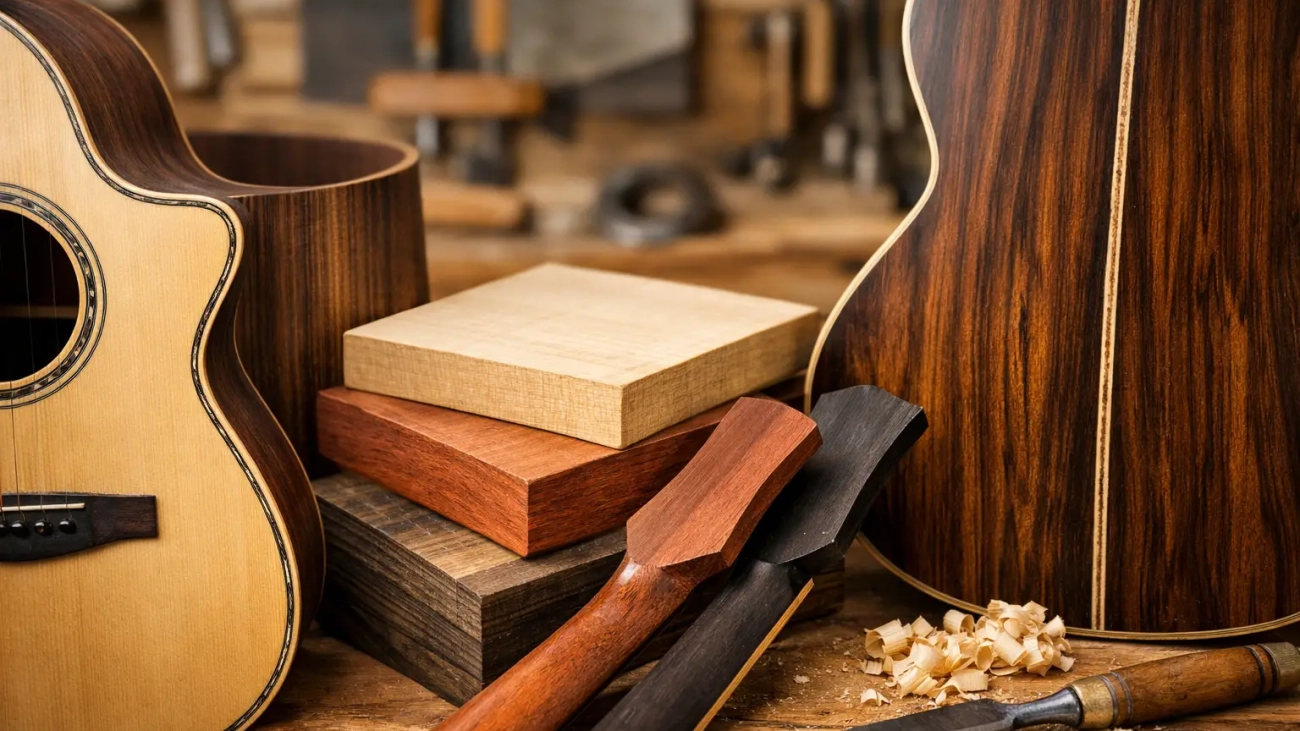
A guitarist with a developed ear rarely asks for a wood by name alone. They ask for bloom in the trebles, a firmer low end, quicker response under the right hand, or a voice that opens gradually over decades. That is where a guide to premium guitar tonewoods becomes useful – not as a catalog of exotic species, but as a way to understand how material shapes musical character.
In fine guitar making, tonewood is never a fashion choice. It is a structural and acoustic decision, one that affects stiffness, damping, weight, overtone content, projection, and the tactile experience of the instrument in the hands. Yet even the finest wood does not guarantee a fine guitar. The quality of selection, seasoning, thicknessing, bracing, and voicing matters just as much. Premium tonewoods reveal their value when they are handled with judgment.
What premium tonewoods really mean
The word premium is often used too casually. In a serious luthiery context, it refers first to suitability, then to rarity. A premium top set is not merely visually clean or old. It must have the right stiffness-to-weight relationship, consistent grain, healthy tap response, and the structural integrity to support a refined voice over time. The same principle applies to back and sides, neck stock, and fingerboard material.
A master-grade set may display exceptional medullary ray, elegant figure, or striking symmetry, but visual beauty is only one part of the story. The more consequential question is whether the wood contributes to the desired musical result. A concert classical guitar intended for color, balance, and sensitivity under the fingers asks for different qualities than a flamenco guitar built for immediacy, dryness, and percussive attack. An archtop intended for clarity and projection under a plectrum places different demands again.
This is why the best guide to premium guitar tonewoods begins with the player, not the lumber rack.
The soundboard – the heart of the instrument
If one wood choice carries the greatest acoustic consequence, it is the top. The soundboard is the primary engine of the guitar’s voice, and small differences in density and elasticity can produce substantial changes in response.
Spruce
Spruce remains the benchmark for many master-built instruments because it offers remarkable stiffness with relatively low weight. That combination tends to support projection, headroom, and dynamic range. In practical terms, spruce can give a guitar composure under stronger attack while preserving articulation and separation.
European spruce is often prized for its complexity, refinement, and balance. It can offer a noble clarity, with trebles that remain poised and basses that speak without bloat. Cedar, however, is not simply the warmer alternative to spruce, nor is spruce always the more powerful choice. Individual sets vary, and so does the builder’s approach.
Cedar
Western red cedar is favored by many players for its immediacy. It often yields a quicker sense of response, with a rounder attack and an inviting overtone character that can feel intimate from the first notes. For players who want a mature, expressive voice early in the instrument’s life, cedar can be deeply compelling.
That said, generalizations only go so far. Some cedar tops are surprisingly clear and focused. Some spruce tops are richly colored and lyrical. Premium material broadens the range of what each species can do, which is one reason experienced builders select by set rather than by stereotype.
Back and sides – the architecture of color
The back and sides influence reflection, sustain, overtone structure, and the perceived shape of the note. They do not replace the role of the top, but they strongly affect how the instrument frames and projects its voice.
Rosewood
Among luxury instruments, rosewood occupies a central place for good reason. It is often associated with depth, overtone richness, strong bass presence, and a sense of spaciousness in the sound. Indian rosewood is admired for its consistency, musical warmth, and broad versatility. It can support a sophisticated concert voice without becoming unruly.
Brazilian rosewood has long held a near-mythic status. At its best, it combines clarity, power, complexity, and a striking bell-like quality that can feel almost orchestral. It is also rare, heavily regulated, and not automatically superior in every build. For some players, its mystique exceeds its practical advantage. For others, it offers exactly the kind of dimensionality they have spent years searching for.
Maple
Maple offers a different proposition. It tends to emphasize transparency, note definition, and speed of response over lush overtone bloom. On an archtop, that clarity can be especially valuable. On a classical or crossover design, maple can produce an elegant directness that rewards players who want the fundamental note to remain at the center.
Maple is sometimes described as bright, but that can be misleading. In a well-voiced instrument, it is better understood as articulate. Its restraint in the overtone field can create a very sophisticated kind of beauty.
Cypress and walnut
For flamenco guitars, cypress remains a defining material. Its light weight and responsive nature support the dryness, immediacy, and snap that players often seek. The result is less about sustain for its own sake and more about rhythmic life, attack, and control.
Walnut occupies an intriguing middle ground. It can offer some of the clarity associated with maple alongside a touch more warmth and texture. For players who want distinction without excess, walnut can be a deeply musical choice.
A guide to premium guitar tonewoods must include feel
Tone is only part of the experience. Premium tonewoods also shape the physical relationship between player and instrument. Neck wood affects stability and tactile comfort. Fingerboard material influences surface feel, attack, and wear resistance. Overall body weight changes how a guitar rests against the player and how freely it seems to vibrate.
Ebony fingerboards are favored for their density, durability, and crisp feel beneath the fingers. They contribute a sense of precision and authority. Rosewood fingerboards can feel slightly warmer in the hand, with a subtly different tactile character. Neither is universally better. The right choice depends on repertoire, touch, and the overall design philosophy of the instrument.
A player commissioning a bespoke guitar should also consider how finish interacts with wood choice. A heavily built finish can inhibit responsiveness, while a refined varnish system allows the material to move more naturally. This is where craftsmanship becomes inseparable from acoustics.
The trade-offs that matter most
Experienced players know that every tonal gain comes with a corresponding compromise. Greater overtone richness can reduce apparent separation. A faster, drier attack may come with less lingering sustain. A very light build can feel thrillingly alive, but it also demands structural wisdom and careful material selection.
This is why wood should never be chosen in isolation. A cedar top paired with rosewood will not behave like cedar paired with maple. The same species will sound different depending on scale length, body geometry, arching, bracing, and the builder’s voice. Premium tonewoods do not remove these variables. They make them more consequential.
For that reason, the most meaningful conversations are not about the best wood in the abstract. They are about the best wood for a specific player. A soloist seeking projection in a hall, a recording artist needing balance under microphones, and a collector wanting tonal sophistication with visual restraint may all arrive at different answers.
How a master luthier evaluates wood
The finest sets are judged by far more than appearance. They are flexed, tapped, weighed, and studied for how they respond under the hand. Grain width is considered, but not worshiped. Perfect symmetry can be beautiful, yet a less visually uniform set may possess exceptional acoustic promise.
Age and seasoning matter as well, though not in simplistic terms. Wood must be stable, properly stored, and fully understood. A set that has matured well can offer confidence and predictability. Still, old wood is not a magic ingredient. It becomes meaningful when the luthier knows how to read it.
This discernment is part of what separates a bespoke instrument from a production model. In an atelier such as Scharpach, wood selection is not merely inventory management. It is an act of authorship.
Choosing tonewoods for the instrument you actually want
For classical players, the choice often comes down to whether they want greater immediacy or greater headroom, more overtone bloom or more linear clarity. For flamenco players, speed, dryness, and percussive response often take precedence over sheer sustain. For archtop players, definition, projection, and tonal focus become central.
The right path usually begins with listening to your own technique. Do you drive the string hard or work with a more economical touch? Do you want the guitar to forgive, to resist, or to answer instantly? Are you building for the studio, the stage, or a lifetime of private playing? Premium tonewoods can support all of these aims, but they do so in different combinations.
The most rewarding instrument is rarely the one built around generalized assumptions. It is the one whose materials have been chosen with enough care that the guitar feels inevitable from the first phrase. That is the real value of understanding tonewoods. Not prestige for its own sake, but a clearer path to an instrument that speaks in your own voice.
A fine guitar should never feel like a compromise disguised as luxury. It should feel like recognition – of your ear, your hands, and the sound you have been trying to find.