
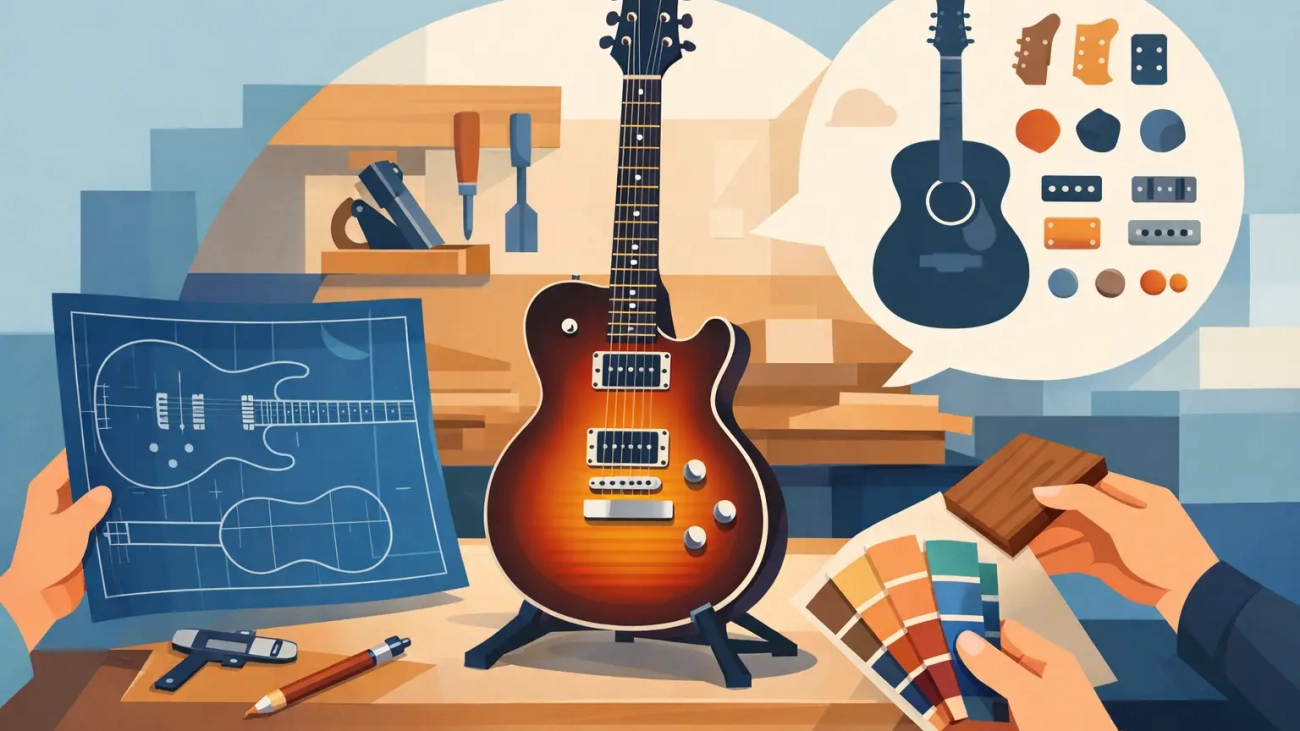
A fine custom guitar begins long before the first piece of wood is shaped. It begins when a player recognizes that no factory instrument, however good, quite answers the hand, ear, and musical intention. If you are wondering how to commission a custom guitar, the real question is not simply what to order. It is how to translate your musical identity into an instrument that will serve you for decades.
That process deserves care. A commissioned guitar is not a luxury because it is rare. It is valuable because it can be made with purpose at every level – response, balance, neck shape, scale length, projection, ornament, and the subtle feel that turns a good instrument into a trusted companion.
How to commission a custom guitar with clarity
The first mistake many players make is approaching a commission as if they were filling out a product order form. A serious luthier is not assembling options from a catalog. He is building a musical instrument around a player.
Before discussing woods or appointments, start with your playing life. Consider what you perform most often, how aggressively or delicately you attack the string, what range of color you seek, and where your current instrument falls short. A classical guitarist pursuing transparency and separation in polyphonic repertoire will not need the same voice as a flamenco player seeking immediacy, dryness, and percussive response. An archtop player may prioritize clarity under a pick, controlled sustain, and projection that sits cleanly in an ensemble.
This stage requires honesty. Many players describe the sound they admire in recordings, but the better question is what they need under their own hands. A guitar that sounds magnificent across the room may still feel resistant, overly stiff, or tonally mismatched to the repertoire you actually play.
Choose the right luthier, not just the right spec sheet
Commissioning succeeds or fails with the maker. Technique, taste, experience, and the ability to listen matter more than a long list of customizable features.
A skilled luthier brings more than craftsmanship. He brings judgment. He understands how top thickness, bracing, body geometry, scale length, neck mass, finish, and wood selection interact. He also knows when to guide a player away from a choice that sounds attractive in theory but works against the instrument’s musical purpose.
This is where experience becomes decisive. An established atelier such as Scharpach does not simply offer bespoke dimensions and decorative options. The value lies in decades of tonal refinement, in knowing how materials behave over time, and in building with a clear understanding of resonance rather than novelty.
Look for a builder whose body of work reflects the musical tradition you inhabit. Classical, flamenco, and archtop guitars are distinct worlds. A luthier may be excellent in one and less compelling in another. Listen to recorded examples if available, study consistency across instruments, and pay attention to whether the builder speaks about sound in a precise and credible way.
Define tone before aesthetics
Most players are naturally drawn to visual choices first. Exotic back and sides, rosettes, bindings, purfling, and special details are exciting, but they should come after the sound concept is understood.
When discussing tone, be specific without becoming rigid. Terms like warm, dry, open, dark, focused, fast, lyrical, woody, and bell-like are useful if they are tied to real musical goals. You may want stronger bass support without losing note separation. You may want a quicker attack, more headroom, or a sweeter treble register. Those are meaningful starting points.
At the same time, accept that guitar making is not mechanical. A luthier can guide an instrument toward a tonal profile, but wood remains an organic material. The goal is not laboratory sameness. It is a coherent voice shaped with intention.
This is also the moment to discuss where and how you play. Concert hall projection, studio sensitivity, and intimate salon playing do not always ask for the same balance. An instrument made for a large dynamic range may feel different from one designed for immediate responsiveness at lower volume.
Fit and ergonomics are not secondary
Many custom commissions focus heavily on sound and too little on physical relationship. Yet the body only reveals tone fully when the player is at ease.
Neck profile, nut width, string spacing, scale length, body depth, upper bout feel, and setup all influence whether a guitar invites expression or fights it. Small variations matter more than many players expect. A neck that is fractionally too full, a scale length that creates avoidable left-hand strain, or a body dimension that unsettles your posture can limit your playing every day.
For left-handed players, a true custom build is especially meaningful. Rather than accepting compromise or a mirrored adaptation of a standard model, the instrument can be conceived from the start for the player’s dominant orientation and technique.
If you have physical sensitivities, an injury history, or very specific preferences developed over years of playing, say so early. The right custom guitar should not ask you to adapt to it more than necessary. It should feel inevitable in the hands.
Woods, construction, and finish all shape the result
Once your tonal and ergonomic goals are clear, material choices can be made intelligently. This is where romance must be balanced with discipline.
Top wood is central to the instrument’s voice, but it is only part of the picture. Spruce and cedar, for example, are often discussed as opposites, yet broad assumptions can mislead. Individual sets differ, and the maker’s voicing determines much of what the player ultimately hears. Back and sides influence reflection, color, sustain, and character, but they do not act in isolation from the top, air volume, and bracing concept.
The same applies to finish. Varnish and other finishing approaches affect both beauty and vibration. A refined finish should protect the instrument while allowing the wood to breathe and respond. The best makers treat finish not as decoration alone, but as part of the acoustic equation.
A serious luthier will help narrow choices based on function, not fashion. That may mean steering you toward restraint. Simplicity, when executed at the highest level, often ages more beautifully than excess.
Expect dialogue, not instant decisions
The best commissions develop through conversation. A luthier may ask what instrument you play now, what you admire in it, what frustrates you, what repertoire defines your musical life, and how your ear has changed over time. These are not polite preliminaries. They are part of the design work.
You do not need to arrive with every answer. In fact, many successful commissions begin with a player who knows the feeling they are chasing but needs expert guidance to translate it into structure and material. That is part of the craft.
Be wary of over-specifying every detail because the internet has made information easy to collect. Knowledge is useful, but a custom instrument is not improved by forcing too many fixed ideas onto it. Some of the most sophisticated decisions are the ones left in the hands of a maker who has earned trust.
Time, cost, and expectations
A master-grade commission takes time. That is not a delay in the ordinary sense. It is part of the making.
Wood selection, voicing, construction, curing, finishing, setup, and final refinement cannot be rushed without consequence. If you are commissioning an heirloom instrument, speed should not be the priority. Patience is part of what you are investing in.
Cost follows the same logic. A bespoke guitar is expensive because expertise, labor, select materials, and artistic judgment are expensive. The question is not whether a commissioned instrument costs more than a production model. It does. The real question is whether your playing life justifies an instrument made without compromise.
For many serious musicians, the answer is yes. Not because every custom guitar is automatically better, but because the right one can remove friction between intention and sound in a way no generic instrument can.
How to know you are ready to commission
You are ready when you can hear the gap between what you have and what you need. You are ready when convenience matters less than fit, when sound matters more than branding, and when you want an instrument with a voice that belongs to no production run.
You are also ready when you understand that a custom guitar is a collaboration. It asks for trust, clarity, patience, and discernment from both player and maker.
The most rewarding commissions are rarely the most extravagant. They are the ones in which every choice serves music. A guitar built with that level of purpose does more than satisfy preference. It becomes a faithful extension of touch, repertoire, and character.
If you approach the process with a clear ear and the right luthier beside you, the result is not merely a custom object. It is an instrument that grows more personal with every year it is played.