
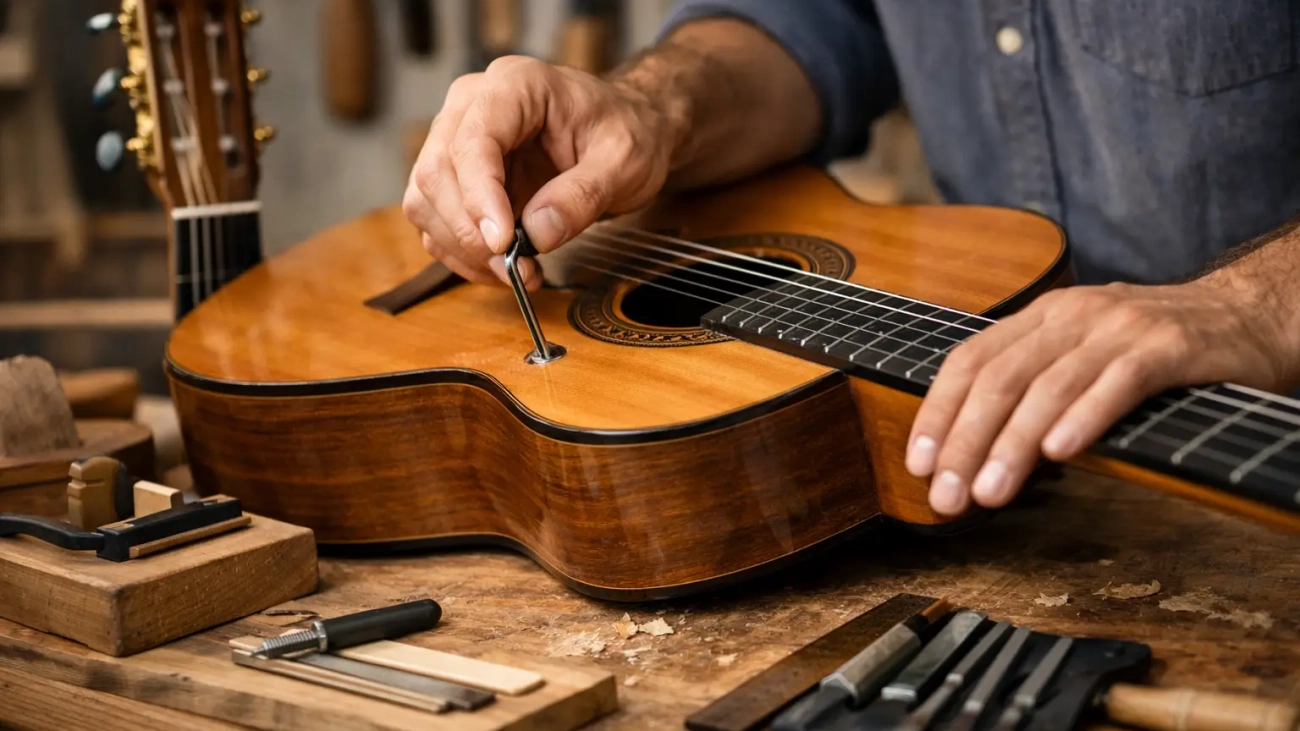
A flamenco guitar reveals its character in the first rasgueado. If the right hand meets resistance, if the left hand must work too hard for a clean ligado, or if a golpe lacks its crisp punctuation, the instrument may be beautifully made yet not fully suited to its player. Knowing how to customize flamenco guitar playability begins with recognizing that playability is not one measurement. It is the living relationship between hand, string, neck, top, setup, and musical intention.
For the serious flamenco player, the goal is not simply the lowest possible action. It is an instrument that responds immediately, tolerates expressive attack, and remains clear when the music asks for speed, force, and silence in quick succession.
Begin With the Player, Not the Specification
A good custom flamenco guitar does not start with a list of fashionable dimensions. It starts with the player’s technique. A concert guitarist who uses broad, forceful rasgueados may need a different balance of string tension and action than a player whose language centers on delicate arpeggio, picado precision, and modern harmonic color.
Hand size matters, but so does hand posture. A player with smaller hands may assume that a narrow nut is the answer, yet an overly narrow string spacing can make clean left-hand placement less secure. Another player may prefer the familiar 52 mm nut width of a traditional flamenco guitar but benefit from a subtly shaped neck that fills the hand less deeply. The right dimension is the one that allows the hand to remain relaxed while preserving accuracy.
A consultation should also account for repertoire. Traditional toque often rewards dryness, immediacy, and a percussive edge. Contemporary flamenco may ask for more sustain, broader dynamic range, and greater separation between voices. Neither approach is superior. They simply place different demands on the instrument.
Customize Flamenco Guitar Playability Through Setup
Setup is the most direct route to changing how a flamenco guitar feels, and it is also where small adjustments carry significant consequences. Flamenco action is generally lower than classical action, particularly at the 12th fret. This encourages the quick release, direct contact, and characteristic controlled buzz many players seek.
But “low” is not a universal prescription. A guitarist with a powerful attack may find an extremely low setup too limiting, producing a rattle that overwhelms the note rather than enriching it. A lighter player may enjoy the same setup as fast and alive. The desirable flamenco buzz is a color at the edge of the note, not a permanent veil over every phrase.
Action, saddle, and break angle
The saddle determines much of the final feel under the left hand. Lowering it reduces string height, but it also changes the break angle over the saddle and can reduce the energy transferred to the top if taken too far. A refined setup protects both comfort and projection.
The height of the strings at the bridge deserves equal attention. A bridge that is too low can leave little room for future adjustment and may compromise the player’s right-hand clearance. A well-conceived custom build establishes the correct geometry from the beginning, rather than forcing a dramatic setup onto an instrument that was not designed for it.
Nut height and first-position freedom
The nut is often overlooked because its influence is most apparent in first position. When the nut slots are too high, basic chords feel stiff and cejillas become unnecessarily tiring. When they are cut with precision, the guitar feels more open before a note has even traveled up the fingerboard.
This is delicate work. Slots must support the string cleanly, release it without binding, and preserve accurate intonation. It is not a place for casual experimentation with a file. On a fine instrument, a few careful strokes can transform comfort. A few careless ones can require a new nut.
Relief and fretwork
A flamenco neck is commonly set close to flat, but perfectly flat is not always the same as perfectly playable. The fret plane, string gauge, humidity, and the player’s attack all influence the ideal amount of relief. Exceptional fretwork allows low action without random choking, while a poorly leveled fretboard can make even a higher setup feel unreliable.
For this reason, playability should be assessed across the whole neck. Test picado passages, barrés, slurs, and notes high on the first string. A guitar that feels effortless in one position but uneven elsewhere has not yet found its proper adjustment.
Neck Shape and Scale Length Shape the Left Hand
The neck is where a custom guitar becomes quietly personal. Its profile is not merely a visual detail. It determines how the thumb rests, how quickly the hand shifts, and how much fatigue accumulates through a long rehearsal or performance.
Some players prefer a more pronounced traditional profile because it offers a secure point of reference during forceful playing. Others favor a slimmer, gently rounded shape that permits freer movement. The distinction can be felt more clearly than described, which is why direct conversation and, when possible, comparison with guitars the player already knows are so valuable.
Scale length also shapes the response. A 650 mm scale remains a familiar center for many flamenco players, offering clarity, projection, and a certain tautness beneath the fingers. A slightly shorter scale can soften the feel and reduce reach, while a longer scale may provide added tension, articulation, and headroom for a strong right hand.
There is always a trade-off. Less tension can make ligados feel inviting, but may reduce the resistance some players rely on for aggressive picado. More tension can strengthen definition, but it asks more of the left hand. String selection can fine-tune this relationship, yet it cannot replace a scale length and neck design chosen with purpose.
The Right Hand Needs Its Own Consideration
Flamenco playability is often discussed as a left-hand issue, but the right hand is where the guitar’s identity becomes audible. The distance from strings to soundboard, the bridge’s placement and shape, the position of the golpeador, and the top’s response all affect the player’s sense of command.
A golpeador must protect the top without feeling intrusive. Its placement should accommodate the player’s natural golpe technique, whether the strike lands near the bridge, closer to the soundhole, or moves between both. The surface must be cleanly fitted and visually restrained, allowing the guitar’s materials to remain present while serving the demands of the music.
String spacing at the saddle also deserves individual attention. Wider spacing can give the right hand more room for rasgueados and arpeggios, while a more compact layout may suit players accustomed to a narrower attack zone. The correct choice depends on the player’s hand, nails, and habitual motion, not an abstract rule.
Materials and Construction Set the Boundaries of Feel
Setup can refine a guitar, but the instrument’s fundamental response comes from its construction. A cypress-bodied flamenco blanca is often prized for its quick attack, dry decay, and percussive clarity. Rosewood can bring greater depth, sustain, and a darker field of color. These are tendencies, not guarantees. The individual top, its thicknessing, bracing, arch, and the maker’s voicing determine the final voice.
For a player seeking maximum immediacy, a lightly responsive top may be compelling. It can speak with very little effort and turn a small gesture into sound. Yet a top built too lightly for a player’s attack may lose composure under pressure. Conversely, a guitar with greater structural reserve may ask for more energy but reward the player with projection and clarity in a large room.
Finish matters as well. A traditional French-polished shellac surface is exceptionally thin and can allow a guitar to vibrate with remarkable freedom. It also requires a more attentive owner. A more protective finish may better suit frequent travel or demanding stage use, though its application must remain restrained if the instrument is to retain sensitivity. The finest choice is the one that respects both the sound and the life the guitar will lead.
Let the Guitar Develop With You
A handcrafted flamenco guitar is not frozen on the day it leaves the workshop. Wood settles, the top matures, and a committed player gradually learns where the instrument gives most generously. Seasonal humidity can alter action and response enough to justify periodic assessment, especially in regions with pronounced climate changes.
That is why a custom commission should include an honest view of the future. A mature player may know precisely what is needed from the first day. Another may need an instrument designed with thoughtful room for adjustment as technique evolves. At Scharpach, this is understood as part of the relationship between maker, musician, and instrument rather than an afterthought.
The most satisfying flamenco guitar is not the one that conforms to the lowest numbers on a setup chart. It is the one that disappears beneath the hands at the moment music begins, leaving the player free to shape rhythm, color, and silence with complete conviction.