
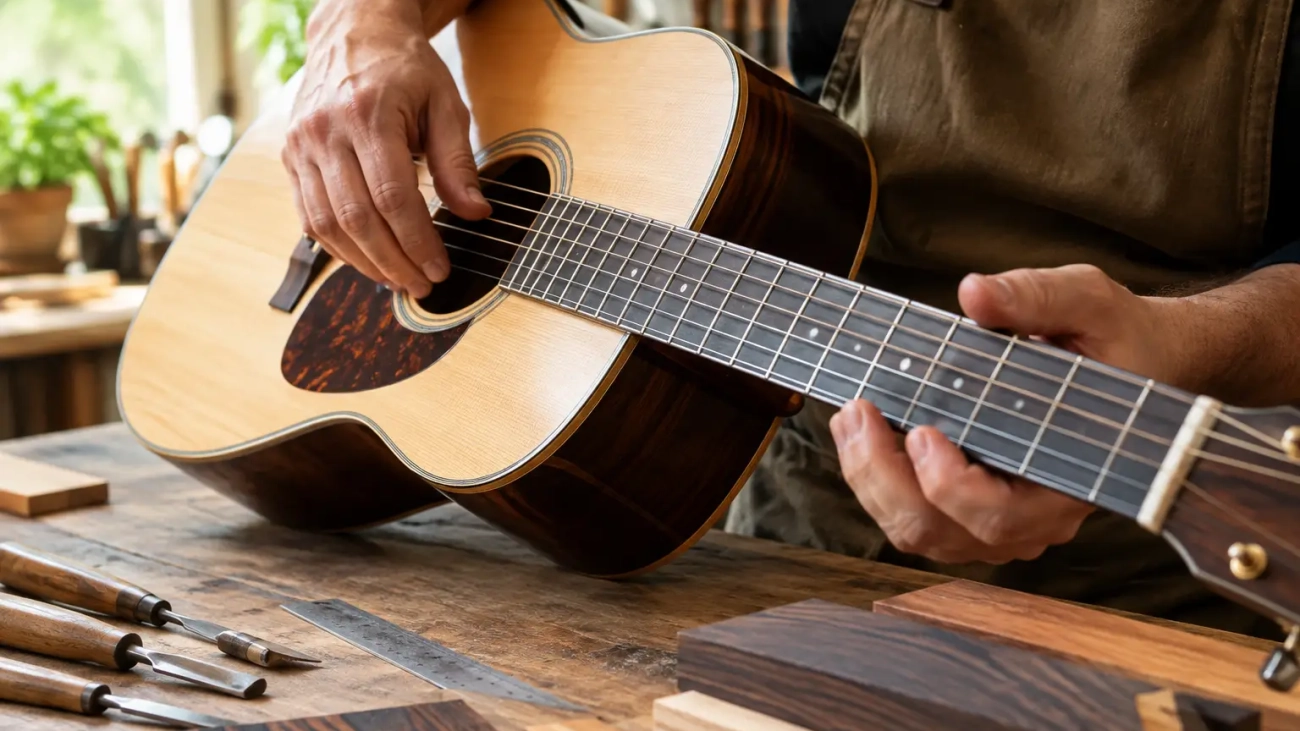
A guitar may be beautifully made, richly voiced, and finished with rare wood, yet still resist the player at the very moment expression is required. What affects guitar playability is not one isolated measurement. It is the quiet agreement between the player’s hands, the instrument’s geometry, and the way every component responds under tension.
For a serious guitarist, playability is not merely low action or an easy first position. It is the confidence that a phrase will speak when asked, that a shift will land without strain, and that the instrument will offer resistance of the right kind. A fine guitar should not feel inert or overly compliant. It should feel alive, clear, and proportioned to the player who holds it.
What Affects Guitar Playability Beyond String Height
String action receives most of the attention because it is immediately felt. Action is the distance between the strings and frets, and it has a direct influence on the force needed to stop a note. If it is too high, the left hand works harder, intonation can suffer, and extended playing becomes tiring. If it is set too low, the strings may buzz, lose dynamic headroom, or feel unstable under a more assertive touch.
But low action is not the same as good action. A flamenco player may welcome a close, immediate response with a measured amount of percussive character. A classical player shaping a wide dynamic range may need more clearance, particularly with a strong right hand. An archtop player may prioritize clean articulation, accurate intonation, and a setup that supports both chord melody and single-note lines.
The right action is therefore a relationship, not a number. It depends on string tension, scale length, fretwork, fingerboard relief, playing style, and the musical demands placed on the instrument.
Neck Relief and the Path of the String
Relief is the slight forward curve built into or adjusted within the neck to give vibrating strings room to move. Too little relief can produce buzzing, especially in the lower positions. Too much can make a guitar feel unnecessarily stiff and raise the action through the middle of the fingerboard.
The best relief is often nearly invisible, but its effect is unmistakable. It allows the string to travel cleanly while preserving a close connection between fingertip and fingerboard. On a finely made guitar, this relationship is considered alongside the player’s string gauge, tuning, touch, and preferred repertoire rather than treated as a generic factory specification.
Fretwork: Where Precision Becomes Feel
A guitar can have ideal action on paper and still play poorly if its frets are uneven, poorly crowned, or insufficiently polished. The fret is the actual stopping point of the string. Its accuracy determines whether notes speak cleanly across the neck, whether bends or vibrato feel fluid, and whether a player can lower the action without unwanted noise.
Fret height matters as well. Taller frets can give the player a lighter touch and a sense of control, but they may require more care to avoid pulling notes sharp. Lower frets create a different kind of intimacy, often appreciated by players who prefer a direct, settled feel beneath the hand. Neither choice is universally superior. The appropriate fret profile serves the musician’s technique.
Neck Shape, Width, and the Player’s Anatomy
The neck is where a guitar becomes personal. Its profile, width, depth, taper, and shoulder shape influence the hand far more than a brief trial in a showroom may reveal. A neck that feels comfortable for five minutes can become fatiguing over a full recital, recording session, or evening of accompaniment.
A wider classical fingerboard offers string separation that supports articulate voicing and precise right-hand work. Yet its comfort depends on the player’s hand size, thumb position, and approach to barring. A flamenco neck may be shaped for swift position changes and a fast, immediate attack. On an archtop, the preferred dimensions often reflect whether the player spends more time with dense harmony, melodic improvisation, or both.
Scale length is equally consequential. A longer scale generally increases string tension and can bring clarity, projection, and firmness to the sound. It may also demand more from the left hand. A shorter scale can feel more yielding and warm, though it may change the instrument’s response and note separation. The choice should honor both the desired voice and the physical reality of the player’s technique.
For left-handed musicians, this principle becomes even more essential. A true left-handed instrument is not simply a reversed arrangement of strings. Bracing, bridge compensation, cutaway design, and ergonomic details should all be conceived for the direction in which the instrument will be played.
The Setup Must Serve the Music
A professional setup brings the guitar’s components into working harmony. It includes the nut, saddle, neck relief, string action, intonation where applicable, and the condition of the frets. Of these, the nut is frequently underestimated.
When nut slots are too high, first-position chords require excess pressure and can play sharp. When they are cut too low, open strings may buzz. A well-cut nut allows the strings to leave the first fret with ease and accuracy, making the instrument feel more refined before the player has moved beyond the opening measures.
The saddle determines much of the final action and break angle at the bridge. Its height affects not only comfort but also the way energy is transferred into the soundboard. Removing material to chase an extremely low action can reduce the guitar’s ability to drive its top with authority. This is one reason thoughtful setup is an act of balance, not a race toward the lowest possible measurement.
Humidity also belongs in this conversation. Solid wood responds to seasonal change. In dry conditions, a top can sink slightly and lower the action; in high humidity, it can rise and make the guitar feel stiffer. Proper care and periodic evaluation protect both playability and the long-term health of an heirloom instrument.
Resonance Changes the Way a Guitar Feels
Playability is often discussed as a left-hand issue, but the right hand has its own experience of the instrument. A responsive top answers a light touch without requiring the player to force tone from the guitar. Notes bloom promptly, colors change readily, and the musician can shape a phrase with less physical effort.
This is where materials and construction enter the conversation. The stiffness and mass of the soundboard, the graduation of its thickness, the bracing pattern, the character of the back and sides, and even the varnish all influence responsiveness. A guitar that is overly heavy or overly restrained may ask the player for more energy before it begins to sing. One that is too loose may offer instant warmth but lack focus when played with force.
The finest result is not maximum resonance in the abstract. It is resonance directed toward a musical purpose. A concert classical guitar may need depth, separation, and sustaining color. A flamenco instrument may favor rapid attack, dryness, and rhythmic clarity. An archtop may seek a controlled bloom that remains intelligible within complex harmony or alongside other instruments.
Why a Custom Guitar Can Feel Different
Factory instruments are necessarily built around averages. A custom guitar begins with the understanding that an average hand, touch, posture, and musical ambition do not exist. The player brings a particular history to the instrument: perhaps a refined classical technique, a powerful flamenco golpe, an intimate studio approach, or hands that need a more considerate neck geometry.
At Scharpach, the conversation surrounding a commission is part of the craft itself. The desired sound is considered alongside scale length, neck dimensions, string spacing, body proportion, visual character, and the player’s physical relationship with the guitar. The goal is not to remove every trace of resistance. It is to create an instrument whose resistance feels meaningful, one that returns the player’s effort as sound, nuance, and confidence.
A guitar reveals its playability slowly. Listen to how it responds in first position and at the upper register. Notice whether a barre feels settled, whether the right hand can produce color at a whisper, and whether the instrument remains composed when the music asks for more. The right guitar does not merely make difficult passages easier. It gives the player more room to say something worth hearing.