
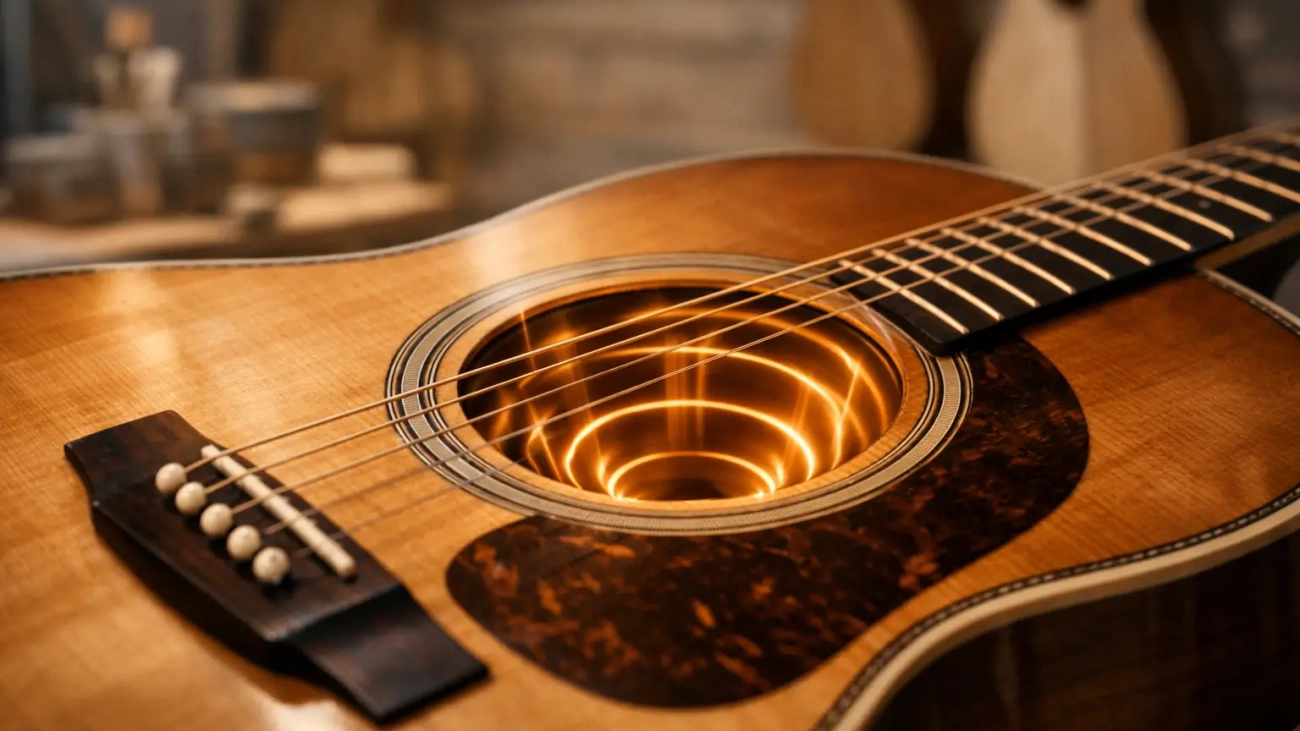
A fine acoustic guitar can feel alive before it is played loudly. A light touch produces a complete note. A sustained chord seems to gather depth rather than simply fade. The player senses vibration against the ribs, through the fretting hand, and beneath the fingertips. That physical and musical exchange is the heart of acoustic guitar resonance explained: the instrument’s ability to receive string energy, transform it into sound, and return something expressive to the player.
Resonance is often reduced to volume. Volume is only one result. A resonant guitar may be powerful, but its deeper quality is responsiveness: the way it speaks at low and high dynamics, the color it offers under different attacks, the length and grace of its decay, and the balance it maintains across its register. For a serious musician, these qualities shape phrasing as surely as the choice of repertoire.
What Resonance Means in an Acoustic Guitar
When a string is plucked, it does not create the full sound on its own. Its energy passes through the saddle and bridge into the soundboard, then through the body, air cavity, back, sides, and neck. Each part has its own natural tendencies to vibrate. Together, they form a complex system of resonances.
Some of those vibrations reinforce particular frequencies; others soften or redirect them. The resulting voice is never a single, fixed thing. It is a relationship between construction, materials, setup, and the player’s touch. This is why two guitars built from the same species of wood can have distinctly different personalities.
The soundboard is usually the principal moving surface. It acts like a finely tuned diaphragm, converting the small motion of the strings into enough movement of air for the ear to perceive a full musical voice. Yet a soundboard that is merely thin will not necessarily be resonant in a desirable way. It must have sufficient stiffness, appropriate mass, and intelligent support from its bracing. The aim is not maximum movement at any cost, but controlled freedom.
A well-made guitar therefore carries a productive tension. It must be light enough to respond, strong enough to endure, and disciplined enough to preserve clarity when the music asks for force. That balance separates raw sound from a mature instrument voice.
Acoustic Guitar Resonance Explained Through the Body
The top, back, and enclosed air each contribute different parts of the instrument’s response. Their interaction is one reason a guitar can sound spacious and immediate at once.
The Soundboard: The First Voice
Spruce and cedar are admired not because one is universally better, but because they can serve different musical intentions. Spruce often offers headroom, clarity, and a capacity to widen under a confident attack. A player may find that it rewards patience, opening further as the instrument is played over time. Cedar can offer an immediate bloom, warmth, and tonal complexity under a lighter touch.
Within either family, individual pieces matter more than labels. Grain structure, stiffness, weight, seasoning, and the builder’s reading of that particular set all influence the final result. Master-grade material is not a guarantee of beauty by itself. It is potential that must be understood and voiced.
Bracing: The Architecture Beneath the Surface
Bracing determines how the soundboard flexes. Its pattern, height, taper, carving, and placement influence bass response, treble clarity, sustain, projection, and tonal separation. Small changes can alter a guitar profoundly.
In a classical or flamenco guitar, the brace design helps establish the instrument’s essential character. A concert classical guitar may call for a broad palette, singing sustain, and evenness across the fingerboard. A flamenco guitar often benefits from a quicker attack, a drier decay, and a percussive edge that gives rhythm definition. Neither approach is a compromise when it serves the music. They are different answers to the same question: how should this instrument release energy?
The Back, Sides, and Air Cavity
The back and sides are sometimes described as reflective surfaces, but that description is incomplete. They also vibrate and participate in the guitar’s tonal life. Rosewood may contribute density, overtone richness, and a sense of depth. Maple can favor focus, speed, and note separation. Other woods bring their own balance of warmth, clarity, and texture.
The air inside the body has a resonance of its own, influenced by the body’s dimensions and soundhole. This low-frequency behavior helps give the guitar its sense of breath and physical presence. If it is poorly matched to the rest of the structure, the guitar may feel boomy, thin, or uneven. When it is well integrated, bass notes have authority without obscuring the middle register, and the entire instrument feels coherent.
Why Light Construction Is Not the Whole Story
Players often hear that a responsive guitar must be built lightly. There is truth in that, but the idea is easily oversimplified. Excess mass can restrain vibration and make a guitar feel reluctant. Excessive thinness, however, can lead to a sound that is unfocused, unstable, or too easily overwhelmed.
The finest instruments are not simply light. They are selectively light. Material is retained where it provides structural integrity and tonal direction, then reduced where unnecessary weight would inhibit movement. This requires judgment developed through years of listening, carving, testing, and returning to the workbench with greater understanding.
Varnish matters here as well. A finish protects the wood, but it also becomes part of the vibrating system. A heavy or overly rigid finish can restrict the surface it covers. A carefully applied, thin finish allows the wood to speak more freely while preserving the instrument for the years ahead. Its influence may be subtle in isolation, yet subtle decisions accumulate in a handmade guitar.
Resonance Changes With the Player
A guitar does not resonate in a vacuum. Nail shape, pick material, right-hand position, left-hand pressure, and dynamic control all change the energy delivered to the instrument. The same guitar can sound intimate under the flesh of the thumb, brilliant near the bridge, or orchestral when the player draws a broad range of color from the strings.
This is why choosing an instrument solely by its first loud strum can be misleading. A guitar should be heard at pianissimo as well as fortissimo. Listen to how quickly a note begins, whether it retains its center as it decays, and whether voices remain distinct in a complex chord. Test the transition from one register to another. A memorable guitar does not merely impress for a moment. It invites more nuanced playing.
For commissioned work, this listening becomes personal. A performer seeking long melodic sustain, a flamenco player requiring immediate articulation, and an archtop musician wanting clarity beneath a pick all ask different things of resonance. At Scharpach, the dialogue around repertoire, touch, desired tone, and physical comfort is part of the making, not a detail added afterward.
The Relationship Between Resonance and Projection
Projection is the guitar’s ability to carry sound into a room. It is related to resonance, but they are not identical. A guitar can feel large and enveloping under the player’s ear yet disperse its sound softly at a distance. Another may seem controlled up close while sending a clear, defined voice to the back row.
The distinction matters for performers. Projection depends on how efficiently the instrument produces useful sound and how that sound is distributed across frequencies. Too much unfocused bass may feel impressive nearby but blur in a hall. A guitar with a well-defined fundamental, articulate midrange, and singing treble often communicates more effectively in performance.
The ideal is not a universally loud guitar. It is a guitar whose voice remains recognizable in the setting where it will be played. A studio musician may prize tonal detail and controllable decay. A concert artist may need projection and dynamic reserve. A private player may value the tactile pleasure of a guitar that responds to the smallest gesture.
How a Fine Guitar Develops Over Time
Wood is not inert in the musical sense. As an instrument is played, its vibrating components can settle into their work. Many guitars develop greater openness, integration, and ease over years of regular use. The change is not magic, nor is it perfectly predictable, but it is one of the enduring pleasures of a finely built acoustic instrument.
Care supports this development. Stable humidity, thoughtful storage, and prompt attention to setup protect the delicate equilibrium that allows a guitar to resonate freely. The goal is not to preserve an instrument as a museum object. It is to preserve its capacity for music.
When evaluating resonance, trust both the ear and the hands. Listen for color, balance, sustain, and projection, but also notice whether the guitar encourages you to phrase more carefully, linger on a note, or play with greater courage. The right instrument does not impose a voice upon its player. It gives that voice a more beautiful place to live.