
A guitar can sound generous beneath the player’s ear and still disappear a few rows away. Concert guitar projection is the more demanding quality: the ability to carry a musical idea into a room with clarity, color, and authority, without forcing the player to sacrifice nuance. It is not simply a matter of decibels. A great concert instrument gives each note a defined beginning, a living center, and enough harmonic shape to remain audible among the acoustics of the hall.
For the serious player, this distinction changes everything. Projection determines whether a pianissimo phrase holds an audience’s attention, whether a bass line retains its contour beneath a singing treble, and whether a change in touch can be heard as intention rather than lost as detail. The finest guitars do not merely make more sound. They organize sound.
What Concert Guitar Projection Really Means
Volume is only one component of projection. A broad, diffuse wash of sound may feel impressive at close range, yet lack the focus needed to travel. Conversely, an instrument with a more disciplined voice can seem almost restrained in a small room while speaking with exceptional presence in a recital setting.
The ear responds strongly to articulation and tonal separation. When the attack of a note is clean, when the fundamental is supported by a balanced pattern of overtones, and when voices do not crowd one another, listeners perceive the guitar as carrying farther. This is why a concert guitar must be judged from across the room, not only from the chair.
Projection also has a temporal dimension. A note must develop quickly enough to communicate the player’s gesture, then sustain with a natural, controlled bloom. If the response is sluggish, fast passagework can blur. If the sound is all initial attack and no body, lyrical playing becomes dry. The rare balance is immediacy with depth: a guitar that answers at once, then continues to reveal its voice.
The Architecture Behind Guitar Projection
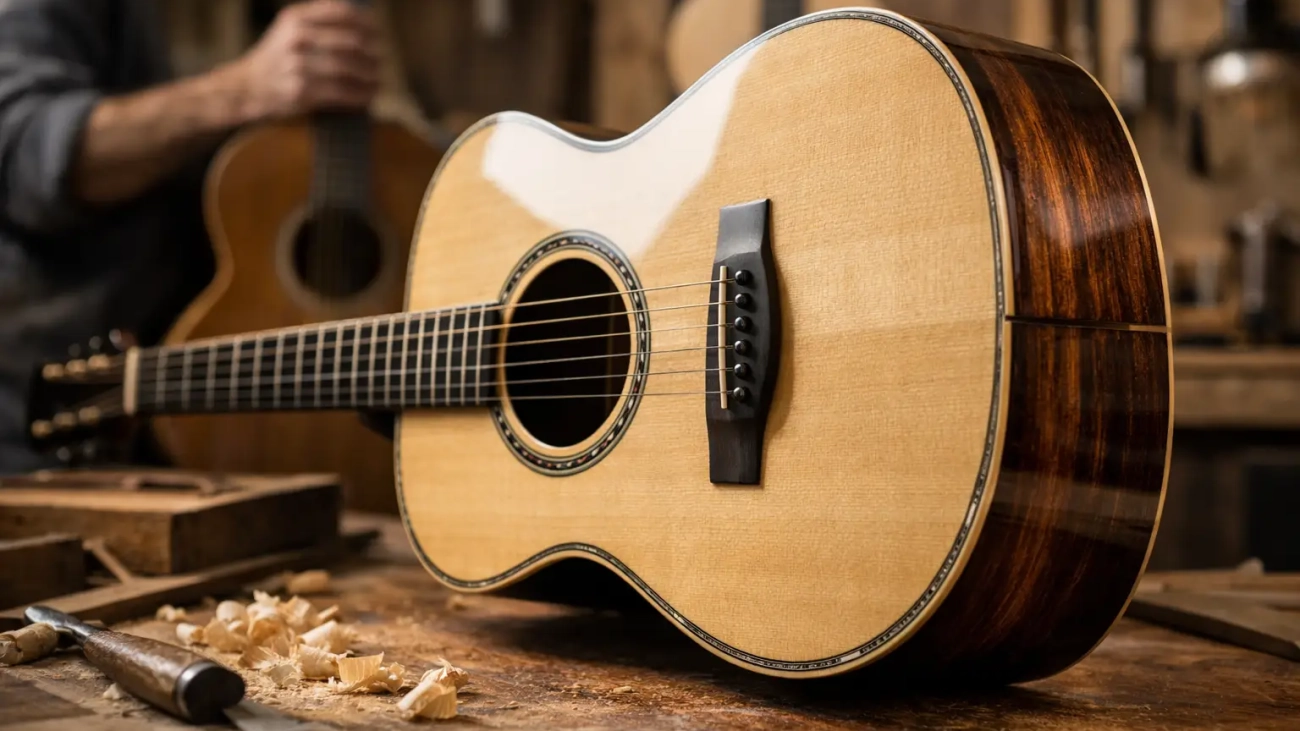
Every part of an acoustic guitar participates in projection, but the soundboard remains its principal source. Its species, grain, stiffness, thickness, arching, and internal bracing determine how efficiently string energy becomes audible sound. There is no universally superior recipe. Spruce often offers a broad dynamic range, brilliant articulation, and considerable reserve under a strong right hand. Cedar can provide warmth, complexity, and a more immediate response. Either can become a compelling concert voice when selected and voiced with discernment.
The key lies in proportion. A top that is too heavy or too stiff may resist the player and produce a tight, reluctant sound. One that is too lightly worked may offer an exciting initial openness but lose structural poise, tonal stability, or headroom. The luthier is always listening for the point at which the plate has enough freedom to breathe and enough integrity to sustain musical pressure over time.
Bracing is not a hidden technical detail. It is the instrument’s internal grammar. Its pattern, height, taper, placement, and interaction with the bridge guide the movement of the soundboard. Small adjustments can change the relationship between bass and treble, alter the speed of response, or affect how the guitar holds together when played with conviction. In a fine concert instrument, the bracing is shaped not toward a theoretical ideal but toward the particular character of that top.
The back and sides matter as well. Indian rosewood may lend depth, complexity, and a generous low register. Maple can bring speed, separation, and a distinctively clear contour. Other woods offer their own combinations of warmth, dryness, sustain, and overtone content. These are not simple rankings. The right choice depends on repertoire, touch, performance environment, and the sound the player wishes to place before an audience.
Varnish has its own quiet influence. A finish must protect the instrument while allowing the wood to vibrate freely. Excess material can mute subtle movement; too little protection can compromise longevity. The best finish work is felt as an absence of obstruction. The guitar retains its elegance, while the surface remains acoustically alive.
Focus Must Be Balanced With Color
A highly focused guitar can project brilliantly, but focus alone is not the goal. If the sound becomes narrow, the instrument may lose the range of color required for Debussy, Albéniz, Bach, or the freer language of contemporary music. Likewise, an instrument built only for lushness may sound beautiful in private yet struggle to define its lines in a hall.
The most satisfying concert guitars preserve contrast. They can offer a firm, clear bass without making the treble thin. They can sustain a cantabile melody without allowing accompaniment to become indistinct. They permit the player to move from intimate shading to rhythmic force while remaining recognizably themselves.
This is where individual voicing becomes essential. A flamenco player may seek an immediate, dry attack, fast decay, and percussive separation. A classical player may require greater sustain, a wider palette of timbre, and reserve for large-form repertoire. An archtop player may value projection that cuts through an ensemble without becoming harsh or overly compressed. The word projection remains the same, but the musical requirement changes.
The Player Is Part of the Acoustic System
Even the finest guitar cannot project what the player does not put into the strings. Right-hand placement changes the harmonic profile dramatically. Playing near the bridge creates a brighter, more incisive sound that can help a rhythmic figure speak. Moving toward the fingerboard softens the edge and enriches the fundamental. Nail shape, stroke direction, follow-through, and the angle of contact all influence how energy enters the instrument.
Good projection is therefore not synonymous with playing harder. Excess force can choke the sound, flatten the dynamic range, and produce a brittle attack. A responsive guitar rewards efficient motion. It allows the player to use weight, release, and control rather than constant muscular effort. The result is a sound that travels because it is well formed, not because it is pushed.
This responsiveness has an artistic consequence. When a player trusts that a soft note will reach the audience, phrasing becomes more daring. Silence gains meaning. The hand can relax, and the music acquires a wider emotional range. An instrument that projects with ease does not simply support performance. It invites a more truthful performance.
How to Evaluate Projection Before Commissioning
A guitar should be heard under conditions that resemble its intended life. If possible, ask another player to perform while you listen from the middle and back of the room. The player’s perspective is valuable, but it can be misleading because the soundboard radiates differently into the space than it does toward the ears above it.
Listen for the outline of individual notes. Can you distinguish the inner voices of a chord? Does a melody remain present when the accompaniment becomes fuller? Does the bass retain pitch and shape, rather than turning into a general rumble? Then listen at different dynamics. A concert instrument should not only sound persuasive when driven. It should remain articulate when played softly.
Pay attention to the transition between registers. Some guitars have a magnificent treble and an unfocused bass, or powerful basses that dominate the middle voice. Others favor one key area over another. These qualities may be appropriate for a particular musical purpose, but they should be chosen consciously rather than discovered after the instrument is complete.
For a commissioned guitar, the conversation should go beyond the request for “more volume.” Describe the halls you play, whether you perform amplified, the repertoire you return to, the colors you admire, and the sound you hear in your imagination. Mention whether your touch is naturally light or forceful, whether you need quick flamenco response or sustained classical legato, and whether you favor a compact, direct voice or a more expansive one. At Scharpach, such details are not decorative preferences. They help define the acoustical direction of the instrument.
A Voice That Reaches Without Strain
The purpose of concert guitar projection is not to make the guitar behave like a louder instrument. Its purpose is to preserve the guitar’s intimacy while allowing that intimacy to be shared. A projected sound should still contain air, grain, and human scale. It should carry the difference between apoyando and tirando, between a rested phrase and a whispered one.
The most memorable instruments possess this paradox. They are refined enough for the smallest inflection, yet clear enough to hold a hall. Their strength is not aggression, but an ordered resonance shaped by materials, patience, and a maker’s ear. Seek the guitar that lets your softest intention remain audible, because that is often where a performance becomes unforgettable.