
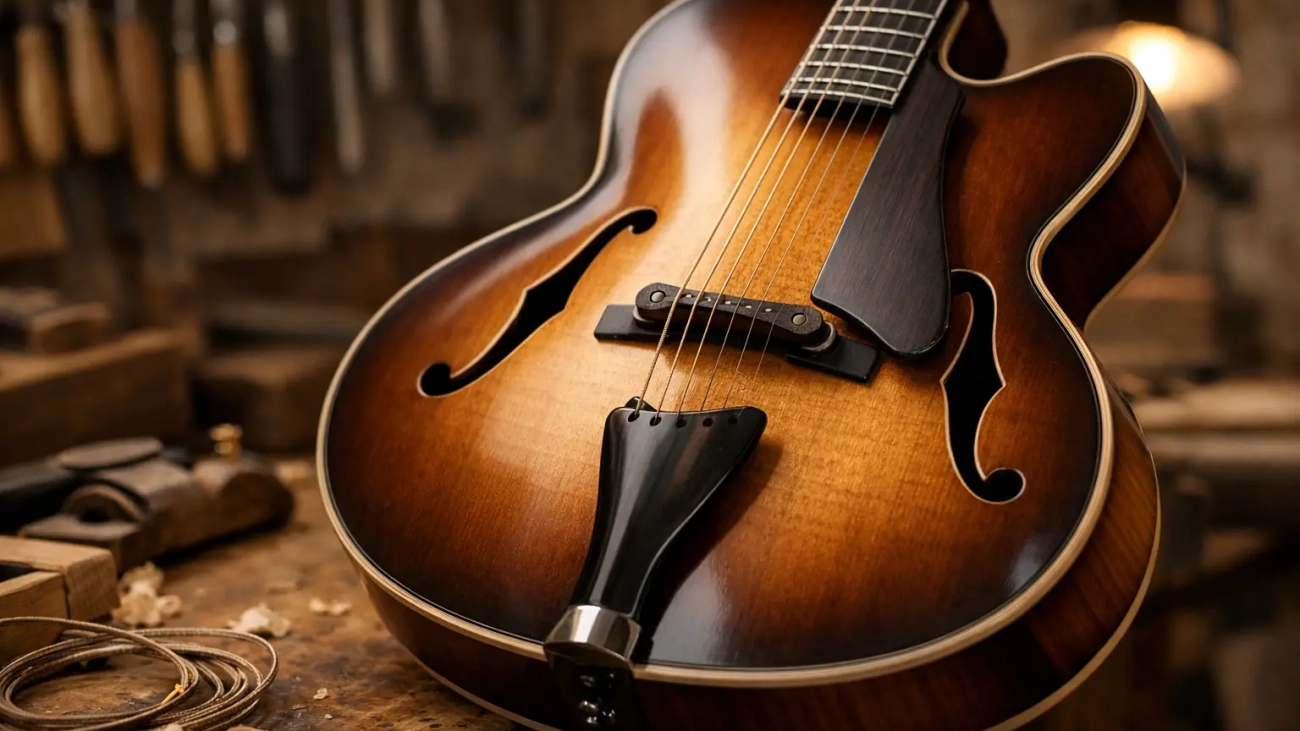
The first chord tells only part of the story. A fine archtop can fill a room with a dry, woody authority, yet its true character appears in the space between notes: the way a line separates under a light touch, how a chord decays, and whether the instrument continues to offer color when played softly. A meaningful handmade archtop guitar review must begin there, with the player’s hands and ears rather than a list of decorative specifications.
A handmade archtop is not simply a more expensive version of a factory guitar. It is an individual acoustic system, shaped through the meeting of wood, arching, graduation, bracing, varnish, hardware, and setup. The finest examples are not built to impress for five minutes. They are made to reveal greater depth across years of rehearsal rooms, stages, studios, and private practice.
What Defines a Handmade Archtop Guitar?
The traditional archtop begins with carefully selected, carved tonewoods. Its spruce top and maple back are not pressed into form or treated as interchangeable components. They are carved, tuned, and graduated according to their own stiffness, density, and acoustic potential. Two pieces of spruce with similar figure may demand entirely different treatment before they can speak with balance and conviction.
This is where handwork becomes audible. The luthier decides how the top should move, where the back should resist or yield, and how the braces should support the structure without suppressing its life. A well-voiced archtop has focus, but it is never sterile. Its fundamental note is clear, while overtones add a subtle halo of warmth and complexity.
The body architecture also carries musical consequences. A deeper body may offer a broader acoustic presence and a more generous low end, while a shallower instrument can feel quicker, more contained, and more resistant to feedback at stage volume. Neither is inherently superior. The right choice depends on whether the player needs an intimate solo voice, a rhythm instrument with strong percussive definition, or an amplified archtop that remains composed beside drums and bass.
Handmade Archtop Guitar Review: Listen Beyond Volume
Volume is easy to notice and easy to overvalue. A handmade archtop should have sufficient projection, certainly, but projection is not merely loudness. It is the ability of a note to retain its shape at a distance. In an ensemble, this may matter more than raw acoustic force.
Begin with the attack. A responsive archtop answers immediately to the pick, but it should not sound brittle or thin. The ideal response has a clean front edge, followed by a core that remains present as the note opens. Jazz players often describe this as clarity or separation. A more lyrical player may hear it as a singing center. Both descriptions point to the same quality: the guitar does not blur the musician’s intention.
Then listen to the decay. Let a single note ring without vibrato. Does it fall away evenly, or does it collapse after the initial attack? Play a closed-position chord, then a more open voicing higher on the neck. A mature instrument preserves definition as harmony becomes more complex. The bass should support the chord without becoming boomy; the treble should carry detail without turning sharp.
Dynamic range is equally revealing. Play at a whisper, then dig in. Some archtops are built for a narrow, controlled response that favors traditional rhythm work. Others have a wider expressive range and reward subtle changes in touch. A player accustomed to fingerstyle passages, chord melody, or unamplified performance may value that elasticity deeply. For a guitarist seeking the compressed, immediate sound of classic big-band rhythm, a more restrained acoustic response may be exactly right.
The Neck Is Part of the Voice
An archtop may possess extraordinary tonewood and elegant carving, yet still fail to become a trusted musical partner if the neck does not belong in the player’s hand. This is one of the clearest distinctions between a handmade instrument and a standardized model.
Neck profile, nut width, string spacing, scale length, fret size, and fingerboard radius influence both comfort and sound. A slightly fuller neck can encourage a relaxed hand and a more secure grip for rhythm playing. A slimmer profile may suit players who move rapidly through modern harmony and single-note lines. Longer scale lengths tend to offer a firmer string feel and a more defined attack, while shorter scales can feel supple and warm under the fingers.
Setup deserves the same seriousness as carving. Action that is too low may make the guitar feel fast at first but deprive it of acoustic energy and leave little room for a strong attack. Action that is too high can turn a resonant instrument into a physical negotiation. The appropriate setting depends on technique, string gauge, repertoire, and how the instrument will be used. There is no universal measurement that can replace an informed conversation with the player.
For left-handed musicians, this issue becomes still more significant. A true left-handed build is not merely a mirrored outline. The bracing, voicing, cutaway, control placement, and ergonomic details should all be considered from the outset. A personal instrument should never ask its owner to adapt to compromises that could have been avoided at the bench.
Beauty Must Serve the Instrument
Flamed maple, intricate purfling, hand-applied varnish, and refined bindings have their place in the archtop tradition. They speak to care, visual rhythm, and the singular presence of a well-made object. Yet ornament should not distract from the instrument’s primary purpose: to transform touch into sound.
The best finishes are thin enough to allow the wood to breathe and mature. A heavily built coating can protect the surface, but it may also restrain vibration. A hand-applied varnish requires patience and judgment, and it can acquire a dignified patina rather than simply showing wear. Its beauty is not frozen at the moment of purchase. It evolves alongside the guitar.
Hardware brings another set of choices. A floating wooden bridge can preserve acoustic openness and offer a traditional response. A more substantial bridge or tailpiece may provide different sustain, feel, and visual character. Pickup selection, if amplification is required, is equally personal. Some players want the clean articulation of a floating pickup; others prefer a carefully integrated magnetic system for greater stage authority. Every addition introduces a trade-off between acoustic purity, practical control, and tonal flexibility.
Why the Builder Relationship Matters
A review can describe materials and measurements, but it cannot replace the process of being heard. The essential question is not, “Is this archtop good?” It is, “Does this archtop allow this particular musician to sound more like themselves?”
That question changes the commission entirely. A builder should want to know how the guitarist attacks the string, what music they play, whether they perform amplified, which instruments have felt nearly right, and what remained missing. The answer may lead toward a darker voice with a quick decay, a bright and open response, a wider neck, a lighter body, or a visual design of quiet restraint.
At Scharpach, this exchange is treated as part of the craft itself. More than four decades of luthiery experience informs the technical decisions, but the player’s musical identity gives those decisions their direction. The result is not a generic luxury object. It is an instrument with a point of view.
What Time Reveals
A handmade archtop should be judged not only when it is new, but by its potential to grow. Fine wood changes under string tension and repeated vibration. The top often becomes more responsive, the voice more integrated, and the relationship between player and instrument more instinctive. This development is one reason an exceptional archtop can feel less like a purchase and more like a long artistic companionship.
There are practical obligations, of course. Solid woods respond to humidity, seasonal change, and careless handling. A serious instrument benefits from a stable environment, a properly fitted case, and periodic professional attention. These are not inconveniences so much as the natural responsibilities of preserving a living, acoustic object.
When considering a handmade archtop, play slowly enough to hear what the instrument does after the note is struck. Notice whether it gives your hands more choices, whether it keeps its character as your touch changes, and whether its voice remains in your mind after the room has gone quiet. That is often where a lasting instrument begins.