
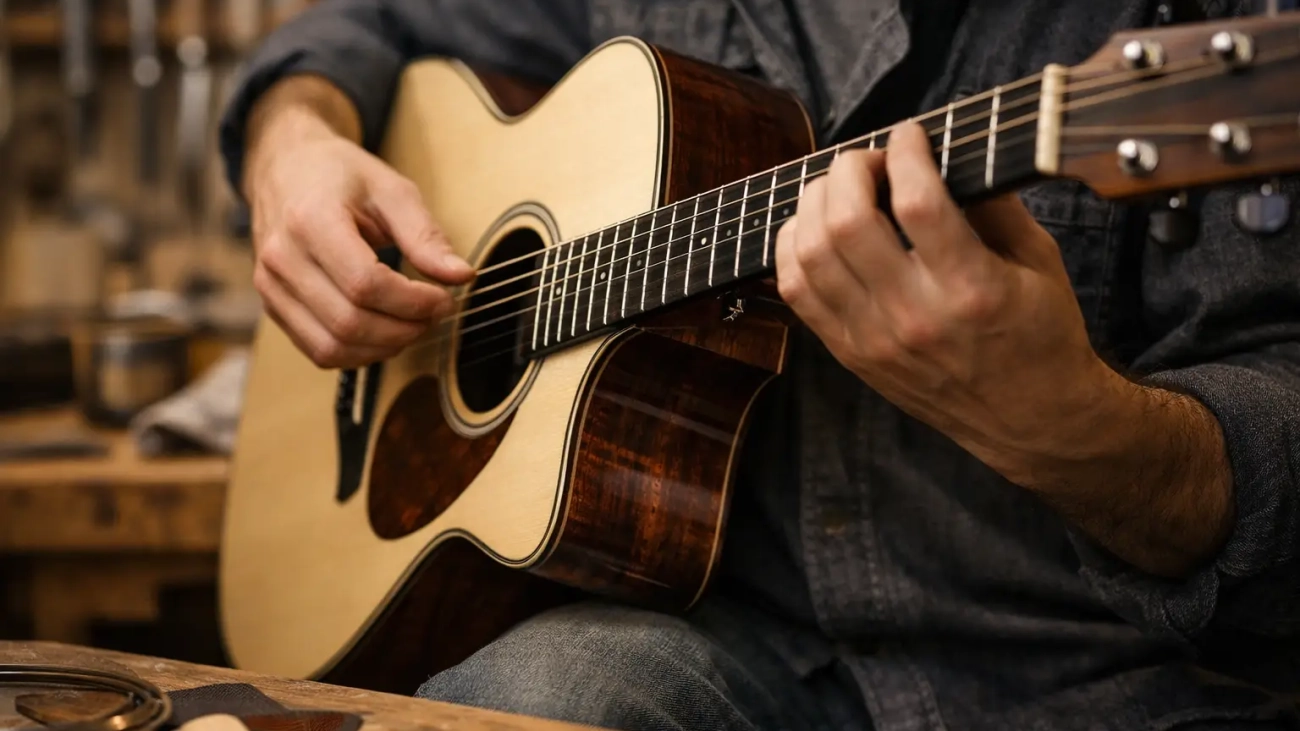
A guitar can be beautifully made, perfectly set up, and still fail to speak in the language of the player holding it. That is where modern guitar voicing begins: not with a fashionable sound, but with an attentive understanding of response, color, balance, and the musical life an instrument is meant to serve.
For the serious player, voicing is the difference between hearing notes and feeling them arrive with conviction. It is found in the first breath of a pianissimo phrase, the clean separation of inner voices, the controlled fire of a flamenco rasgueado, or the sustaining warmth needed beneath a singer. A fine guitar does not impose one fixed personality. It offers a coherent character while allowing the musician’s own phrasing to remain visible.
Modern Guitar Voicing Is Not a Preset
The word “modern” can suggest brightness, volume, or a highly immediate attack. Those qualities may be desirable, but they are not a complete definition. Modern guitar voicing is better understood as purposeful tonal design informed by how accomplished players perform now: across intimate rooms and concert stages, in recording environments, alongside ensembles, and in repertoires that demand both subtlety and projection.
A concert classical guitarist may seek long sustain, clarity under the left hand, and a wide palette of colors near the bridge and fingerboard. A flamenco player may require a dry, percussive response that remains articulate at speed. An archtop player may want a fundamental-rich voice with enough air around the note to retain its identity when amplified. These are not competing ideals. They are distinct musical needs.
The most persuasive instruments make their intention clear without becoming narrow. Power without refinement can become harsh. Warmth without definition can blur counterpoint. An extremely quick attack may be exhilarating for one player and exhausting for another. Voicing therefore involves choices, and every choice carries a trade-off.
The Guitar as a System of Moving Parts
A luthier does not voice one component in isolation. The soundboard, bracing, bridge, back, air cavity, neck mass, fingerboard, finish, and strings all participate in the final result. The challenge is to bring them into sympathetic relationship.
The soundboard is the primary diaphragm of the instrument. Its species, grain structure, stiffness, thickness, arching, and graduation establish much of the guitar’s potential. Spruce often offers headroom, brilliance, and a complex clarity that continues to reveal itself under a strong right hand. Cedar may offer an earlier bloom, a darkly lyrical center, and an immediate intimacy. Neither is inherently superior. The right choice depends on the player’s touch and desired musical horizon.
Bracing translates that potential into behavior. Its pattern, height, taper, and placement govern how the top flexes, how quickly it speaks, and where the instrument holds or releases energy. A top voiced for great elasticity can produce an unusually responsive instrument, but it must retain sufficient structure to preserve focus and endure the tension of years. A more resistant top may ask more from the player, yet reward that effort with greater reserve at high dynamic levels.
The back and sides are equally consequential. They shape reflection, sustain, tonal density, and the sense of space surrounding each note. Dense rosewood can contribute depth and overtone complexity. Maple may bring a more direct, transparent separation between notes. The point is never to follow a wood’s reputation blindly. Exceptional material must be read individually, because two sets from the same species can possess very different stiffness, damping, and acoustic character.
Voicing for the Hands, Not Only the Ear
An instrument’s voice is inseparable from its playability. If a player must fight the neck profile, string spacing, action, or right-hand clearance, their natural sound cannot emerge freely. A guitar may be tonally extraordinary yet remain the wrong artistic partner if its ergonomics interrupt technique.
This is especially relevant for mature players, professionals returning from injury, and left-handed guitarists who have spent years adapting to instruments never designed around them. The geometry of the neck, the scale length, the balance of the body against the player, and the relationship between string tension and repertoire all influence what the hands are willing to say.
A responsive guitar should not merely react to force. It should recognize nuance. Under a light touch, the note should form without hesitation. Under a stronger attack, it should expand rather than collapse into compression. The player needs enough resistance to shape a phrase, but not so much that every musical decision becomes physical labor. This balance is highly personal, and it cannot be fully judged from a specification sheet.
How a Contemporary Voice Takes Shape
At Scharpach, a commissioned guitar begins with listening. The player may describe a sound in technical terms, but often the most useful information arrives through musical references: a recording whose treble has the right tenderness, an instrument remembered for its dry attack, a hall where projection felt effortless, or a phrase that never quite worked on a previous guitar.
From there, the work becomes specific. Repertoire matters. So does whether the guitar will principally be heard in a private studio, a recital hall, or through a microphone. A player who favors Baroque articulation may need a different balance from one who builds a program around Romantic color and contemporary extended techniques. The same is true of a flamenco guitarist accompanying dance compared with one playing solo concert repertoire.
Material selection follows the intended voice rather than a decorative formula. Master-grade tonewoods are chosen for their individual acoustic promise and visual beauty, then paired with a design that gives their qualities meaningful work to do. The finishing process is equally important. A heavy or overly rigid finish can restrain the top’s movement; a refined finish protects the instrument while allowing its resonance to remain alive.
Voicing continues through careful adjustment and listening. It is an iterative craft, not a switch that is turned on at the end of construction. Small changes in graduation, brace shaping, bridge design, or setup can alter the relationship between bass and treble, attack and sustain, immediacy and depth. The aim is not to chase a dramatic effect in the workshop. It is to create an instrument whose character remains convincing in the hands of its owner.
Why Balance Means More Than Even Volume
Players often ask for balance, and rightly so. Yet balance is more complex than matching the decibel level of every string. A bass note can be slightly larger than the treble and still feel perfectly balanced if it decays cleanly and leaves room for the melody. Trebles can be delicate rather than loud, provided they carry enough core to project their line.
True balance also changes across the fingerboard. Notes should retain their family resemblance as the player moves through positions, rather than becoming thin in one register and congested in another. Chords need separation, but they must also gather into a unified harmony. The ideal proportion depends on the music. A soloist may welcome an expansive bass foundation, while an ensemble player may prefer a more disciplined low end that does not crowd other instruments.
This is why the language of louder, brighter, or warmer is useful only up to a point. A mature modern voice has internal order. It allows the player to control foreground and background, to draw a single melodic note from a chord, and to change color without losing the integrity of the instrument.
A Voice That Deepens With Time
A handcrafted guitar should not be judged only by its first impression. Fine wood continues to settle and respond to years of vibration, humidity care, and musical use. A well-voiced instrument often gains openness, complexity, and ease as the player and guitar become acquainted.
That future matters. The most satisfying commission is not one that impresses immediately and then becomes familiar too quickly. It is one that continues to offer new colors while becoming more dependable, more intimate, and more unmistakably the player’s own.
When considering modern guitar voicing, listen beyond volume and visual detail. Play the quietest note you can make. Let a chord decay fully. Notice whether the guitar gives you room to shape a phrase rather than finishing it for you. The right instrument will not simply sound beautiful across the room. It will invite you to say something worth hearing.