
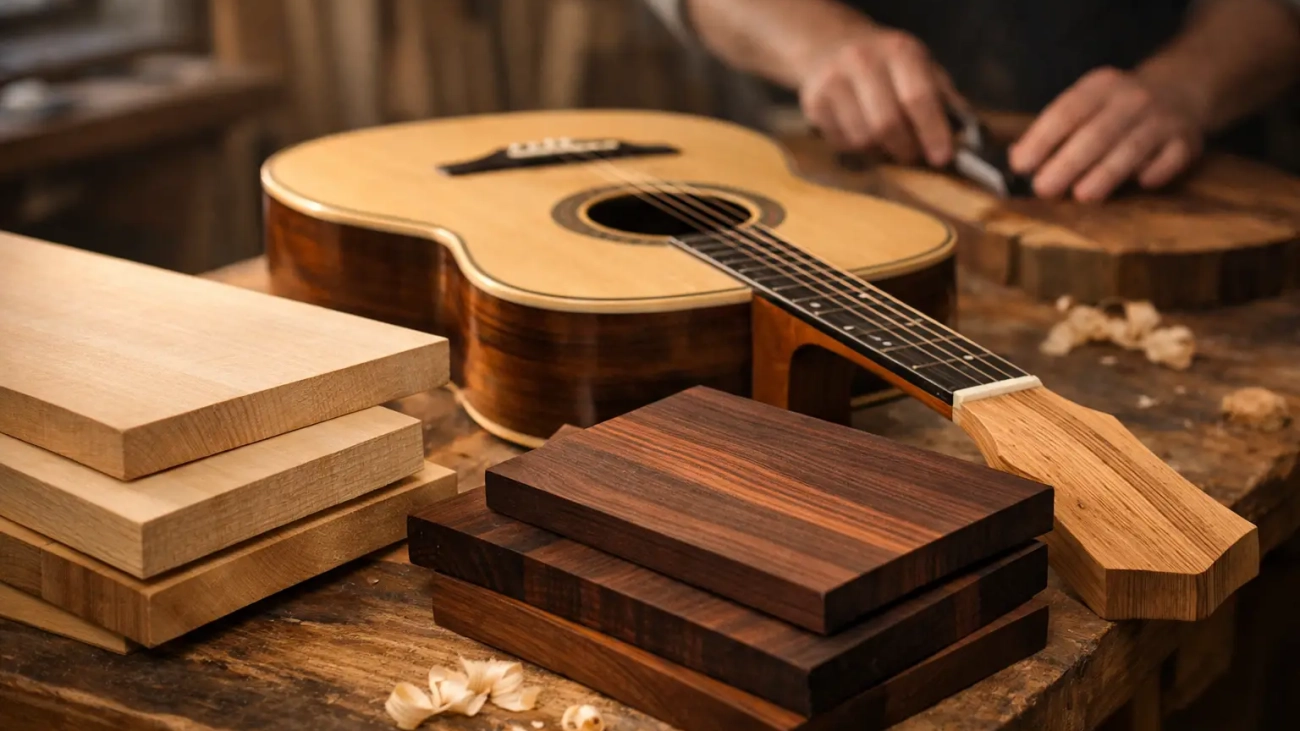
A concert guitar begins speaking long before its strings are fitted. In tonewood sourcing, the luthier listens with the hands: feeling stiffness along and across the grain, studying the geometry of a split, weighing a set’s density, and recognizing the quiet promise held in properly seasoned wood. Species matters, but it is only the beginning. The individual piece is what ultimately enters the guitar.
For the serious player, this is more than an exercise in provenance. The wood chosen for a top, back, sides, neck, or fingerboard helps determine how readily an instrument responds, where its tonal weight lies, and how its voice matures over decades. A fine guitar is not assembled from a list of prestigious materials. It is composed from materials selected to work together in service of a particular musical intention.
Tonewood Sourcing Is an Act of Judgment
A wood’s name can suggest a broad family of tonal possibilities. European spruce is often prized for clarity, headroom, and a complex, singing upper register. Cedar may offer an immediate warmth and a supple response under a lighter touch. Indian rosewood can bring overtone richness and a broad foundation; maple can offer quick articulation, focus, and transparency.
Yet no responsible maker can promise a sound solely from a species label. Two spruce tops cut from neighboring trees may differ significantly in density, elasticity, grain structure, and damping. One may suit a powerful classical guitar built for projection in a hall. Another may be better reserved for a more intimate instrument, where color and sensitivity matter more than sheer volume.
This is where experience becomes irreplaceable. The luthier does not select wood as a catalog item. He evaluates each set in relation to the guitar it may become: scale length, body design, bracing approach, player technique, repertoire, and the desired balance between immediacy and reserve. The finest materials are not simply rare. They are appropriate.
The Top: Where Energy Becomes Sound
The soundboard is the guitar’s primary acoustic engine. A plucked string carries limited energy; the top must accept that energy, translate it into motion, and return it as a living voice. Its selection therefore demands exceptional care.
A promising soundboard set shows more than attractive, even grain. The grain should run cleanly and consistently, ideally following the length of the plate with minimal runout. The wood must have sufficient stiffness for its weight, allowing the maker to bring it to a refined thickness without sacrificing structural integrity. It must also possess a responsive character that can be shaped through voicing and bracing.
Visual beauty has its place, but it is never the final authority. Silking, medullary rays, and fine grain can be signs of excellent quarter-sawn material, yet a beautiful top is not automatically a musical one. The hands, ear, and accumulated memory of thousands of worked pieces reveal what appearance alone cannot.
The distinction matters especially in a commissioned guitar. A player with a forceful right hand may need a top with greater resistance and reserve, one that opens under pressure without compressing. A player seeking the nuance of early music, lyrical classical repertoire, or accompanying voice may prefer a quicker, more yielding response. Neither direction is superior. The right choice depends on the musician’s language.
Spruce and Cedar Are Starting Points, Not Destinies
The familiar choice between spruce and cedar deserves more thought than a simple contrast between brightness and warmth. A superb spruce top can be deeply warm, while a fine cedar top can have remarkable clarity and projection. Construction, thicknessing, bracing, finish, and the player’s touch all influence the result.
Still, the materials invite different possibilities. Spruce often rewards patience, revealing increased openness and complexity as the guitar is played. Cedar can offer an intimate, immediate quality that many players find inspiring from the first encounter. The decision should arise from the desired relationship between hand and sound, not from fashion or generalization.
Backs and Sides Shape the Guitar’s Color
If the top is the voice, the back and sides help define the room around that voice. Their density, stiffness, and internal damping influence sustain, tonal color, separation, and the sense of depth a listener hears behind the fundamental note.
Rosewoods have long been valued for their richness, projection, and colorful overtone content. They can support a broad, orchestral palette, particularly appealing to players who want a guitar capable of dramatic contrast. Maple often offers a faster, more direct reflection of the top’s energy. Its clean note separation can serve flamenco players and jazz musicians beautifully, while its visual figure gives an instrument a distinctive, elegant presence.
Other woods bring their own voices. Walnut may offer warmth with clarity. Cypress remains central to the traditional flamenco character, with its dry, immediate attack and percussive vitality. Each choice involves a trade-off. Greater overtone complexity can be captivating, but a player who values precise articulation may prefer a more transparent tonal field.
The back is not merely decorative cabinetry. Its arch, graduation, bracing, and material work in concert with the entire body. Wood sourcing creates the palette; craftsmanship determines how that palette is brought into balance.
Responsible Tonewood Sourcing Protects the Future of the Craft
For a luthier, reverence for wood includes respect for its origin. Slow-growing, old-growth forests have yielded exceptional instrument wood, but the traditions of guitar making cannot be separated from the responsibility to preserve the natural systems on which they depend.
Careful sourcing means understanding legal trade requirements, seeking documented provenance where possible, and choosing suppliers whose standards extend beyond mere availability. It also means using valuable wood with discipline. A master-grade set deserves thoughtful design, careful storage, and efficient use, not wasteful handling for the sake of spectacle.
The conversation is especially relevant with regulated rosewoods and other scarce species. Regulations can make certain materials more complex to obtain and travel with, particularly for international musicians. That reality does not diminish the musical worth of a guitar. It asks both player and maker to look beyond a narrow list of traditional names and to recognize the expressive potential of thoughtfully selected alternatives.
A guitar built from responsibly obtained wood carries a more complete kind of value. It honors the forest, the material, and the future musician who may one day inherit the instrument.
Seasoning Cannot Be Rushed
Freshly cut wood is not ready for a concert instrument. It must be dried and allowed to stabilize gradually, often for years, until its moisture content and internal stresses have settled to an appropriate equilibrium. Proper seasoning reduces the risk of distortion and cracking, but its purpose is not only structural. It gives the maker a clearer understanding of how the wood will behave under the tool and within the finished guitar.
Storage is equally significant. Tonewoods should rest in controlled conditions, protected from abrupt changes in humidity and temperature. Even after a guitar is completed, the player becomes part of that stewardship. A handmade instrument is resilient when properly cared for, but it is not indifferent to its environment.
There is no honest shortcut here. Kiln drying can be useful when carried out intelligently, and it is part of many modern supply chains, but it does not replace careful aging and evaluation. A luthier’s reserve of seasoned wood represents years of foresight. It is one reason a truly individual commission cannot be reduced to a quick transaction.
From Material to Musical Identity
Wood does not dictate a guitar’s fate. A gifted maker can draw remarkably different results from the same species through design and voicing. At the same time, craftsmanship cannot make every set into every kind of instrument. The art lies in recognizing the material’s natural inclination, then guiding it toward its highest expression.
At Scharpach, this understanding belongs at the center of the commission process. A flamenco player may seek dry attack, immediacy, and the controlled growl that makes rhythmic passages feel alive. A classical artist may ask for long singing sustain, evenness across the registers, and a voice that remains clear beneath complex harmony. An archtop player may value definition, warmth, and the subtle compression that sits beautifully in an ensemble. These are not abstract preferences. They lead directly back to the wood on the bench.
The most rewarding question is not, “What is the best tonewood?” It is, “What sound do you recognize as your own?” From there, material selection becomes a conversation between the player’s ear, the luthier’s judgment, and a piece of wood that has waited years for its purpose.
A fine guitar should make a musician want to play one phrase more, then another. When the tonewood has been chosen with patience and conviction, that invitation is present in every note.