
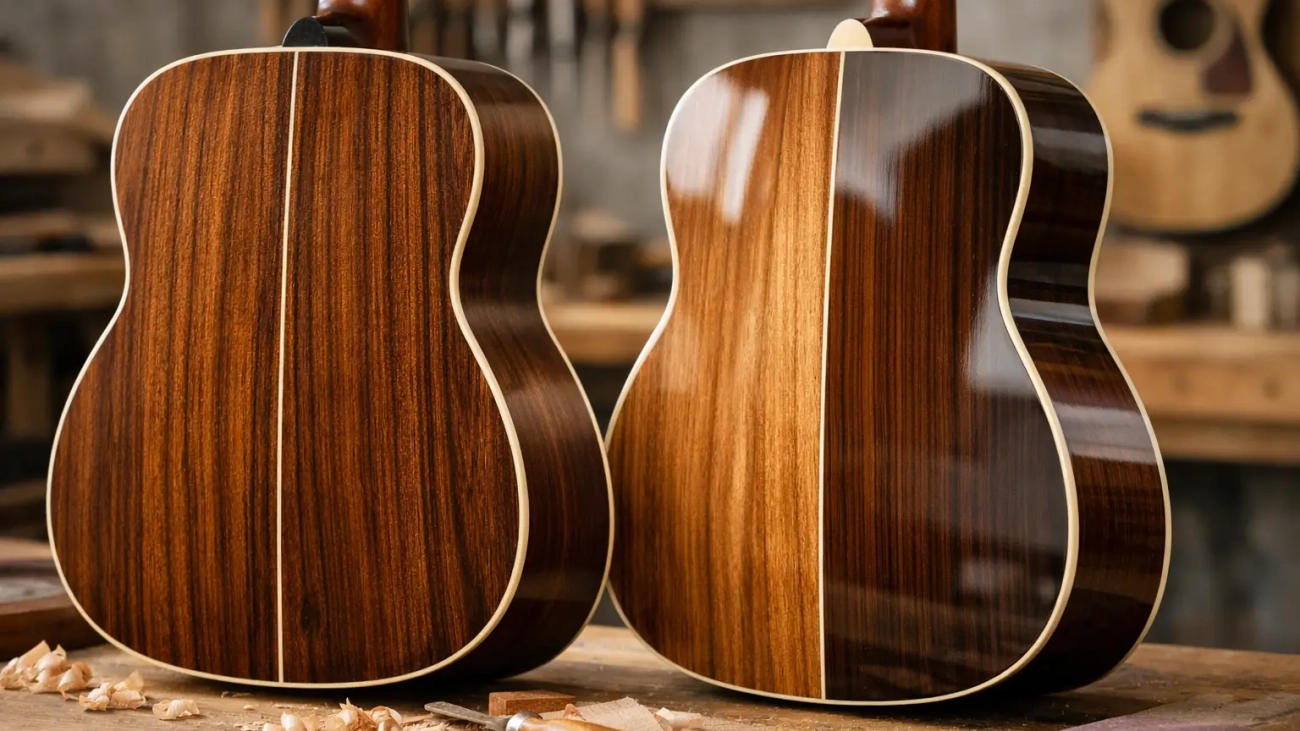
A guitarist can feel the difference before a single note has fully left the soundhole. One instrument seems to meet the hand with resistance and clarity; another offers an immediate, polished sound that remains much the same no matter how hard it is played. In the question of solid wood versus laminate, the meaningful distinction is not prestige alone. It is about how a guitar moves, matures, projects, and ultimately responds to the particular voice of its player.
For a serious musician, materials are never merely decorative. The top, back, and sides form an acoustic system in constant conversation with the strings, the air within the body, and the player’s touch. Understanding their roles makes it easier to choose an instrument with clear eyes and lasting satisfaction.
Solid Wood Versus Laminate: What the Terms Mean
A solid-wood guitar is built with plates cut from a single piece of tonewood, usually joined from two carefully matched halves. A solid spruce top, for example, is a thin, graduated piece of spruce shaped and braced to flex with extraordinary precision. Solid rosewood, maple, cypress, or mahogany back and sides are similarly selected, thicknessed, and voiced for their musical properties.
Laminate is made by bonding thin layers of wood together under pressure. In a guitar, the outer veneer may be an attractive species such as rosewood or maple, while inner layers provide structural stability. A well-made laminate guitar can look refined and can serve practical musical purposes very well. Yet its construction changes the way the wood vibrates.
The terms require a little care. A guitar may have a solid top with laminated back and sides, a common arrangement in many professional-grade production instruments. That is not the same as an all-laminate guitar, nor is it the same as an all-solid-wood instrument. The top has the greatest influence on a guitar’s immediate voice, while the back and sides shape color, projection, sustain, and the sense of space around each note.
Why a Solid Top Matters So Much
The soundboard is the guitar’s principal speaker. String energy travels through the bridge into the top, causing it to pulse and set the air inside the body in motion. A luthier’s work lies in controlling that movement: choosing the grain, evaluating stiffness and weight, carving the braces, and graduating the top until strength and freedom are in balance.
Solid wood has a continuous cellular structure. When chosen and worked well, it tends to transmit vibration with greater complexity than a laminated plate. The result is often a wider dynamic range, more subtle changes in color, and a more immediate connection between touch and sound. A classical player may hear greater separation within a contrapuntal passage. A flamenco guitarist may feel a quicker, drier attack under the thumb. An archtop player may find that a carved solid top gives the note a more vocal, dimensional bloom.
This is not a promise that every solid-top guitar will surpass every laminate instrument. Poor design, heavy finish, unsuitable bracing, or indifferent setup can mute the potential of fine wood. But when material and workmanship are aligned, solid wood gives the maker more opportunity to refine a guitar around a player’s musical intentions.
The Contribution of Solid Back and Sides
If the top is the primary source of motion, the back and sides are the body that gives that motion character. They influence how energy is reflected within the instrument and how the guitar projects into a room. Solid back and side sets can add depth, overtone content, and a more personal sonic signature.
Indian rosewood is often valued for its broad bass foundation, sparkling upper register, and rich sustain. Maple can offer focus and articulation, with a clean separation that suits many archtop voices. Cypress contributes the dry, immediate character associated with traditional flamenco guitars. Mahogany brings warmth, directness, and an appealing fundamental clarity.
In each case, the species name tells only part of the story. Two sets of rosewood may differ significantly in density, stiffness, and tap tone. The way the wood is bent, joined, thicknessed, and finished matters as much as the label. At the highest level of luthiery, wood selection is not a catalog exercise. It is a listening process.
Laminated back and sides are generally less responsive to fine vibration because adhesive layers interrupt the movement of the fibers. They may produce a more controlled, contained sound, sometimes with less harmonic depth. That restraint can be entirely acceptable for a player who values consistency, amplified performance, or a dependable travel instrument. It becomes more limiting when the goal is a guitar that reveals new shades of expression as the player develops.
Stability Is a Real Advantage of Laminate
The case for laminate should not be dismissed. Laminated wood is structurally stable, less prone to movement from changes in humidity, and often more resistant to the routine hazards of travel. For schools, touring situations, humid climates, and players who need a reliable secondary instrument, those advantages have real value.
A laminate guitar can also offer a lower entry price because the material is more efficiently used and less labor-intensive to prepare. This has allowed many players to own a capable instrument who might otherwise be limited to inferior materials and construction.
But stability and artistry are not the same criterion. A fine solid-wood guitar requires attentive ownership: sensible humidity, a proper case, and prompt care when conditions become extreme. That responsibility is part of preserving an instrument made to serve for decades. The player receives, in return, a material capable of a more intimate and evolving musical relationship.
How Solid Wood Changes With Time
One of the most compelling reasons to choose solid wood is that it can mature. As a finely built guitar is played, the soundboard and body settle into their work. The instrument may become more open, more responsive, and more complex over years of regular use. Its voice is not fixed at the moment it leaves the workshop.
This development should not be romanticized into a guarantee. A guitar needs thoughtful construction from the beginning, and every instrument changes in its own way. Still, solid tonewoods possess the capacity to develop in a manner laminates generally do not. The cellular structure continues to respond to vibration, while a laminate’s bonded layers tend to remain more sonically constant.
For a collector, this potential is part of the instrument’s enduring value. For a performing musician, it can be more personal still: the guitar slowly learns the player’s hands, repertoire, and musical life. An heirloom instrument should not simply survive the years. It should have something more to say because of them.
The Finish and the Builder Matter, Too
Material alone does not create a great guitar. A solid-wood instrument can be overbuilt and inert, while a carefully designed laminate instrument can be pleasing, balanced, and useful. The deciding factor is always the complete design: the proportions of the body, the arching or dome, brace placement, plate thickness, bridge mass, neck angle, setup, and finish.
Varnish deserves particular attention. A heavy finish can restrict the top’s movement regardless of the quality of the wood beneath it. A finely applied, thin finish protects the instrument while allowing its surface to remain acoustically alive. This is one reason a handmade guitar commands such patience. The final voice emerges from many small decisions that cannot be rushed or standardized.
For custom work, those decisions can be directed toward a player’s needs. A guitarist who wants luminous sustain, a powerful concert voice, and generous color may require a different set of woods and proportions than a player seeking fast flamenco response or crisp jazz articulation. At Scharpach, the question begins not with what material is most expensive, but with what kind of sound and physical relationship the musician is seeking.
Which Choice Serves Your Playing?
Choose laminate when resilience, price discipline, and environmental stability are your first concerns. It can be an intelligent choice for rehearsal, travel, teaching, or circumstances where a treasured instrument would be exposed to unnecessary risk.
Choose solid wood when the guitar is meant to be a central artistic partner. It is the right direction for the player listening for greater dynamic nuance, deeper resonance, tactile responsiveness, and a voice that may grow more individual with use. It also suits those who value the visible and audible integrity of materials selected one set at a time.
The distinction is especially significant for musicians whose technique depends on subtle control. In classical repertoire, a guitar must carry a singing melody while retaining the inner detail of harmony. In flamenco, it must answer instantly, without losing its percussive authority. In an archtop, the player may seek a carved response that remains clear within an ensemble yet retains warmth under a solo line. These are not qualities that can be reduced to a single specification, but solid wood gives the maker a more expressive field in which to work.
A guitar should never be chosen solely because its label says solid wood. Play it, listen beyond the first bright chord, and notice what happens when you soften your attack or ask for more. The right instrument will not merely produce sound for you. It will invite you to say something finer.