
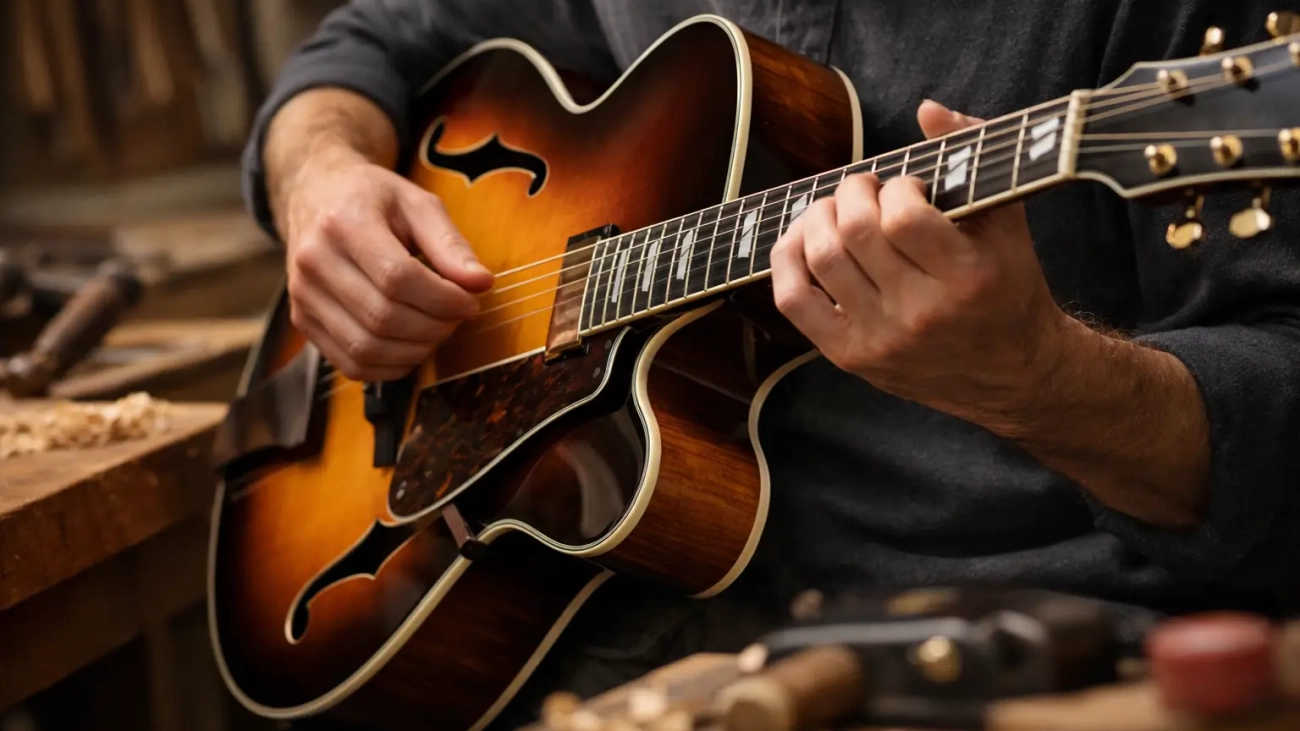
The first chord on a fine archtop should reveal more than volume. It should reveal a point of view: whether the instrument speaks with dry, immediate authority; blooms with warmth beneath the note; cuts cleanly through an ensemble; or surrounds a solo line with a broad, vocal halo. This guide to archtop guitar voicing concerns the decisions that create that character long before strings are fitted and the first note is played.
For the serious player, voicing is not a decorative refinement added after construction. It is the heart of the instrument. Two archtops can share the same outline, scale length, and species of wood, yet respond very differently under the hands. One may favor crisp rhythm work and disciplined projection. Another may reward a lighter touch with color, sustain, and a more orchestral range. Neither is inherently superior. The right voice is the one that serves the musician and the music.
What Archtop Guitar Voicing Really Means
Voicing is the deliberate shaping of a guitar’s top, back, bracing, arching, and mass so that these parts move together in a desired way. It is a process guided by listening, touch, measurement, and experience. It cannot be reduced to chasing a single tap tone or a universal thickness number.
An archtop is especially sensitive because its carved plates are already structured by their curves. The arch carries strength differently than a flat top, allowing the luthier to work with a sophisticated balance of stiffness and flexibility. Small changes in the recurve near the edge, the central graduation of the top, or the treatment around the f-holes can alter the relationship between attack, sustain, projection, and tonal density.
A voiced archtop is therefore not simply thin or thick. It is selectively alive. Its top must have enough resistance to remain clear when played with conviction, while retaining enough freedom to respond to nuance. The back must contribute resonance without confusing the fundamental note. The braces must support the plate without silencing it.
Begin With the Player, Not a Formula
The most useful archtop voicing conversation begins with repertoire and touch. A player who spends evenings driving four-to-the-bar rhythm in an acoustic jazz ensemble has different needs from a guitarist playing amplified modern jazz, chord-melody arrangements, or lyrical solo work in a studio.
For a traditional acoustic rhythm voice, the priorities often include a fast attack, pronounced fundamental, focused midrange, and quick decay. The guitar must articulate each chord cleanly, leaving room for the ensemble rather than filling every space with lingering overtones. A firmer top and carefully controlled resonance can create this direct, percussive authority.
For single-note jazz playing, many musicians seek a more generous envelope around the note. They may want warmth without haze, a singing upper register, and sustain that remains intelligible when amplified. Here, the top may be voiced for greater sensitivity, while the back and braces are shaped to preserve definition as the instrument opens up.
The player’s right hand matters just as much. A strong flatpicker can drive a responsive instrument beyond its most graceful range if the top is too lightly built. Conversely, a player with a refined, economical touch may find an overly stiff guitar withholding its color. String gauge, pick material, preferred tuning, and whether the instrument will carry a floating pickup all belong in the conversation.
The Top: Where the Voice Begins
The carved spruce top is usually the primary engine of an archtop’s sound. Spruce is prized for its exceptional strength relative to weight, but no two sets behave alike. Grain spacing, density, stiffness, and seasoning all influence what the wood can become. A master-grade top is not chosen merely for visual beauty. It is selected for the musical possibilities held within its fibers.
Graduation gives the top its working profile. The center generally retains enough substance to support bridge pressure and maintain a coherent fundamental. Moving outward, the luthier gradually adjusts thickness to encourage the plate to flex in controlled patterns. The recurve, where the arch relaxes toward the rim, is particularly consequential. Too rigid, and the guitar can sound constrained. Too yielding, and it may lose focus, headroom, or long-term stability.
The f-holes also influence the top’s behavior. Their placement, shape, and size affect air movement and remove material from a sensitive part of the plate. Elegant f-holes are not merely ornamental. They are part of the acoustic design, and their relationship to the arch and bracing must be understood as such.
Bracing Shapes Attack, Color, and Authority
On an archtop, braces are not passive supports. Their height, width, taper, placement, and carving guide the way energy travels through the top. Parallel bracing, traditionally associated with many classic jazz instruments, often supports a focused, punchy response with strong projection and definition. It can be an excellent choice for players who want rhythmic clarity and a disciplined, immediate attack.
X-bracing can encourage a broader, more open response, often with added warmth and a more expansive harmonic field. This does not mean every X-braced archtop is soft or every parallel-braced instrument is sharp. The result depends on the entire structure: arching, plate stiffness, wood selection, bridge mass, and the precise final carving of the braces.
The best choice is a matter of musical intention. A player looking for a dry Freddie Green-inspired rhythm voice may favor different structural priorities than someone seeking the rich, responsive complexity of a solo instrument. Good voicing respects that distinction instead of treating one tonal ideal as universal.
The Back Is a Partner, Not a Reflector
The maple back of an archtop is often described as reflective, but that word can be misleading. A carved back is an active acoustic plate. It can return energy to the body, reinforce certain frequencies, and influence how the guitar feels against the player. Its arch, graduation, and stiffness affect both projection and the sense of depth behind the note.
Figured maple brings visual drama, but figure alone does not determine sound. Some highly figured sets are remarkably stiff; others require different handling. The experienced luthier listens to the individual wood rather than imposing a preconceived result upon it. Flame, quilt, and curl may please the eye, but the musical decision is made in the hands and ears.
A well-voiced back can lend an archtop a feeling of reserve and refinement, keeping the sound clear at the edge of a chord. It can also add complexity and bloom. The balance is delicate. Too much activity from the back may blur the response; too little can leave the instrument feeling dry in a way that does not serve the player.
Wood, Finish, and Hardware Complete the System
Archtop tone is often discussed as though the top alone tells the whole story. In practice, the guitar is a system. Maple rims contribute structural character and tonal focus. A mahogany or maple neck influences feel, mass, and the transfer of vibration. Ebony fittings can offer clarity and speed, while bridge design and weight have an immediate effect on attack and sustain.
Finish deserves equal respect. A heavy finish can restrict the subtle movement painstakingly created in the carving process. A carefully applied thin finish protects the instrument while allowing its surfaces to remain acoustically responsive. As the guitar is played and matures, its voice may gain ease, integration, and richness. This development is one of the quiet rewards of a finely made instrument.
For amplified archtops, electronics add another layer of judgment. A floating pickup preserves more of the top’s acoustic freedom than a top-mounted pickup, but each approach brings its own tonal and practical trade-offs. The desired amplified sound, feedback tolerance, stage volume, and acoustic priorities should be considered together rather than after the instrument is complete.
A Guide to Archtop Guitar Voicing in Commission Work
A bespoke archtop offers an unusual opportunity: the player can influence the voice before the first shaving leaves the plate. That process should be specific. Rather than asking for a guitar that is simply warm or loud, describe the musical situations that matter most. Mention whether you need definition under a horn section, bloom for chord-melody work, a dry rhythm presence, or an acoustic voice that remains convincing through a pickup.
Reference instruments can be helpful, but they should be treated as vocabulary rather than prescriptions. You may admire the cut of one guitar’s attack, the low-register warmth of another, and the comfort of a third. A skilled builder can identify the underlying qualities you are responding to and make choices that belong together in one coherent instrument.
At Scharpach, this kind of dialogue is central to the work. The aim is not to reproduce a catalog specification, but to shape a guitar around a player’s musical identity, physical relationship to the instrument, and long-term artistic life.
The finest archtop voice is not the loudest, brightest, or most ornate. It is the one that makes a player reach for the guitar again, because every phrase arrives with greater truth, color, and ease.