
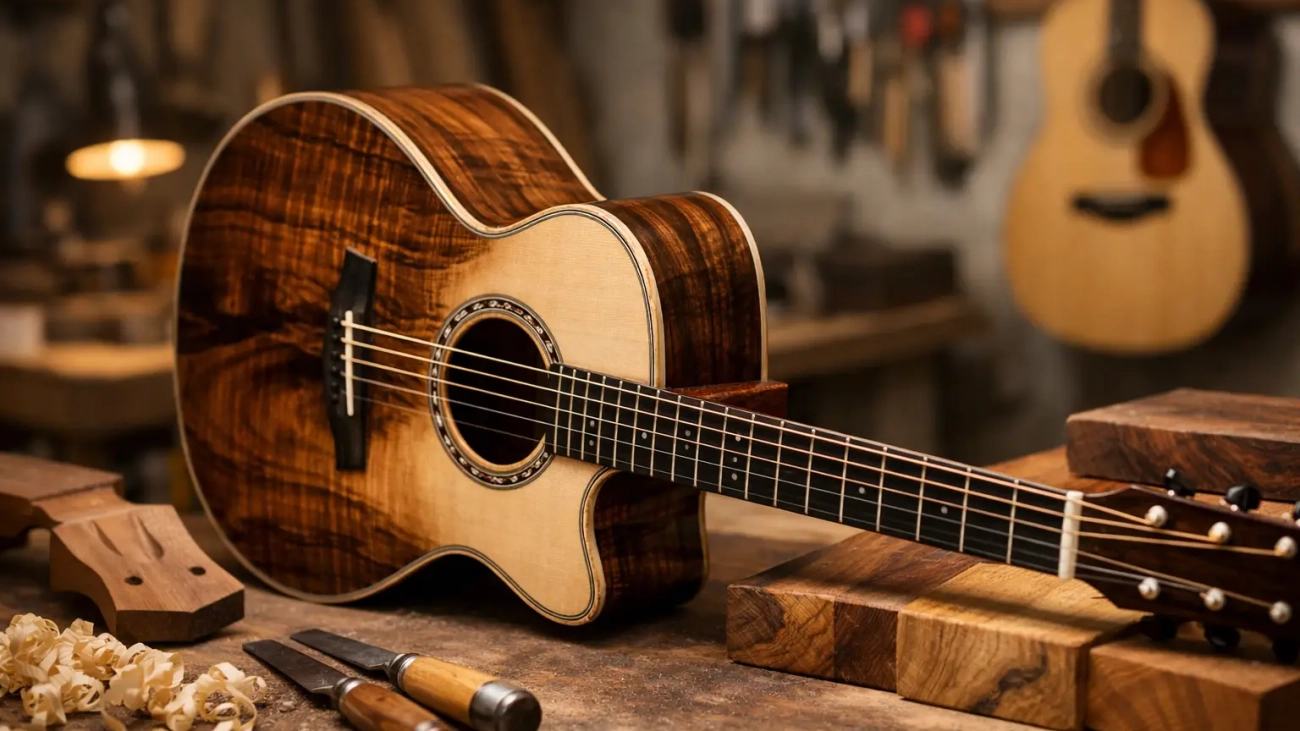
A fine guitar can be beautifully made and still feel like it belongs to someone else. That gap between an excellent instrument and a personal instrument is at the heart of the top reasons to buy bespoke guitars. For the serious player, a custom guitar is not a luxury added after the musical decisions are made. It is the place where those decisions begin: in the response beneath the fingertips, the color of a note, the balance of a chord, and the quiet confidence of an instrument that asks nothing of the player except to be played.
A Bespoke Guitar Begins With Your Sound
Factory instruments are built to satisfy a broad range of hands, rooms, repertoires, and expectations. The finest among them can be remarkable. Yet they must remain a compromise, because their dimensions, woods, voicing, and setup are determined before they meet the musician who will play them.
A bespoke guitar reverses that order. The player comes first. A classical guitarist may seek a focused singing treble with a deep, supportive bass. A flamenco player may want dryness, speed, and the immediate percussive edge required for rasgueados and golpes. An archtop player may be listening for a woody fundamental, clarity under amplification, or a more complex bloom for solo work.
These are not merely adjectives on a specification sheet. They guide the luthier’s decisions about body proportions, top thickness, bracing, arching, wood selection, and the final voicing of the instrument. The result is not simply a guitar that sounds good. It is a guitar shaped around the sound you recognize as your own.
Playability Is a Musical Advantage
The most persuasive reason to commission a guitar is often felt before it is heard. A neck that fits the hand naturally changes the relationship between thought and sound. Shifts become calmer. Extended chords require less strain. A player can remain with a phrase rather than managing the instrument beneath it.
Bespoke construction allows meaningful attention to details that standard production must generalize: nut width, string spacing, scale length, neck profile, fingerboard radius, action, and the placement of a cutaway when one is appropriate. For left-handed guitarists, this consideration is even more significant. A purpose-built left-handed instrument respects the tonal architecture of the guitar rather than treating handedness as a cosmetic reversal.
There is no single ideal setup. A player with a light touch and a lyrical classical approach may prefer a different action from someone whose flamenco technique demands a rapid, assertive response. Likewise, a larger hand does not automatically require a larger neck, nor does a smaller hand always benefit from a narrow one. The value lies in the conversation: technique, repertoire, physical comfort, and tonal ambition are considered together.
Comfort Supports Longevity
Ergonomics are not an indulgence. They are part of artistic endurance. A guitar that sits well against the body, balances at the right point, and allows the fretting hand to work without unnecessary tension can support longer practice sessions and more confident performance.
This matters especially for musicians who have spent years adapting themselves to instruments that were never made for them. A custom build does not promise to correct every physical limitation, but it can remove avoidable resistance. That is a profound difference over decades of playing.
Materials Are Chosen for Character, Not Appearance Alone
A master-grade instrument begins with exceptional materials, but rare wood alone does not create exceptional sound. The work lies in recognizing what each piece of spruce, cedar, rosewood, maple, cypress, ebony, or other selected tonewood can become.
The stiffness, density, grain structure, and acoustic behavior of a top influence its potential long before the guitar is assembled. Back and side woods contribute their own voice through projection, overtone content, warmth, and reflection. Even the choice of varnish matters. A finish must protect the instrument while allowing the plates to move and mature freely.
This is one of the central distinctions between a bespoke instrument and an expensive guitar chosen from a wall. In a commission, the materials are selected as part of an intended musical result. A player who values transparent note separation may be guided toward one combination; another who seeks breadth, warmth, and a more orchestral response may be guided toward another.
Beauty remains important. A guitar should reward the eye as well as the ear. But the most satisfying visual details are those that grow from the instrument’s identity: restrained purfling, a rosette with purpose and proportion, a graceful headstock, or a set of woods whose figure complements their acoustic character. Ornament should frame the music, not compete with it.
The Guitar Is Voiced by Hand
The word “handcrafted” is used freely in the guitar world. In its most meaningful sense, it refers to the luthier’s willingness to listen and respond at every stage of the build.
Voicing is where technical knowledge becomes judgment. The top is brought toward its final thickness not by a number alone, but through an understanding of its individual stiffness and response. Braces are shaped to influence strength, flexibility, sustain, immediacy, and tonal balance. On an archtop, the carved plates and their graduations demand equally careful attention. Small changes can alter the way a guitar releases sound into a room.
This work cannot be reduced to a universal recipe. A proven design provides the foundation, but every exceptional set of wood presents its own demands. The luthier’s experience is heard in the decisions that preserve clarity without sterility, power without harshness, and warmth without losing definition.
At Scharpach, more than four decades of luthiery inform this balance between established principles and the individual voice of each instrument. The goal is not a guitar that announces the maker more loudly than the musician. It is one that gives the musician more to say.
A Bespoke Guitar Develops a Relationship With Its Player
Fine acoustic guitars change with use. As the wood responds to vibration and the instrument settles into regular playing, subtle shifts in openness, resonance, and color can emerge. The process is gradual, and no responsible maker should promise a predetermined transformation. Still, a carefully built instrument has the capacity to deepen over time.
That possibility gives a bespoke guitar a different place in a musician’s life. It is not a temporary upgrade selected by feature comparison. It becomes familiar through rehearsals, recordings, lessons, concert halls, quiet rooms, and years of returning to the same repertoire with new ears.
For collectors, that individuality has another dimension. A commissioned instrument carries a clear artistic lineage: its maker, its chosen materials, its design, and the musical intention behind it. Its value is not confined to resale considerations, which can never be guaranteed. Its enduring value is the integrity of the object and the story embedded in its making.
Commissioning Invites Meaningful Participation
A custom guitar is not assembled from a menu of decorative options. The best commission process is a serious exchange between player and maker. It begins with questions that may not have obvious answers: What sound do you miss in your current guitar? Where does it feel resistant? What repertoire reveals its limitations? Do you need projection, intimacy, cut-through, sustain, or more dynamic range?
A skilled luthier translates those musical impressions into construction choices. The player need not arrive with technical vocabulary or a fixed blueprint. In fact, an open conversation is often more useful than an overly rigid specification. The maker can offer perspective on what will genuinely serve the desired result and where trade-offs exist.
For example, greater projection may alter the intimate softness some players treasure. A very lightweight build can offer exceptional sensitivity while requiring more mindful care. Highly figured woods may be visually striking, but they are assessed first for their structural and tonal suitability. Bespoke does not mean every request is wise. It means each decision receives the attention it deserves.
The Right Choice Is Not Always the Most Elaborate One
A bespoke guitar is a substantial investment of time, money, and trust. It makes the most sense for players who already understand what they value or who are ready to explore that question with care. A newer guitarist may be better served first by playing a range of well-made instruments and developing a clearer sense of touch, repertoire, and tonal preference.
Nor does custom work require extravagant decoration. Some of the most compelling guitars are visually quiet, with their character revealed through proportion, wood, and sound. Others call for a more personal visual language. Both can be right when the aesthetic serves the instrument rather than distracting from it.
The lasting appeal of a bespoke guitar is not that it is different for the sake of being different. It is that it can remove the distance between the musician you are and the sound you have been trying to reach. If you can describe that distance, even imperfectly, you are ready to begin a conversation worth having.