
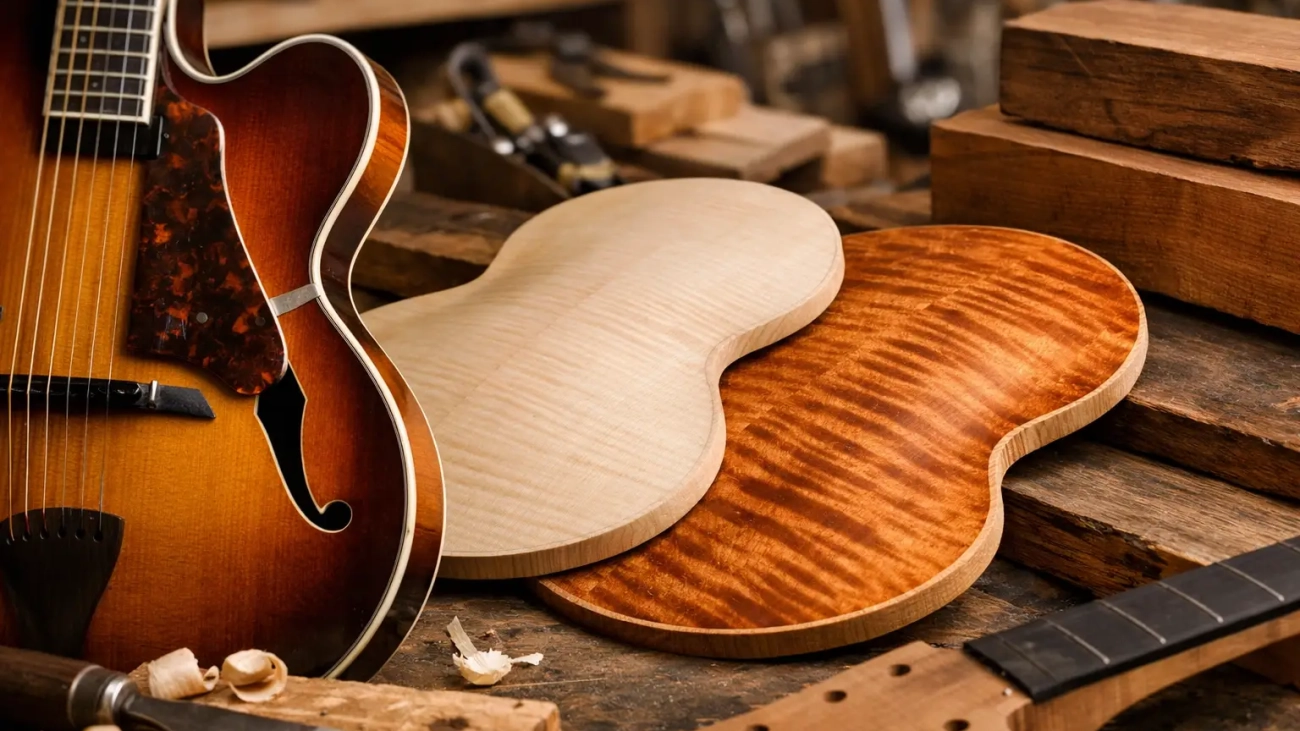
A fine archtop begins speaking before a note is played. Its wood has already determined much of its potential: the speed of its response beneath the pick, the complexity of its chord voice, the way a single line carries through an ensemble, and the character it will reveal after decades of music. The best woods for archtop guitars are therefore not a fixed ranking. They are a considered choice of materials, shaped around a player’s touch, repertoire, and idea of sound.
In a carved archtop, wood is not simply a decorative surface or a specification on a label. The top, back, sides, neck, and fingerboard form a responsive system. Their density, stiffness, grain orientation, seasoning, and the luthier’s carving decisions all matter. Two pieces of the same species can produce notably different instruments. This is why exceptional archtops are built by listening to the material rather than forcing every set of wood into one formula.
What the Best Woods for Archtop Guitars Must Do
An archtop must balance opposing qualities. Its top needs enough stiffness to support the bridge and withstand string tension, yet enough elasticity to move freely. Its back must reflect and shape the top’s energy without becoming sonically inert. The body must offer projection, but also refinement; clarity, but not sterility.
The choice becomes more nuanced when the instrument’s musical role is considered. A player seeking an acoustic jazz guitar for unamplified performance may value fundamental warmth, fast bloom, and a broad, enveloping voice. A guitarist who performs amplified may prefer tighter bass, focused mids, and strong note separation that remains articulate through a pickup. Neither preference is superior. They are different musical destinations.
Just as significant is construction. A hand-carved solid-wood archtop tends to reveal a more immediate, dimensional acoustic character than a laminated instrument, with greater sensitivity to the player’s right hand. Laminated maple has its own respected place, particularly for amplified jazz, where feedback resistance and a controlled, focused response can be virtues. The finest choice is always the one that serves the instrument’s intended life.
Spruce: The Traditional Voice of the Archtop Top
Spruce remains the classic soundboard wood for good reason. Properly selected spruce combines low weight with impressive stiffness, allowing it to respond quickly while retaining structural grace. Its tonal character often includes a clear fundamental, strong projection, and an openness that develops beautifully as the guitar is played.
European spruce is especially prized in master-grade instruments for its refined, complex response. It can offer a broad dynamic range, from a whisper of a chord to the authority of a firmly articulated single-note line. Well-seasoned Adirondack spruce is another distinguished choice, often bringing substantial headroom and a more forceful, direct attack. It can be compelling for players with a powerful pick hand or those who want an archtop that stays composed under energetic playing.
Sitka spruce is also capable of excellent results. It often provides a balanced, dependable voice with pleasing warmth and clarity. The species alone, however, never tells the whole story. A luthier examines the stiffness across and along the grain, the evenness of the grain lines, the cut of the board, and its individual tap response. A remarkable top is selected for its musical promise, not merely its name.
Cedar appears less often in traditional carved archtops, but it deserves consideration for a particular kind of player. Its warmth and quick response can suit a lighter touch and intimate, expressive phrasing. The trade-off is that cedar generally offers less reserve under a heavy attack than fine spruce. It can be extraordinary in the right hands, but it requires a design that respects its nature.
Maple: The Defining Partner for Back and Sides
Flamed maple is visually inseparable from the classic archtop image, but its importance is far deeper than its figure. Maple’s density and reflective character help produce the focused, articulate voice associated with great jazz guitars. It supports clear note separation, a firm low end, and a quick decay that keeps complex harmony from becoming congested.
European maple is a traditional favorite for carved backs and sides. It can bring a singing high register, a dry elegance in the midrange, and a responsive, vocal quality when carefully graduated. Its flame can be dramatic or restrained, but aesthetic beauty should never outweigh acoustic suitability. The finest figured wood is meaningful only when it also possesses the stiffness, stability, and resonance required for the instrument.
American hard maple can offer a more immediate, punchy response, while softer maples may contribute a warmer and more yielding character. These are tendencies, not guarantees. The arching, thicknessing, and relationship to the top will ultimately determine how that piece of maple speaks.
Maple is often chosen because it leaves room around the note. For a jazz player moving through close voicings, altered chords, and melodic lines, that space can be invaluable. Each note arrives with definition rather than dissolving into a wash of overtones. Yet players who want a longer, more blended sustain may find a different back wood more aligned with their voice.
Mahogany: Warmth, Directness, and Human Presence
Mahogany is less traditional than maple in the archtop world, though it has a deeply persuasive musical identity. It tends to emphasize warmth, woodiness, and a strong midrange presence. An archtop with mahogany back and sides can feel immediate and personal, with a round attack and a touch of dryness that suits blues, solo jazz, and lyrical playing.
Compared with maple, mahogany often produces less brilliant high-end reflection and a more integrated tonal envelope. This can make the guitar feel forgiving under the fingers, especially for players who favor flesh-and-nail articulation, softer picks, or a relaxed swing feel. It may not provide the same crystalline separation as a maple instrument, but it can offer an inviting depth that many players find emotionally direct.
Mahogany also makes a superb neck wood. Its stability, manageable weight, and warm visual character have made it a luthiery standard for generations. In a bespoke instrument, the neck profile and its wood selection should be considered alongside the body woods, because the neck is part of the vibrating structure as well as the player’s physical connection to the guitar.
Rosewood and Other Back Woods
Rosewood is valued for its overtone richness, deep bass, and sustaining quality. Used for archtop back and sides, it can create an expansive, luxurious voice with greater harmonic color than maple. For a player whose concept of archtop sound includes lush chord melodies, solo performance, or a more orchestral acoustic presence, rosewood can be a compelling direction.
The trade-off is definition. Rosewood’s generous overtone content may be less ideal for a player who wants the dry, percussive snap of a classic acoustic jazz box. A thoughtful design can preserve clarity, but the fundamental personality remains different. Rosewood is not better than maple. It is broader, more lingering, and more harmonically complex.
Walnut occupies a graceful middle ground. It can offer some of mahogany’s warmth and some of maple’s clarity, often with a handsome, understated appearance. Koa can bring a vivid midrange and attractive visual depth, while cherry may provide a warm, balanced response with an unpretentious elegance. These woods can make exceptional archtops when chosen for a distinct tonal purpose rather than novelty.
Ebony, Neck Woods, and the Details That Shape Feel
The fingerboard makes a quieter but meaningful contribution. Ebony remains a favored choice for its hardness, smooth feel, durability, and precise attack. It supports a clean articulation that suits the archtop’s demand for clarity. Different ebony species vary in color and visual texture, and a fine fingerboard need not be uniformly black to be musically and structurally excellent.
A maple neck can add snap and visual continuity to a maple-bodied guitar. Mahogany offers warmth and familiar comfort. Multi-piece neck construction, carefully oriented grain, and an appropriate reinforcement system are often more important to long-term stability than a simplistic preference for one species. A master-built guitar is an assembly of considered relationships.
Finish also deserves restraint. Heavy finish can diminish the freedom of a responsive carved plate, while a carefully applied thin finish protects the instrument without obscuring its vitality. The wood must be allowed to breathe acoustically, even as it is protected from the demands of changing seasons and regular performance.
Choose Wood for the Music You Want to Make
For the player seeking classic acoustic jazz clarity, spruce with maple back and sides remains a profound and enduring pairing. For warmth and directness, spruce with mahogany may be more revealing. For complexity, sustain, and solo color, spruce with rosewood can open another expressive world. The right decision also depends on scale length, body depth, arching, bracing, string choice, and whether the guitar will live mainly onstage, in the studio, or in a quiet room at home.
At Scharpach, material selection begins with the musician rather than a catalog specification. A serious instrument should not ask its owner to adapt to a generic voice. It should become more familiar, more responsive, and more personal with every year of playing.
When considering an archtop commission, bring recordings that move you, describe the touch you trust, and be honest about where the instrument will be heard. The right wood is the one that turns those musical instincts into a voice you recognize as your own.