
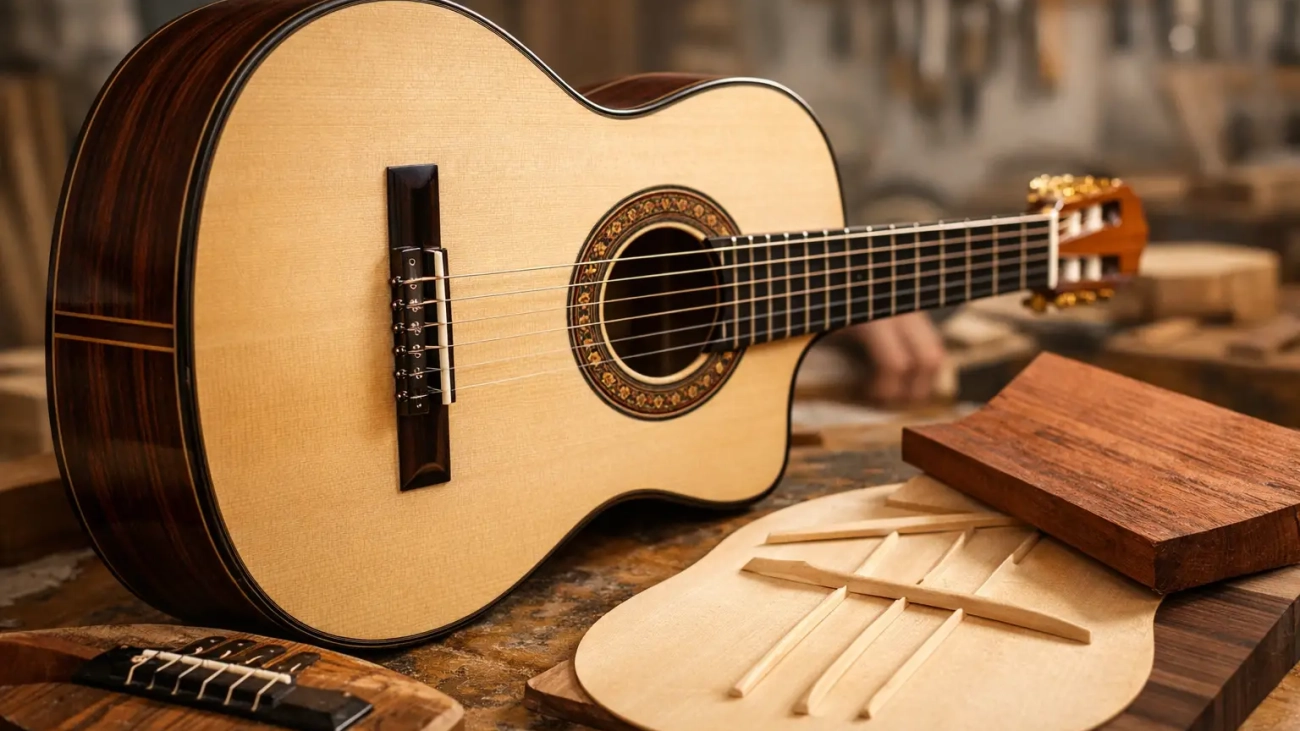
A flamenco guitar must answer before the player has time to ask. A thumb stroke needs dryness and authority. A rasgueado needs a quick, bright flare of sound. A picado passage must remain clear when the tempo rises and the hand becomes relentless. The best features for custom flamenco guitars are therefore not a catalog of upgrades. They are choices that bring the instrument into direct alignment with a player’s touch, repertoire, and sense of rhythm.
A fine custom flamenco guitar begins with this understanding: projection alone is not enough. The guitar must be immediate, percussive, and alive under the right hand, while retaining enough color to make a falseta sing. Every decision, from the top’s graduation to the height of the strings above the soundboard, contributes to that character.
The Best Features for Custom Flamenco Guitars Begin With Response
Flamenco players often describe a great instrument as fast. This is not merely a matter of volume. It is the sensation that the guitar releases sound at once, with little resistance between intention and result. The top must be light and responsive, yet supported by an internal structure that can bear years of hard playing without losing its vitality.
For many traditional flamenco voices, a carefully selected European spruce top remains the natural choice. It offers a crisp attack, strong note separation, and a clarity that rewards precise right-hand work. Cedar can be equally compelling for a player seeking a warmer, more immediate tonal response, often with a slightly darker center to the sound. Neither is inherently superior. Spruce may continue to open and refine over many years, while cedar can offer its character more readily from the beginning.
What matters most is not the species in isolation, but the individual piece of wood and the way it is voiced. Grain, stiffness, weight, and the relationship between the top and its bracing are judged by hand and ear. A master luthier is not simply selecting beautiful timber. He is listening for its potential before the guitar has made its first note.
Cypress, Rosewood, and the Character of the Back and Sides
The traditional flamenco blanca, built with cypress back and sides, is valued for its dry, woody attack and lean, direct projection. Cypress keeps the sound focused. It allows rhythm to speak plainly and gives the instrument the unmistakable snap many players expect in accompaniment, dance work, and traditional toque.
A flamenco negra, commonly made with rosewood back and sides, offers a different balance. Its voice can carry greater depth, sustain, and overtone color while preserving flamenco urgency when the top and setup are properly conceived. For a soloist moving between concert flamenco, recording, and more lyrical material, a negra may offer a wider tonal palette.
This is a meaningful choice rather than a cosmetic one. A blanca is not less sophisticated, nor is a negra automatically more versatile. The right decision depends on whether the player wants the guitar to cut through a dance setting, support a singer with rhythmic precision, or hold a more expansive melodic line on its own.
Setup Is Part of the Instrument’s Voice
A flamenco setup should never be treated as an afterthought. Action, neck angle, saddle height, fretwork, and the geometry of the bridge form a single system. Together, they determine how the guitar feels in the hands and how willingly it produces the controlled buzz that gives flamenco its edge.
Lower action can make legato, ligados, and rapid scale work feel effortless. It can also encourage the subtle percussion created when a string meets a fret under a firm attack. But action that is too low can restrict dynamic range, compromise clarity, or cause unwanted noise in the wrong registers. A player with a forceful right hand may need a different setup from one whose technique is lighter and more nuanced.
The goal is not simply to make the strings low. It is to create a playing surface that invites commitment. A well-made flamenco guitar can tolerate a strong stroke, remain articulate in a fast compás, and still respond when the player asks for a whisper.
Scale Length and Neck Shape Should Serve the Player
The familiar 650 mm scale length offers tension, projection, and the traditional feel many flamenco players recognize immediately. Yet a custom build allows room for personal proportion. A slightly shorter scale can ease left-hand stretches and make the instrument more welcoming for players with smaller hands, without sacrificing musical seriousness when the rest of the design is thoughtfully adjusted.
Neck profile is equally personal. Some players prefer a more substantial shape that offers a secure anchor for the thumb. Others favor a slimmer profile for rapid position changes and relaxed endurance during long practice sessions. Nut width, string spacing, and the contour of the fingerboard should be considered together, especially for a guitarist whose technique depends heavily on thumb-led passages, wide rasgueado patterns, or intricate arpeggio work.
For left-handed players, a true left-handed build is more than a reversed visual arrangement. Bracing, compensation, ergonomic details, and setup should be designed from the beginning for the instrument’s actual orientation. That level of attention is one of the clearest advantages of commissioning rather than adapting a standard guitar.
The Golpeador Must Protect Without Muting the Top
The golpeador is essential to flamenco technique, but it must be fitted with care. It protects the soundboard from golpes, fingernails, and the daily evidence of serious playing. At the same time, every layer applied to a responsive top has some acoustic consequence.
A well-chosen, finely fitted golpeador protects the guitar while preserving its quickness and visual elegance. Clear material allows the beauty of the top to remain visible; a darker or more traditional treatment can give the instrument a stronger visual identity. The important question is practical as well as aesthetic: where does the player’s hand land, how forceful are the golpes, and what areas need protection?
This is one of several details that reveal the difference between a guitar made to look flamenco and one made to be played as flamenco.
Varnish and Weight Shape the Final Sensation
Finish is not merely decoration. A heavy finish can restrain a lightly built soundboard, while a carefully applied thin finish allows the wood to vibrate with greater freedom. French polish has long been prized for its beauty, repairability, and minimal mass. Its luminous depth suits an instrument intended to reward close attention. It also requires a degree of care from its owner, particularly compared with harder modern finishes.
The choice involves an honest trade-off. A touring artist who travels constantly may place greater value on durability. A collector or concert player who values the most sensitive expression may prefer the refinement of a traditional finish. The finest decision is the one that reflects the guitar’s real life after it leaves the workshop.
Weight deserves similar attention. Flamenco guitars are often built lightly because speed of response is central to their nature. Yet lightness without structural judgment is not artistry. The guitar must remain stable across changing seasons, retain its voice over time, and support the musical demands placed upon it. Long experience with materials is what turns this balance from an ambition into a dependable instrument.
Personal Details Should Deepen, Not Distract
A custom guitar can carry a player’s identity through restrained visual choices: a rosette designed around a meaningful motif, carefully selected bindings, elegant purfling, or a headstock shape with quiet distinction. Fine tuners may be chosen for their precision, weight, and feel. The woods themselves may offer their own visual language, from the pale, open character of cypress to the dramatic figure of exceptional rosewood.
These details matter because the guitar is intimate. It rests against the body, lives in the hands, and becomes part of a musician’s daily discipline. Still, ornament should never compete with proportion, balance, or sound. The most enduring instruments are often those in which beauty appears inevitable rather than imposed.
At Scharpach, a commission begins not with a fixed specification but with a conversation about the sound a player hears, the music they perform, and the physical experience they need from the instrument. That conversation gives technical choices their purpose.
The right custom flamenco guitar does not try to be every guitar at once. It becomes more valuable by being specific: dry enough for compás, lyrical enough for a solo voice, and shaped so naturally around the player that the hands can forget the instrument and return fully to the music.