
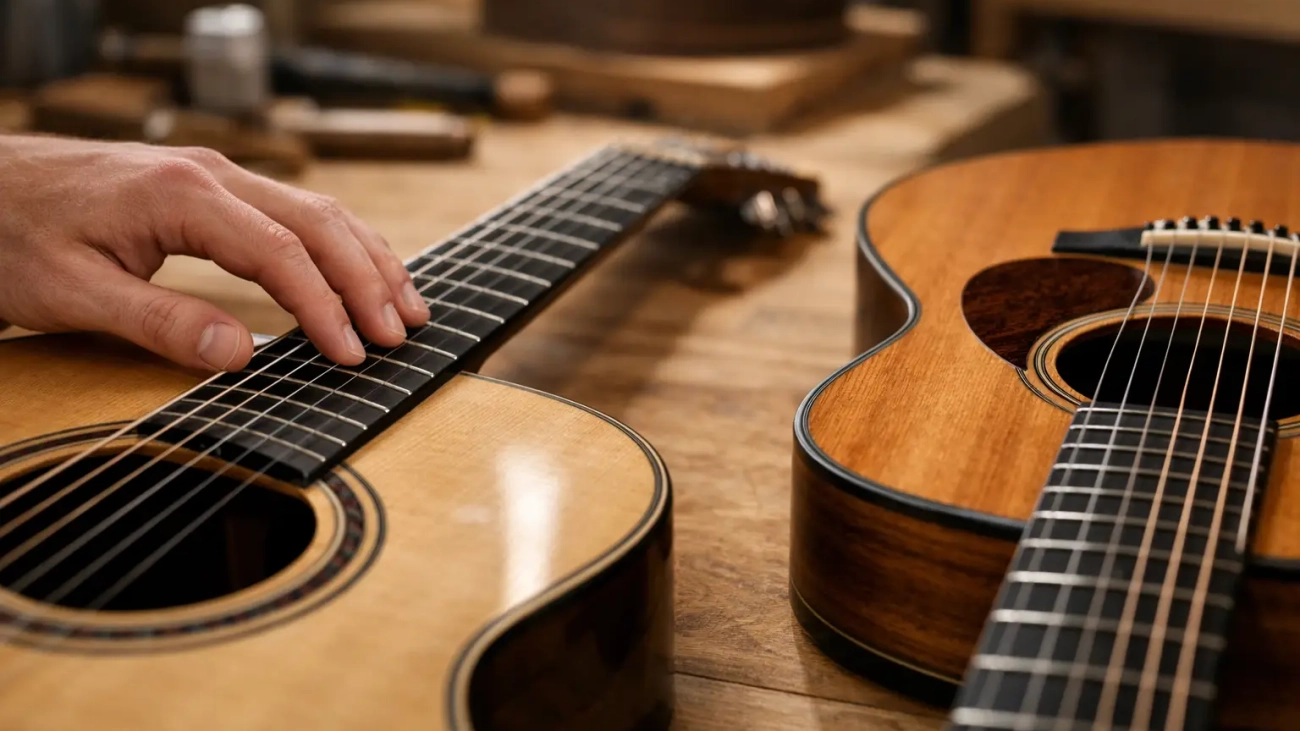
A few millimeters can change the relationship between a guitarist and an instrument. They can alter the ease of a long stretch in a Bach prelude, the resistance beneath a flamenco rasgueado, or the way a phrase settles into the hand after hours of playing. To understand how to select guitar scale length, begin not with a specification sheet, but with the music you want to make and the physical language through which you make it.
Scale length is one of the quiet decisions that shapes nearly every other musical impression a guitar gives. It affects string tension, fret spacing, tonal response, projection, and the feeling of intimacy or authority in the player’s hands. There is no universally correct scale. There is only the scale that serves a particular player, repertoire, and conception of sound.
What Guitar Scale Length Actually Means
Scale length is the vibrating distance between the nut and saddle, measured along the string. On a classical or flamenco guitar, 650 mm has long been a familiar standard. Yet instruments are also built at 660 mm, 655 mm, 645 mm, 640 mm, and shorter dimensions, each with its own musical consequences.
The measurement may appear modest on paper, but its effect is substantial. A longer scale increases the speaking length of the string. At the same tuning and with the same string set, it creates more tension. Frets are also placed slightly farther apart, especially in the lower positions where the left hand spends much of its time. A shorter scale does the reverse: it reduces tension and brings the frets closer together.
For a commissioned instrument, scale length should never be treated in isolation. Neck profile, nut width, string spacing, fingerboard radius or flatness, action, body geometry, and the player’s posture all contribute to the final experience. The finest choice is an integrated one.
How to Select Guitar Scale Length for Your Playing
The first question is not, “What scale length do great guitars use?” It is, “What does my hand need to express my music without resistance that serves no purpose?” A guitarist with large hands may enjoy the breadth and clarity of a 655 mm or 660 mm scale, while another player may find that the same instrument turns stretches into labor and restricts relaxation.
Hand size matters, but it is not the whole story. Finger length, thumb mobility, joint flexibility, playing posture, and technical approach can matter just as much. A player with smaller hands and refined position may be entirely comfortable at 650 mm. Conversely, a guitarist with larger hands may prefer a shorter scale because it supports a more relaxed left hand and a faster response under the fingers.
Consider your actual repertoire. Classical music often asks for wide extensions, sustained barrés, and precise voicing across the fingerboard. A scale around 640 mm to 650 mm may offer an excellent balance between traditional sonority and manageable reach. Flamenco players may favor the immediacy and quicker feel of a 650 mm scale, though a shorter scale can be compelling for players who value ease, speed, and a more yielding response.
Archtop players face a different set of priorities. Their preferred string gauge, tuning, chord vocabulary, and desired attack may lead them toward longer scales, often for definition and a firmer feel. But even here, the ideal measurement depends on the player’s touch. A guitar should support the hand’s natural intelligence, not demand that the player conform to an arbitrary standard.
The Feel of Tension Under the Right Hand
Scale length changes more than the left-hand stretch. It also changes the right hand’s encounter with the string. A longer scale gives greater tension, which can produce a firmer attack, strong note separation, and a sense of reserve beneath the fingertip. Many players appreciate this when seeking projection, headroom, and clarity in powerful playing.
That additional tension has a trade-off. It can make the instrument feel less forgiving, particularly for players who use a delicate touch, play for extended periods, or prefer a guitar that speaks with minimal effort. The issue is not whether higher tension is better. It is whether the instrument returns the sound you seek for the energy you invest.
A shorter scale generally feels more supple. The strings can be easier to fret, vibrato may feel more fluid, and the guitar may respond readily to a lighter attack. This can be especially rewarding for lyrical classical playing, nuanced color work, and musicians managing hand fatigue. If the design is properly voiced, a shorter scale need not sound small. It can possess remarkable depth, warmth, and immediacy.
String choice can refine this relationship. A player who loves the reach of a longer scale but finds its tension excessive may choose a lower-tension string set. A player drawn to a shorter scale but wanting more resistance may choose higher-tension strings. Still, strings are adjustments, not substitutes for a scale length that fundamentally suits the player.
Tone, Projection, and the Character of the Instrument
Scale length influences tone, but it does not determine it alone. The soundboard’s stiffness and thickness, bracing architecture, body depth, air resonance, bridge design, woods, and finish all play vital roles. A beautifully built guitar is a system of relationships, not a collection of independent measurements.
That said, longer scales often favor a focused, articulate voice with strong separation between notes. They can encourage a clear fundamental, a disciplined bass response, and an authoritative projection that carries through a hall. This is one reason some concert players are drawn to 655 mm or 660 mm instruments.
Shorter scales can bring a different poetry. They often encourage warmth, elasticity, and a closer, more immediate bloom. The sound may feel less austere and more conversational, particularly under a sensitive touch. For the musician who values color, intimacy, and an instrument that responds to the smallest inflection, this can be deeply satisfying.
Neither description is a rule. A master luthier can voice a 640 mm guitar with exceptional presence and build a 660 mm instrument with great warmth. The scale establishes part of the instrument’s potential, but the builder’s judgment determines how that potential is shaped.
Standard Is Useful, Not Sacred
A 650 mm scale remains popular because it is a well-proven middle ground. It offers familiar classical proportions, ample string tension, and a repertoire-friendly layout for many players. If you have played comfortably on 650 mm guitars for years and admire their sound, there may be no reason to move away from it.
Yet “standard” should not end the conversation. A player who continually tightens the left hand in first position, avoids certain stretches, or feels exhausted after a long rehearsal may benefit from 645 mm or 640 mm. Those five or ten millimeters can preserve a traditional musical voice while changing daily comfort significantly.
A player who finds standard instruments too soft or compressed may find that 655 mm offers the desired firmness and tonal definition. At the far end, 660 mm can be magnificent in the right hands, especially for a player who welcomes broader spacing and seeks a more commanding response. It is less suitable when physical comfort is already in question.
Evaluate Scale Length in the Music You Actually Play
When trying instruments, do not judge scale length from a single open chord or a brief burst of fast playing. Bring the passages that reveal your real demands. Play a piece with sustained barrés, a passage with large slurs, a melody requiring controlled vibrato, and chords high on the neck. Then play quietly. A guitar that sounds impressive only when driven hard may not be the instrument that reveals your finest phrasing.
Pay attention to delayed fatigue. The hand may initially accept a longer scale, only to become tense after thirty minutes. Notice whether your thumb begins to grip, whether extensions become abrupt, and whether your shoulders rise as difficult passages approach. A properly chosen scale allows technique to remain available when concentration shifts from mechanics to music.
Also listen for what happens at the edge of your dynamic range. Can you draw a clear pianissimo without forcing the string? Does the guitar retain composure when you play with conviction? The right scale length is often felt as an absence of struggle, but it is heard as freedom.
For left-handed players, the same principles apply, with an additional requirement: the guitar must be conceived as a true left-handed instrument, not merely reversed at the last moment. Scale, bracing, bridge compensation, ergonomics, and voicing should all serve the direction in which the instrument will be played.
A Custom Guitar Makes the Decision More Meaningful
In a bespoke instrument, scale length becomes part of a larger portrait of the musician. At Scharpach, the discussion can include repertoire, hand dimensions, preferred strings, concert needs, tonal references, posture, and the subtle qualities a player may struggle to name but recognizes instantly when encountered.
The goal is not to prescribe a number. It is to understand whether the player needs the traditional equilibrium of 650 mm, the openness of a longer scale, or the graceful accessibility of a shorter one. A scale length is successful when it disappears beneath the music, leaving only response, color, and confidence.
Choose with patience. The right measurement is not a concession to comfort or an abstract pursuit of power. It is a foundation for a guitar that can remain in your hands for decades, meeting each new chapter of your playing with the same quiet willingness to speak.