
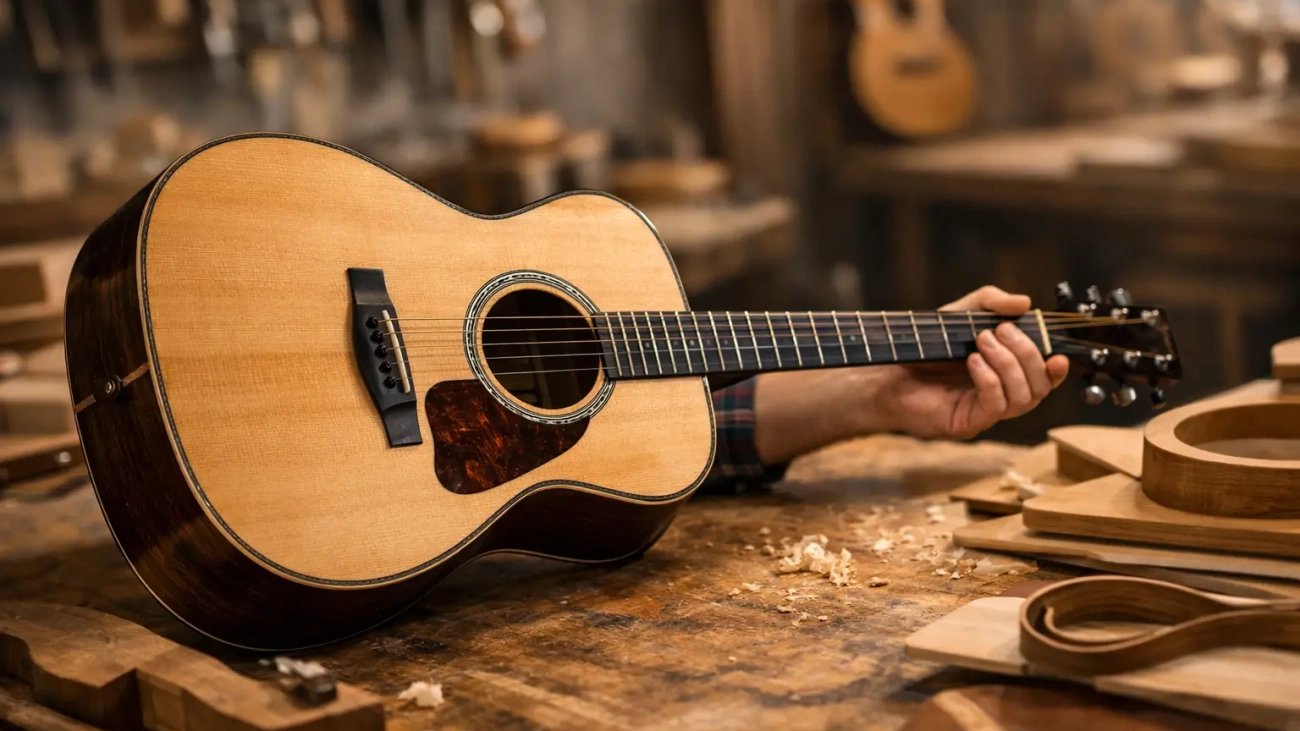
A left handed custom acoustic is not simply a standard guitar turned around. It is an instrument whose geometry, balance, and voice should begin with the player who will bring it to life. For a serious musician, that distinction is felt immediately: in the way the right arm rests against the body, in the freedom of the fretting hand, in the response beneath the fingertips, and in the confidence to shape a phrase without negotiating with the instrument.
Factory left-handed guitars have become more available, which is welcome. Yet availability is not the same as suitability. A player with a developed touch, a particular repertoire, or years of physical habits deserves more than a mirror image of a production model. A custom acoustic offers the rare opportunity to make the guitar an extension of musical intention rather than a compromise made in its absence.
Why a Left Handed Custom Acoustic Begins With the Player
Handedness affects far more than string order. The dominant picking hand is responsible for attack, color, articulation, and dynamic control. The fretting hand governs pressure, shifts, vibrato, and the ease with which harmony can unfold. When a guitar is built for a left-handed player from the outset, the entire instrument can be considered in relation to these movements.
That consideration includes the neck profile and width, string spacing at nut and saddle, fingerboard radius where appropriate, body depth, scale length, and the placement of the armrest or bevel. For a classical guitarist, a few millimeters of nut width or a thoughtfully carved neck shoulder can alter the comfort of extended practice. For a flamenco player, the relationship between action, attack, and the soundboard’s immediate response becomes central. For an archtop player, the neck angle, bridge behavior, and acoustic projection may be shaped around a more percussive or more lyrical approach.
A purpose-built guitar also treats visual balance with the same seriousness as physical balance. The cutaway, pickguard, rosette, headstock detail, and side ornamentation should feel composed for the left-handed orientation, not adapted after the design has already been resolved. An instrument of this caliber ought to look inevitable from every angle.
The Difference Between Conversion and True Left-Handed Construction
Reversing strings on a right-handed guitar is sometimes a practical short-term solution. It can also be a useful experiment for a beginner who is still finding a direction. But it leaves the player with a guitar that was voiced, braced, compensated, and physically shaped for another orientation.
On an acoustic instrument, the bridge saddle is not neutral. Its compensation helps each string play in tune across the fingerboard. The nut slots are cut for specific string gauges. Internal bracing may be asymmetrical, particularly on guitars voiced for a wide palette of bass, treble, and midrange character. Even the placement of a side soundport, a bevel, or an electronics control can influence comfort and function.
A true left-handed build addresses these matters at the design stage. The saddle is compensated for left-handed string order. The bracing is mirrored or, more meaningfully, voiced according to the desired tonal result. The ergonomic features are placed where they serve the player rather than where a template happens to allow them. This is not ornamentation. It is the difference between a guitar that accommodates a musician and one that belongs to them.
Voicing Is More Than Volume
Many players describe a great acoustic guitar as loud. Volume can be valuable, especially in ensemble work or on an unamplified stage, but it is only one dimension of sound. The more enduring question is what the guitar does at low and medium dynamics. Does it retain a singing center? Can a melody emerge above accompaniment without force? Does the bass support the line without clouding it?
These qualities are shaped through the relationship of top thickness, bracing, arching, bridge mass, body air volume, and the character of the woods themselves. A cedar top may offer immediate warmth and a quick bloom under the fingertips. Spruce can provide a wider dynamic ceiling, clarity, and a sense of reserve that deepens with years of playing. Rosewood, maple, cypress, walnut, and other back-and-side choices each bring their own color, sustain, focus, and overtone structure.
There is no universal best combination. A player devoted to Spanish repertoire may seek dry separation, quick decay, and an incisive rhythmic voice. Another may want a classical guitar with long sustain and a broad, orchestral field of color. A jazz musician may favor the focused fundamental and controlled projection of an archtop. The finest material is the material that serves the music, the hands, and the ear.
Designing a Left Handed Custom Acoustic Around Repertoire
The repertoire often reveals more than a list of preferred specifications. It tells the luthier how the player listens.
A musician who spends hours with Villa-Lobos, Bach, and contemporary classical works may need clarity through dense voicings, evenness across positions, and a treble that remains expressive in quiet passages. A flamenco guitarist may require immediate attack, a dry and percussive response, and the headroom to drive rasgueados without losing definition. A singer-songwriter may value a warmer vocal register, controlled overtones, and a body shape that supports long sessions without fatigue.
Technique matters just as much. Fingernail shape, rest stroke versus free stroke, the firmness of the attack, and whether the player tends to sit, stand, record, or perform all influence the brief. A guitar intended primarily for a quiet studio does not need to behave exactly like one expected to fill a recital hall. Asking for more power can mean accepting a different degree of intimacy. Asking for extreme lightness can bring a more immediate voice, while requiring greater care in the long stewardship of the instrument. These are not faults. They are choices with musical consequences.
Ergonomics Should Protect the Long Relationship
A custom instrument can be one of the most practical investments a committed player makes. Physical strain is often gradual: a shoulder that tightens after rehearsals, a wrist that resists a certain chord shape, a neck that feels substantial after an hour even though it seemed comfortable for five minutes in a showroom.
Thoughtful ergonomic design can address those realities. A reduced body depth may improve reach without sacrificing the resonance a player values. A beveled armrest can reduce pressure at the forearm. A carefully selected scale length may ease stretches or increase string tension and definition, depending on the player’s needs. Neck dimensions can support secure thumb placement without creating excess bulk.
The goal is not to make the guitar feel small. It is to make it feel proportionate. A well-designed instrument disappears physically enough that the musician can attend fully to phrasing, time, and sound.
The Value of a Patient Commission Process
A meaningful custom commission is a conversation, not an order form. Measurements matter, but listening matters more. The best decisions emerge when a builder understands what a player hears in admired instruments, what has frustrated them in past guitars, and what kind of music they intend to make over the next decade.
This process benefits from precision. Recordings can reveal whether a player favors a rounded attack or a bright, immediate edge. Existing instruments can identify useful references for neck feel and body size. Discussions of wood, varnish, decoration, and appointments can place the visual language of the guitar in harmony with its voice. Traditional French polish, for example, offers a refined, thin finish that can complement a responsive soundboard, while asking for attentive care from its owner.
At Scharpach, this dialogue is treated as part of the craft itself. More than forty years of luthiery experience informs not only the making of the instrument, but the ability to translate a player’s sometimes instinctive language into practical decisions of structure, proportion, and tone.
What to Bring to the First Conversation
Arrive with clear impressions rather than a rigid specification sheet. Describe the guitars you have loved and the ones you moved on from. Mention the music you play most often, the settings in which you perform, and any tension or discomfort that appears during longer sessions. If you have recordings that capture the sound you seek, they can be useful reference points.
Be equally candid about priorities. Some players want the widest possible tonal range. Others want one unmistakable voice. Some prefer visual restraint, allowing exceptional wood and elegant proportion to speak quietly; others imagine personal inlay or a distinctive rosette that carries private meaning. A master-built guitar can honor either direction, provided the choices remain coherent.
The most valuable request is not for a guitar that does everything. It is for a guitar that tells the truth about your playing. When the instrument is made with that purpose, each practice session becomes less about adapting to an object and more about hearing where your own musical voice can go next.