
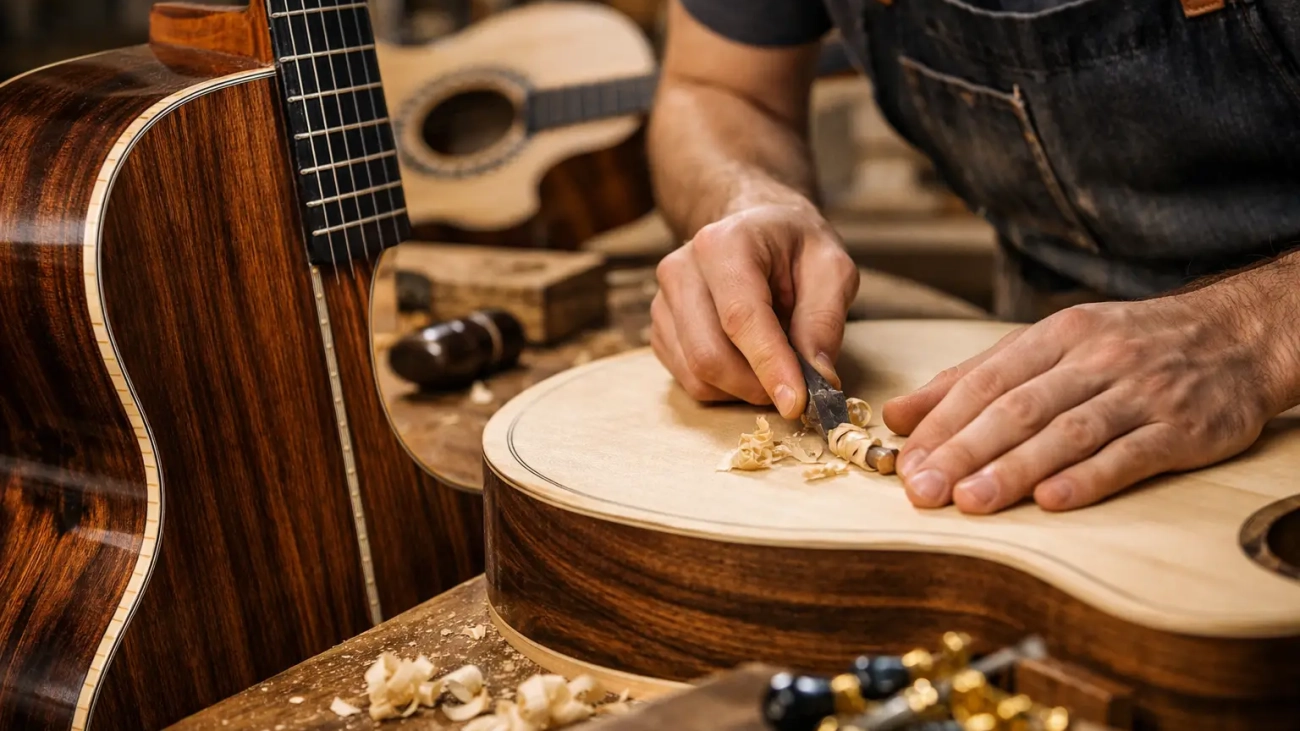
A fine guitar reveals itself in the first held note: not simply through volume, but through the way the sound gathers, blooms, and remains present beneath the hands. A guide to luxury guitar commissioning begins there, with the recognition that a commissioned instrument is not an expensive version of a standard model. It is a musical partnership between player and luthier, shaped around the sound you hear inwardly, the repertoire you carry, and the physical relationship you need with the instrument.
For a serious guitarist, this distinction matters. A factory guitar is designed to satisfy a broad range of hands, rooms, and musical expectations. A master-built commission can be directed toward a far more personal destination: a classical guitar with exceptional separation and color, a flamenco guitar with immediate attack and dry, percussive authority, or an archtop that holds its voice with elegance under a pick.
Begin With Your Musical Voice
The most useful first question is not, “Which wood should I choose?” It is, “What do I need the guitar to say?” A player of Romantic and contemporary classical repertoire may seek sustain, dynamic range, and a singing treble that carries a phrase beyond the initial stroke. A flamenco player may value fast response, clarity under rasgueado, and a bass register that remains defined rather than heavy. A jazz guitarist may prioritize balance, projection, and the articulation that lets complex harmony remain intelligible.
Bring real musical evidence to the conversation. Describe the pieces you play most often, the venues in which you perform, whether you record, and what you find missing in your present guitar. If possible, speak in terms of touch: Do you tend to play with great right-hand weight or a lighter, more nuanced stroke? Do you want the guitar to resist slightly and reward a strong attack, or respond at the faintest gesture?
A skilled luthier listens for more than preferences. They interpret a player’s language into choices of structure, proportion, materials, and setup. That interpretive work is the heart of commissioning. The goal is not to chase a collection of fashionable specifications. It is to create an instrument whose parts serve a coherent musical intention.
What a Luxury Guitar Commissioning Can Change
The principal advantage of a bespoke guitar is that its design can be considered as a whole. Scale length, body dimensions, soundboard voicing, neck profile, string spacing, and finish all influence the final experience. None should be treated as an isolated upgrade.
Tonewoods Are a Starting Point, Not a Guarantee
Tonewoods carry character, but they do not determine the finished voice by themselves. A responsive spruce top may offer clarity, headroom, and a gradual opening of color as the player presses into it. Cedar can present warmth and immediacy, often giving the player a sense of sound arriving close to the hand. Yet individual sets vary profoundly. Their stiffness, weight, grain, tap tone, and seasoning matter as much as their species.
The same is true of back and sides. Indian rosewood is valued for depth and a broad, familiar palette. Maple can bring focus, quickness, and a lucid note center. Cypress remains central to traditional flamenco character, while other carefully selected woods may offer their own balance of warmth, projection, and visual distinction.
An experienced maker selects wood for the particular instrument at hand, not for a label on a specification sheet. The finest material is not merely beautiful. It has the structural and acoustic potential to be voiced into a living sound.
The Soundboard Carries the Most Intimate Decisions
A guitar’s top is thin enough to move, yet strong enough to withstand years of string tension and musical use. Its bracing, thicknessing, arching, and graduation are among the most consequential decisions in the build. This is where a luthier’s accumulated judgment becomes audible.
A lighter, more sensitive top can offer extraordinary immediacy and color, but it may not be the ideal choice for every player or performance environment. A guitar intended for large halls, forceful attack, or a wide dynamic range may need a different balance of stiffness and flexibility. There is no universal “best” voicing. There is only the voicing that best supports the intended player and musical life.
Ergonomics Are Part of Tone
Discomfort changes technique, and altered technique changes sound. For that reason, a luxury commission should treat playability as a central acoustic concern rather than an afterthought.
Neck shape and depth deserve careful attention, especially for players who spend long hours practicing, touring, or recording. Nut width, string spacing at the bridge, fingerboard radius where appropriate, action height, and scale length can all be tailored to the player’s hands and style. A left-handed guitarist, in particular, should not have to accept a compromised adaptation of a right-handed design. A properly conceived left-handed build respects the player’s technique from the beginning.
The right dimensions are rarely dramatic on paper. Their value appears when the player stops negotiating with the guitar and begins making music without hesitation.
The Aesthetic Should Belong to the Instrument
Luxury does not require excess. A rosette, purfling line, headstock, binding, or inlay should feel inevitable within the guitar’s design, not applied as decoration for its own sake. The finest visual details reward close attention while allowing the proportions of the instrument to remain calm and assured.
This is also where personal history can enter the work with restraint. A preferred motif, a piece of figured wood, a subtle color in the rosette, or a meaningful detail concealed inside the instrument can make a commission deeply personal. The question is whether the choice will continue to feel true after decades of playing. Heirloom instruments benefit from clarity of design.
Finish deserves equal care. A thin, thoughtfully applied finish protects the wood while allowing it to vibrate freely. Its visual effect may range from the transparency of a traditional French polish to a more durable modern application, depending on the desired appearance, maintenance expectations, and intended use. French polish possesses a particular depth and sensitivity, but it asks for a considerate owner. A touring musician may reasonably choose a finish with greater resistance to daily wear.
Choosing the Right Luthier
Commissioning asks for trust, so evaluate a maker by more than photographs and ornament. Listen to their instruments whenever possible. Notice whether their guitars possess a recognizable musical integrity across different examples, while still allowing room for the individual player. Examine the finish, joinery, fretwork, setup, and the quiet precision of the work. Craftsmanship is often most evident in details that do not ask to be noticed.
Just as important is the quality of the conversation. A serious luthier should be able to explain trade-offs without reducing them to sales language. They should ask intelligent questions, state their recommendations with conviction, and remain honest about what a particular design can and cannot promise.
At Scharpach, the commission process is grounded in this direct exchange between musician and maker. The instrument develops through a disciplined understanding of materials, resonance, and the player’s individual voice. Over time, that dialogue gives the finished guitar an authority no catalog specification can supply.
Understand the Timeline and the Commitment
A master-built guitar requires patience because many of its essential stages cannot be rushed. Wood must be properly seasoned and selected. The building process unfolds in sequences, with each decision affecting the next. Voicing, fitting, finishing, curing, and final setup all demand time and concentration.
Before confirming a commission, discuss the anticipated build schedule, deposit structure, communication during construction, and the final approval process. Ask how the maker approaches adjustments after delivery, particularly if the instrument will travel across different climates. A fine guitar is made for a long life, but wood remains responsive to humidity and temperature. Careful humidification, sensible handling, and regular professional attention protect both its condition and its voice.
It is also wise to distinguish between an instrument intended primarily for collecting and one intended for daily artistic work. These purposes can overlap, but they may lead to different choices in finish, ornament, materials, and setup. The most valuable guitar is not necessarily the most elaborate one. It is the one that continues to call you back to the chair.
A Commission Is Meant to Deepen With You
A newly completed guitar has a voice, but it also has a future. As the soundboard experiences vibration and the instrument settles into a player’s habits, its response can become more open, more complex, and more distinctly its own. This development is one of the quiet privileges of owning an instrument made with care.
Choose the commission that serves the music you are ready to make now, while leaving room for the musician you will become. The right guitar does not impose an identity. It gives your own voice a more faithful place to live.