
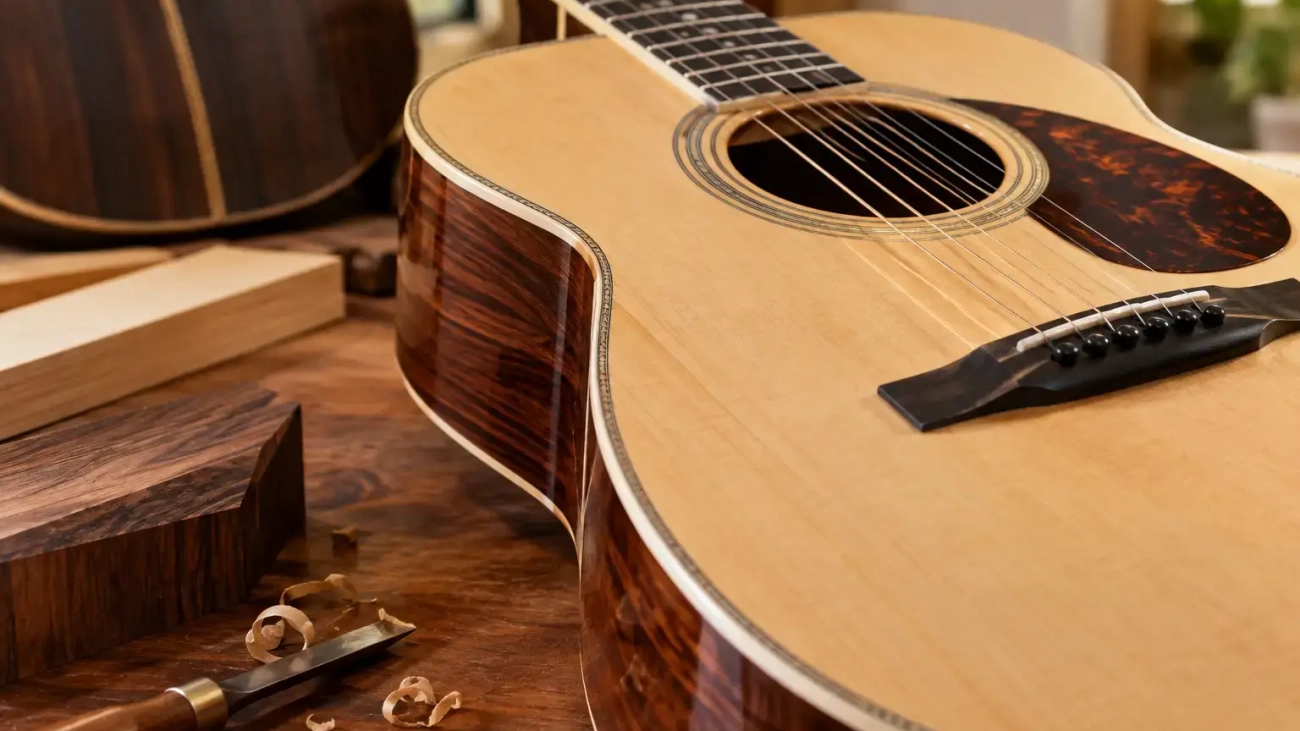
A collector grade acoustic guitar investment begins with a question more discerning than, “What might this be worth later?” The better question is, “Will this instrument still speak to a serious musician decades from now?” Monetary value matters, certainly. Yet the guitars that endure in collections are rarely chosen by speculation alone. They are chosen because the maker’s hand, the materials, and the voice of the instrument form a convincing whole.
For the committed player, a fine acoustic guitar occupies a rare position. It is a functional work of art, shaped by years of training and a particular understanding of sound. It can accompany a performer through recordings, concert halls, private study, and family history. When such an instrument also holds or gains value, that is not an accident. It is the result of artistic integrity, careful stewardship, and the patient recognition of excellence.
What Makes a Guitar Collector Grade?
The phrase “collector grade” is often used too freely. A high price, exotic wood, or a limited production number does not automatically make an acoustic guitar collectible. Collector quality is more demanding. It asks whether an instrument has distinction beyond its moment of sale.
First comes the maker. A guitar by an established luthier with a recognizable body of work carries a different weight from an anonymous instrument, however attractive it may be. Collectors look for a clear artistic identity: a refined approach to voicing, an elegant visual language, consistency in construction, and an earned reputation among serious players. The most respected makers do not simply repeat a formula. They develop a coherent musical point of view.
Then comes the guitar itself. Fine tonewoods must be selected for more than appearance. The stiffness, density, grain, seasoning, and response of spruce, cedar, rosewood, maple, or cypress influence what the instrument can become. A master-grade top may be visually beautiful, but its greater purpose is musical. It must translate the player’s touch into color, projection, sustain, and dynamic range.
Construction reveals whether that potential has been fulfilled. The relationship between top thickness, bracing, bridge mass, neck geometry, and finish is not decorative detail. It is the architecture of resonance. A guitar with a responsive voice at low volume, composure under forceful playing, and clarity across registers has qualities musicians recognize immediately. Those qualities are also central to its long-term desirability.
Sound Comes Before Speculation
A collector may purchase an instrument for historical significance, but a living guitar market is led by the ear. The acoustic guitars most likely to command lasting respect offer an experience that cannot be easily substituted by a factory model or duplicated by a photograph.
Listen for separation between voices, especially in complex chords. Notice whether the treble has substance rather than mere brightness, whether the bass remains defined, and whether the guitar changes character gracefully with the player’s attack. On a classical guitar, the balance between warmth and articulation may be decisive. On a flamenco guitar, immediacy, dryness, and percussive energy can be essential. On an archtop, the relationship between warmth, focus, and projection may determine whether the instrument belongs in a serious collection.
This is why buying unseen can be risky, even when the maker is highly regarded. Specifications describe a guitar’s intentions. They do not replace the physical encounter with its voice.
How a Collector Grade Acoustic Guitar Investment Holds Value
A collector grade acoustic guitar investment is best understood as a long horizon, not a quick trade. The market for fine handmade instruments can be selective. Values rise unevenly, and liquidity is not guaranteed. A guitar may be worth a great deal and still require time to find the right next owner.
Provenance helps bridge that gap. Original papers, a signed label, build records, correspondence with the maker, professional photographs, and documentation of notable performances all strengthen an instrument’s story. For a commissioned guitar, the original specification sheet can be particularly meaningful. It shows the care behind the selection of woods, scale length, neck profile, ornamentation, and tonal direction.
Condition matters just as much. Honest playing wear is often accepted on a guitar that has clearly been loved and responsibly maintained. Structural uncertainty is different. Cracks, poorly executed repairs, altered finishes, replaced bridges, neck issues, or excessive humidity damage can reduce both musical and collector value. Some repairs are necessary and expertly handled repairs need not disqualify a guitar, but originality remains powerful.
The most desirable instruments tend to possess four things at once: a respected maker, exceptional sound, excellent condition, and a well-documented history. Remove one of these, and value may still remain. Remove several, and the guitar becomes harder to place confidently in the upper collector market.
The Importance of Rarity, Without Chasing It
Rarity is valuable only when it is joined to demand. An obscure guitar made in very small numbers may be rare, but scarcity alone does not create a market. By contrast, a respected luthier who produces a limited number of instruments each year may have a meaningful waiting list and an established following among performers. That combination can create enduring interest.
For contemporary commissions, collectors should distinguish between artificial exclusivity and genuine individuality. A one-of-one guitar is not necessarily important because no other exists. It becomes important when its design serves a musical purpose and reflects the maker’s mature work. The finest bespoke instruments are personal without being eccentric. They answer the needs of a particular player while retaining the clarity of the luthier’s voice.
At Scharpach, this principle is central to the commission process. A guitar may be shaped around a player’s repertoire, physical comfort, tonal preferences, and visual sensibility, yet it is still built within a disciplined tradition of acoustic refinement. Individuality is not an ornament placed on the instrument after the fact. It is present in the way the guitar responds.
Buy With Your Hands, Ears, and Records
A prudent collector approaches a fine guitar from three directions. The hands assess comfort, setup, balance, and ease of expression. The ears assess the instrument’s voice. The records establish what it is, who made it, how it has been cared for, and where it belongs within the maker’s work.
Play the guitar in a quiet room, then ask how it performs at the dynamic extremes. Does it offer resistance that encourages control, or does it feel unresponsive? Does the sound remain compelling after an hour, when first impressions have settled? A mature instrument need not be loud to be commanding. Often, its authority lies in the complexity and carrying quality of its voice.
Examine the instrument under good light. Look at the top arch or doming, the bridge area, fretwork, neck angle, finish integrity, and signs of movement around joints. Ask direct questions about humidity control, previous repairs, refrets, and setup history. A respected repair technician can provide valuable perspective before a significant purchase, especially with older instruments.
Documentation should be preserved from the beginning. Keep invoices, certificates, appraisals, correspondence, and detailed photographs in a dedicated file. If the instrument is insured, update its appraisal as its market position changes. This is not bureaucracy for its own sake. It is part of caring properly for an object whose artistic and financial value are intertwined.
Care Is Part of the Investment
Even the finest guitar is made of living material. Wood responds to changes in humidity and temperature, and a collector’s care has direct consequences for longevity. Stable relative humidity, a quality hard case, sensible handling, and regular inspection by a qualified technician protect both the instrument and its value.
Avoid treating a rare guitar as either a fragile museum object or an indestructible tool. A great acoustic instrument is built to be played. Regular, thoughtful playing can reveal its tonal depth and keep the relationship between musician and guitar alive. But it should be played with awareness. Leaving it near heat, storing it in a dry room, or delaying attention to a developing issue can turn a small concern into an expensive repair.
The strongest collection is not assembled from price charts. It is shaped by conviction, knowledge, and a willingness to wait for instruments with real musical substance. Choose the guitar whose voice continues to reveal itself in your hands, care for it with discipline, and let time do the quiet work that true craftsmanship deserves.