
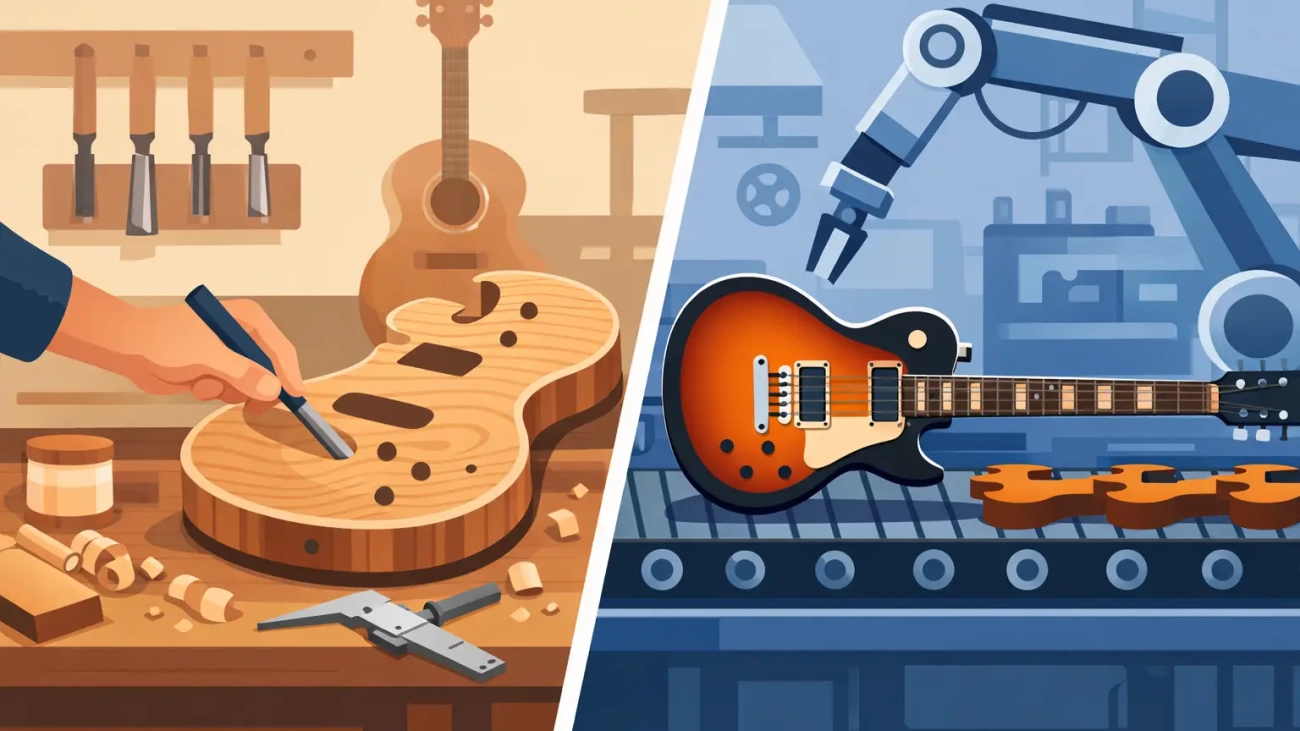
A player knows the difference within seconds. Not from a label on the headstock, but from the way the first note rises, how the neck settles into the hand, and whether the instrument seems to resist expression or invite it. That is the real question behind custom guitar versus factory guitar. It is not simply a matter of price or prestige. It is a matter of whether the guitar was built to meet a market, or built to meet a musician.
For casual use, a factory instrument can be entirely serviceable. Many are well made, stable, and musically satisfying within their category. But serious players tend to reach a point where standardization begins to feel like a limit. The ear becomes more selective. The touch becomes more precise. Subtle imbalances in response, weight, setup, or tonal color stop being minor inconveniences and start shaping the music itself.
Custom guitar versus factory guitar begins with intention
A factory guitar is designed around efficiency and repeatability. Even at a high level, production depends on templates, batch processing, standardized dimensions, and predictable output. This approach has clear strengths. It makes instruments more widely available, keeps pricing more accessible, and can produce consistent results across a line.
Yet consistency is not the same as individuality. The factory model is built around averages – average hand size, average repertoire, average tonal preference, average expectations for playability. That makes sense in industrial production. It is far less compelling when a guitarist has spent years refining touch, attack, right-hand color, or left-hand technique.
A custom guitar begins from the opposite direction. It starts with the player and asks what the instrument must do, not what the market will accept. Scale length, neck shape, string spacing, body dimensions, responsiveness, projection, tonal balance, aesthetic details, and even the physical relationship between arm, shoulder, and hand can all be shaped with purpose. The result is not novelty for its own sake. It is coherence.
Tone is where the custom guitar versus factory guitar debate becomes serious
Every guitarist speaks about tone, but experienced players know tone is not one thing. It is a field of relationships: immediacy and depth, clarity and warmth, attack and sustain, focus and bloom. A factory guitar may offer a pleasing general voice. A custom instrument can be voiced with far greater specificity.
That difference begins with wood selection, but it does not end there. Material alone does not create musical character. Two tops cut from the same species can behave very differently. What matters is how each piece is evaluated for stiffness, elasticity, weight, grain structure, and potential. In a custom atelier, woods are not simply chosen by category. They are matched, tuned, and worked in dialogue with the intended result.
Bracing, thicknessing, top and back interaction, bridge weight, varnish, and countless minute decisions all shape resonance. A master luthier does not merely assemble premium materials. He draws out a voice from them. For a classical guitarist seeking lyrical sustain and layered overtones, the instrument can be guided one way. For a flamenco player who needs immediacy, dry attack, and crisp articulation, it can be guided another. For an archtop player requiring projection, warmth, and separation under the pick, the architecture changes again.
This is where custom work becomes especially meaningful. The instrument is not asked to be good at everything. It is asked to excel at something specific.
Playability is never generic
One of the quiet frustrations of factory guitars is that players often adapt themselves to the instrument. They tolerate a neck profile that almost works. They compromise on nut width. They accept an action that is technically correct but not personally ideal. Over time, these compromises become physical habits.
A custom instrument reverses that relationship. It is designed around the way the player actually performs. That matters for professionals, but it matters just as much for dedicated amateurs whose sensitivity may be every bit as refined. A left-handed guitarist, a player with smaller hands, someone balancing power with comfort in long sessions, or a musician navigating repertoire with very different technical demands can all benefit from dimensions that are intentional rather than assumed.
The effect is not only ergonomic. It is artistic. When the guitar feels naturally aligned with the body, technical effort recedes and phrasing becomes freer. The player spends less energy negotiating the instrument and more energy shaping sound.
Materials, finish, and the question of longevity
Factory instruments are built under production realities. Timelines are tighter. Material yield matters. Finishes often favor durability and speed. None of this automatically makes a guitar poor. It simply means that the priorities are broader than pure musical refinement.
In a custom build, the hierarchy is different. The best materials are selected not because they scale well across hundreds of units, but because they serve a singular instrument. That may include exceptional tonewoods, but also subtler choices in neck construction, fingerboard selection, internal voicing, and finish application.
Finish deserves more attention than it often receives. Heavy finishes can inhibit resonance, even when they provide admirable protection and visual uniformity. A finely judged varnish or thin finish asks more of the maker and sometimes more of the owner as well. But the reward can be a livelier, more open instrument, one that responds with greater sensitivity to nuance.
Longevity follows from this philosophy. A well-built custom guitar is not simply meant to survive. It is meant to mature. Its tonal character can deepen with years of playing, as the structure settles and the wood opens. For many musicians and collectors, that evolution is part of the point. The guitar becomes more itself over time.
Cost matters, but value is the better question
It would be disingenuous to pretend this choice is only aesthetic. A custom guitar requires a significant investment. A factory guitar, even an excellent one, usually offers a faster and more affordable route to ownership.
So the better question is not which costs more. It is what kind of value the player is seeking.
If the goal is immediate access to a competent instrument, factory production often makes perfect sense. If the goal is to own a guitar that reflects years of musical self-knowledge, supports a highly developed technique, and carries lasting artistic and material value, the custom route becomes much easier to justify.
There is also value in the process itself. Commissioning an instrument invites reflection. What do you hear when you play? Where does your current guitar hold you back? What kind of resistance do you want under the fingers? What repertoire defines your sound? These are not decorative questions. They are musical questions, and answering them often clarifies a player’s artistic identity.
Who should choose custom, and who may not need it yet
Not every guitarist needs a custom instrument today. A student still developing technique may benefit more from exploration than specialization. A player who has not yet formed clear preferences in response, neck geometry, or tonal color may be better served by spending time with excellent existing instruments first.
But there is a moment when custom becomes not indulgence, but logic. It tends to arrive when a musician can describe what is missing with precision. Perhaps the trebles do not sing the way they should. Perhaps the basses are too polite. Perhaps the guitar lacks projection in a hall, or warmth under the microphone, or comfort across long practice sessions. Once those needs become specific, a standardized instrument begins to feel like an approximation.
For the serious guitarist or collector, a bespoke instrument offers something rarer than exclusivity. It offers alignment. In the hands of a master builder such as Theo Scharpach, that alignment is pursued at every level – acoustic, structural, tactile, and visual.
The real difference in custom guitar versus factory guitar
The deepest difference is not visible from across the room. It lives in the relationship between maker, material, and musician. A factory guitar is produced to satisfy a category. A custom guitar is built to reveal a voice.
That does not mean every player must reject factory instruments. Many have made meaningful music on them, and many still do. But for those who have developed a clear ear, a disciplined touch, and a personal musical language, there is profound value in an instrument that answers back with equal specificity.
The right guitar should do more than function well. It should deepen your listening, sharpen your touch, and make you want to play with greater honesty. When an instrument begins to do that, the decision is no longer about custom or factory in the abstract. It becomes personal, which is exactly where serious music begins.