
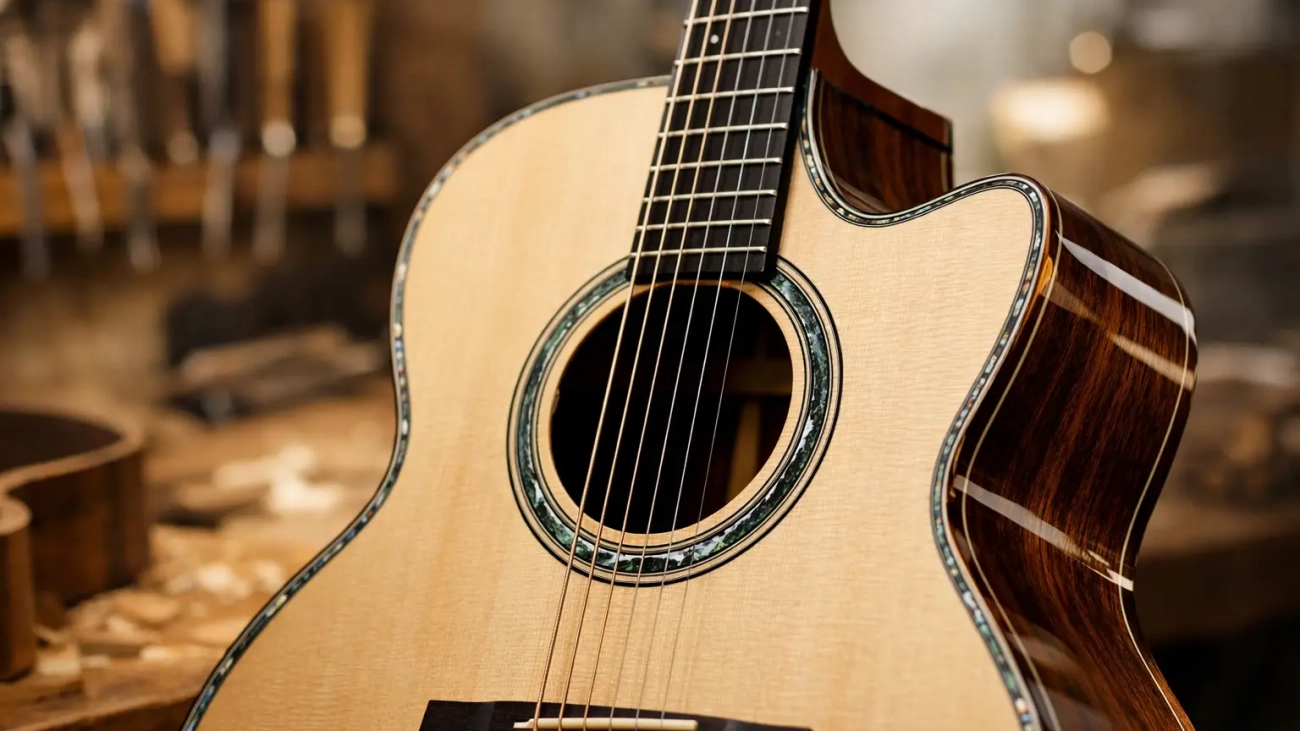
A serious master grade acoustic guitar review begins before the first chord is struck. It begins with a question: does this instrument allow a player to hear more of themselves? At the highest level, a guitar is not defined by a dramatic piece of rosewood or a flawless finish alone. It is defined by the relationship between the player’s touch, the air moving within the body, and the voice that emerges.
This distinction matters because the phrase “master grade” is used loosely. It can describe visually exceptional timber, meticulous construction, or a complete instrument made at the highest artistic level. Those are related qualities, but they are not interchangeable. A beautiful guitar may be visually master grade while remaining musically ordinary. A truly exceptional instrument must unite material, design, workmanship, and tonal intention.
What “Master Grade” Should Mean
In its narrowest sense, master grade often refers to tonewood with unusually refined visual character: straight, even grain in spruce or cedar; deep color and striking figure in rosewood, maple, or koa; careful seasoning and freedom from cosmetic defects. These qualities are desirable, especially on an instrument commissioned as a lifelong companion. Yet appearance does not tell the whole story of acoustic potential.
For a luthier, the more meaningful question is how a particular piece of wood behaves. Its stiffness, density, weight, grain structure, and responsiveness determine how it can be voiced. Two sets of wood from the same species may look nearly identical while asking for very different treatment at the bench. One may offer clarity and reserve. Another may possess an immediate, open bloom that rewards a lighter structure.
Master-grade work, then, is not a catalog of expensive materials. It is the judgment to select materials for a specific musical purpose, then shape every part of the guitar around that purpose. The top is graduated to speak freely without losing strength. Bracing is tuned to support projection, color, and separation. The neck geometry is considered as carefully as the rosette, because an instrument that does not invite the hand cannot fully serve the musician.
Master Grade Acoustic Guitar Review: Listen Beyond Volume
Volume is easy to notice and easy to overvalue. A guitar that fills a room can be thrilling, particularly in a shop environment. But projection is not merely loudness. The finest acoustic instruments carry a focused, complex signal that remains intelligible across a hall, among other instruments, or under a microphone.
Begin with the fundamental note. Does it arrive immediately when played softly, or must the player force the string to make the guitar respond? A master-level instrument should have a low threshold of activation. It should reward the smallest change in pressure, angle, and attack. For classical and fingerstyle players, this sensitivity is often where the guitar becomes a true extension of the hand.
Then listen to the overtone structure. A rich guitar does not need to be blurred. Ideally, the note contains color around its center: a singing treble, a warm but articulate middle register, and bass notes with depth rather than indistinct boom. Play a slow scale and let every note decay fully. If certain pitches leap forward while neighboring notes disappear, the instrument may be exciting but not necessarily balanced.
Sustain also deserves careful attention. Long sustain is valuable, but it is not automatically musical. Some players want a note that lingers and unfolds, particularly for lyrical repertoire or solo recording. Others, including flamenco players, may prefer a faster decay and a dry, percussive response that preserves rhythmic definition. The right review does not award points for the longest ring. It asks whether the decay suits the player’s repertoire and musical language.
Dynamic Range Is the Real Test
A refined guitar should remain composed at both ends of its dynamic range. Played quietly, it should retain color and pitch definition. Played with conviction, it should open rather than harden. Listen for compression, the moment when added force produces more noise but little additional musical energy.
This is where thoughtful voicing becomes apparent. A concert guitarist may need headroom for a large hall without sacrificing delicacy in a pianissimo passage. A recording musician may favor a more immediate, nuanced voice that speaks close to the microphone. Neither preference is universally superior. The instrument must be judged against the work it is meant to do.
Craftsmanship You Can Hear and Feel
At this level, workmanship is not decoration. It is discipline made visible. Examine the meeting of the neck and body, the consistency of the binding, the cleanliness of the purfling, and the precision of the frets. Fine details reveal patience, but they also suggest the standard applied to less visible decisions inside the instrument.
The finish deserves particular attention. A beautifully applied varnish or French polish should protect the wood while allowing it to vibrate. An overly heavy finish can restrain the top, while an excessively delicate finish may demand more care than a touring player can reasonably give. There is no single perfect finish. There is only the appropriate balance among resonance, visual depth, repairability, and the owner’s life with the instrument.
Comfort is equally central. A guitar may possess an extraordinary voice yet fail to become a daily partner if its neck profile causes fatigue or its body dimensions fight the player’s posture. The distance between strings, nut width, scale length, fingerboard radius, and action are not minor specifications. They determine how freely a musician can phrase, shift, articulate, and remain relaxed through a long performance.
For left-handed players, this consideration becomes even more significant. A genuine left-handed build is more than a reversed string order. The internal voicing, bracing relationship, bridge compensation, and ergonomic choices should be conceived for the instrument’s orientation from the beginning.
The Difference Between Fine Materials and a Fine Guitar
A review should be cautious with superlatives. Exotic wood, ornate inlay, and a prestigious name can create an expectation of greatness before the player has heard a single phrase. Yet the most memorable instruments often have a certain simplicity. Nothing calls attention to itself at the expense of the music.
That simplicity is difficult to achieve. It comes from hundreds of interdependent choices: how thin the top can be safely taken, where stiffness is retained, how the bridge transfers energy, how the air cavity supports the lower register, and how the entire structure will mature with years of playing. A guitar built with sensitivity continues to reveal new shades as the player’s ear develops.
This is also why factory comparisons have limits. Production instruments can offer remarkable consistency and strong value. For many musicians, they are exactly the right choice. But a commission from an experienced maker offers a different proposition: the possibility of building toward a particular hand, repertoire, tonal image, and visual sensibility. At Scharpach, that conversation is treated as part of the craft, not as a preliminary sales step.
How to Evaluate One in Person
If possible, spend unhurried time with the guitar in a quiet room. Start with music you know deeply, not a showpiece designed to impress someone else. Play familiar scales, chord voicings, rasgueados, arpeggios, and passages at varying dynamics. Your hands will detect resistance and your ears will recognize whether the guitar makes your usual phrases more convincing.
Ask another musician to play while you listen from several feet away. The sound under the player’s ear can differ greatly from the sound projected outward. If the instrument will be recorded, test it with the microphone approach you actually use. A guitar that sounds enormous in a room may need careful placement in the studio, while a more balanced, articulate instrument may sit beautifully in a mix.
Finally, allow room for the emotional response. This is not sentimentality. When an instrument feels alive, players practice longer, listen more closely, and take greater artistic risks. The right guitar does not replace technique or musical thought. It gives both a more generous place to speak.
A master-grade guitar earns its place over years, not minutes. Choose the one whose voice continues to invite a return to the chair, the stand, and the next phrase waiting to be played.