
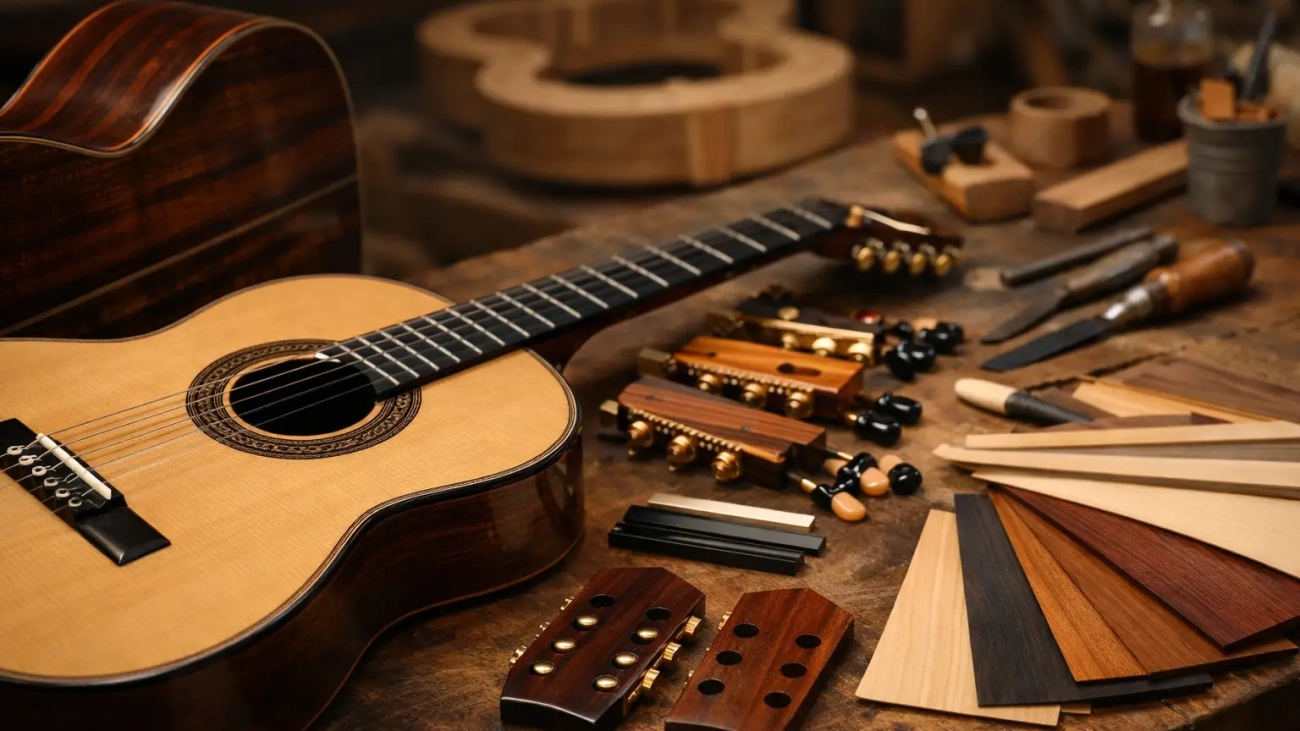
A fine classical guitar should not ask a player to adapt to its limitations. It should meet the player at the point where technique, repertoire, touch, and imagination become inseparable. That is the promise behind the best custom options for classical guitars: not ornament for its own sake, but purposeful choices that allow an instrument to speak with greater clarity, ease, and character.
For a serious musician, customization begins long before a rosette is chosen. It begins with a question: what sound do you hear when you play? The answer may be a luminous, singing treble for Romantic repertoire; a dark, spacious bass for modern works; or the quick, articulate response required for flamenco-inflected phrasing. A master-built guitar can be shaped around that answer, but every decision carries a trade-off. The most compelling commissions are guided by musical priorities rather than a catalog of upgrades.
Best Custom Options for Classical Guitars Begin With Sound
The top, or soundboard, remains the heart of a classical guitar. It is also one of the most consequential choices a player can make. European spruce is prized for its clarity, headroom, and focused projection. It often rewards a player whose touch is deliberate and nuanced, revealing more complexity as the instrument matures. Cedar, by contrast, tends to offer immediate warmth, color, and responsiveness under a lighter touch. Its voice can feel intimate and generous from the first note.
Neither is universally superior. A concert player who needs definition in a large hall may lean toward spruce, while a player seeking a round, lyrical voice for close recording or expressive solo work may find cedar more natural. The individual piece of wood matters as much as the species. Density, stiffness, grain structure, and seasoning all affect the final result. Material selection at this level is not decorative shopping. It is the first stage of voicing an instrument.
Back and side woods refine the sound rather than simply adding visual distinction. Indian rosewood is admired for its rich overtone content, strong bass foundation, and broad dynamic range. Madagascar rosewood may offer exceptional clarity and separation alongside depth. Cypress is lighter and more immediate, traditionally associated with flamenco but capable of a direct, vivid voice in a classical setting. Maple can bring fast response and transparency, allowing the fundamental note to stand clearly within complex passages.
A player should think about the room, repertoire, and ensemble context in which the guitar will live. A richly overtone-heavy instrument can be magnificent alone, yet a more fundamental, articulate voice may sit more clearly alongside other instruments or microphones.
Bracing and Body Design Shape the Instrument’s Language
Bracing is where a luthier’s experience becomes audible. The pattern beneath the soundboard governs how it moves, how quickly it responds, and how its tonal colors are balanced across the register. Traditional fan bracing can produce a familiar, deeply musical classical voice, while more evolved patterns may increase projection, sustain, or separation without sacrificing refinement.
This is not an area best reduced to a single formula. A guitar intended for a forceful concert performer may need a different balance of stiffness and flexibility than one built for a player with a subtle, close-to-the-string touch. The scale length, body proportions, bridge design, and top thickness must work as a single system. A successful custom instrument does not merely have desirable specifications. Its components are in conversation with one another.
Body dimensions also deserve consideration. A slightly larger body can offer greater air movement and bass presence, but it may alter the player’s right-arm position. A more compact body can feel immediate and comfortable while retaining remarkable power when intelligently voiced. For many players, the right answer is not the largest possible sound, but the sound that arrives with the least effort and the greatest control.
Neck Geometry Is One of the Most Valuable Custom Choices
A beautiful voice loses meaning if the guitar resists the hands. Neck customization is often the difference between an excellent instrument and a lifelong companion. Classical players should consider scale length, nut width, string spacing at the bridge, neck profile, fingerboard radius, and setup height as connected decisions.
The traditional 650 mm scale length offers a familiar feel and firm string tension. A 640 mm or 630 mm scale can reduce the left-hand stretch and make demanding repertoire more comfortable, particularly for players with smaller hands or those managing fatigue. The change is meaningful, though it may slightly affect tension, projection, and the spatial feel of the fingerboard.
Nut width and string spacing should serve the player’s technique. A wider neck can give the right hand more room for clean articulation, yet it may feel demanding for extended left-hand reaches. A modestly narrower configuration can offer comfort without compromising classical precision, depending on the player’s hand shape and repertoire. There is no correct measurement in isolation. The best dimensions are the ones that disappear beneath the hands.
For left-handed guitarists, a true left-handed build is more than a reversed string arrangement. Bracing, bridge compensation, voicing, visual balance, and ergonomic details should all be conceived for the instrument’s intended orientation. A dedicated build respects the player rather than asking them to make do with a compromise.
Setup, Action, and Playability Must Be Personal
Action is commonly discussed as a number, but it is better understood as a relationship between string height, attack, fretwork, tension, and the player’s touch. A lower action can make fast passages and extended practice more comfortable, but set too low, it may limit the player’s ability to attack the strings with authority. A higher action can support volume and dynamic range, though it demands more from the left hand.
The ideal setup depends on whether the musician plays primarily classical repertoire, flamenco, contemporary music, or a blend of styles. It also depends on nail shape, right-hand power, and the degree of acceptable string noise. Precise fretwork and a carefully shaped fingerboard provide the foundation. Fine adjustment then brings the instrument into alignment with the player’s real musical life.
Finish and Aesthetics Should Serve the Instrument
A guitar’s finish is not merely its surface. It influences how freely the wood can vibrate and how the instrument will age. French polish, applied in patient, whisper-thin layers of shellac, remains revered for its elegance, repairability, and acoustic lightness. It can allow a responsive top to breathe with unusual freedom. Its trade-off is vulnerability: it asks for more care than a heavier modern finish.
A thin lacquer finish may provide greater day-to-day resilience while preserving much of the guitar’s tonal potential when expertly applied. The choice should reflect the player’s habits. A touring artist may value durability; a collector or careful home player may be drawn to the living beauty of French polish.
Visual details carry emotional weight when handled with restraint. A custom rosette, purfling, arm bevel, headstock design, or selected set of figured wood can make a guitar unmistakably personal. Yet simplicity has its own authority. The finest aesthetic choices honor the material and never distract from the instrument’s voice.
The Consultation Is the Most Important Custom Feature
Players often arrive with a list of specifications. That is useful, but a meaningful commission goes further. The builder should learn how the musician plays, what instruments they have loved or outgrown, which tonal qualities they seek, and where discomfort appears after an hour of practice. Recordings, repertoire, performance settings, and even a player’s language for describing sound can reveal essential direction.
At Scharpach, the commission process is grounded in this conversation between player and maker. More than forty years of luthiery experience matters not as a claim of age, but as a developed ability to translate a musician’s impressions into wood, structure, and response.
The most enduring custom guitar is not necessarily the one with the most unusual features. It is the one whose sound, proportions, and visual presence feel inevitable in the player’s hands. Give the builder an honest account of your musical voice, and let the instrument become a place where that voice can continue to deepen for decades.