
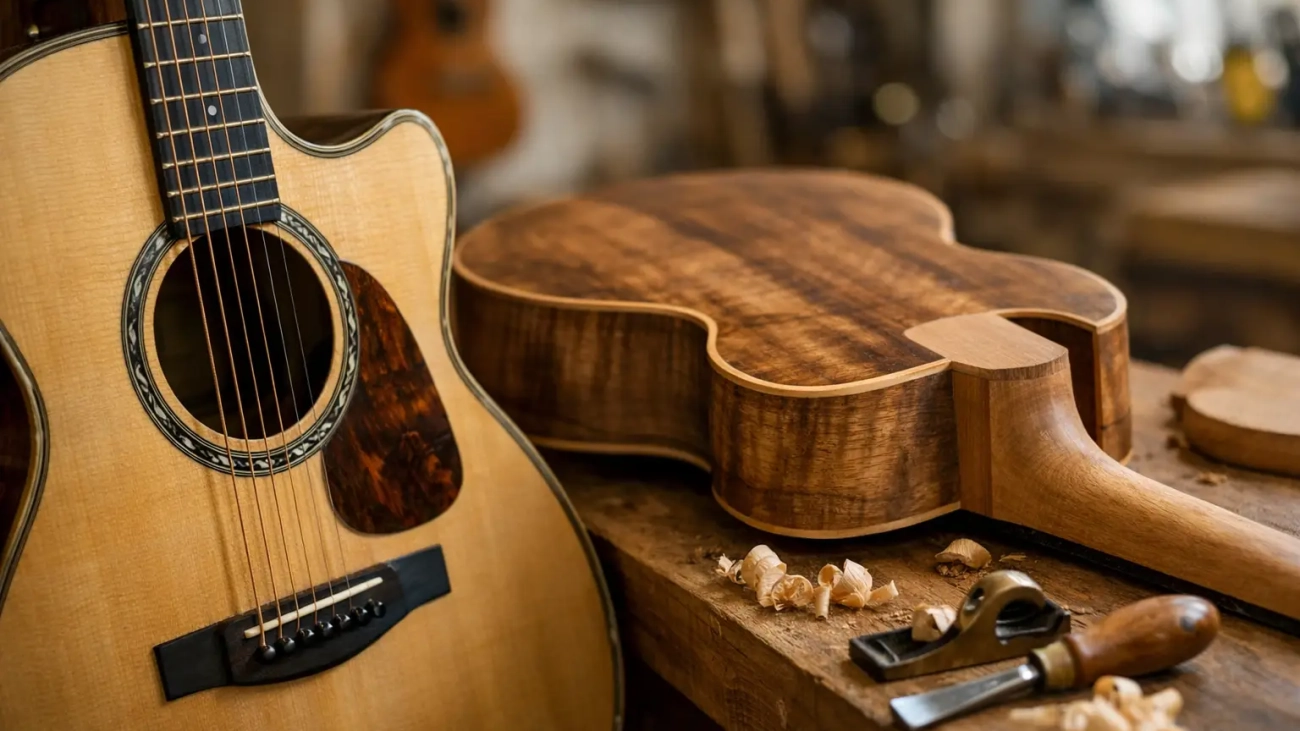
A guitarist knows the moment. You pick up an instrument that is technically excellent, beautifully finished, even expensive, and yet something remains slightly out of reach. The neck does not quite disappear into the hand. The response under the right hand feels close, but not intimate. The voice is good, but it is not your voice. That is where the question begins: are custom guitars worth it?
For some players, the answer is plainly yes. For others, no matter how fine the workmanship, a bespoke instrument would be more luxury than necessity. The real difference lies in how seriously you depend on the guitar as an extension of touch, repertoire, and musical identity.
When are custom guitars worth it?
Custom guitars are worth it when a player has outgrown compromise. That can mean many things. A concert classical guitarist may need a very specific balance between clarity and warmth across the registers. A flamenco player may want immediacy, dryness, and a particular percussive attack that factory instruments rarely deliver with precision. An archtop player may be searching for a voice that sits in an ensemble with elegance rather than sheer volume.
In each case, the instrument is no longer just a purchase. It becomes a collaboration between musician and builder.
A factory guitar, even an excellent one, is designed around averages. Average hand dimensions, average setup preferences, average tonal expectations, average repertoire. That approach serves many players well. It also leaves serious musicians adapting themselves to the instrument rather than the instrument being shaped around the musician.
A custom build changes that relationship. Scale length, neck profile, nut width, body depth, action, string spacing, top stiffness, wood selection, and voicing can all be chosen with intention. These are not cosmetic details. They affect fatigue, articulation, projection, color, and the confidence with which a player approaches the instrument.
The real value is not only rarity
One of the weakest reasons to commission a custom guitar is simply that it is exclusive. Exclusivity has appeal, of course, but rarity alone does not make an instrument meaningful. What justifies a bespoke guitar is the union of musical function and artistic refinement.
The best custom instruments offer a more exact response to the player’s technique. They can feel quicker under the fingertips, more open in the midrange, more stable in dynamic contrast, and more coherent from one register to the next. A fine builder is not only assembling premium materials. He is shaping how the guitar breathes.
This is why experienced players often speak less about specifications and more about response. They describe an instrument that gives back more than expected, one that seems to anticipate nuance rather than resist it. That sense of ease is difficult to quantify, but unmistakable once encountered.
There is also a longer horizon to consider. A master-grade custom guitar is often built with greater patience, more selective woods, and a deeper understanding of tonal development over time. If the instrument is made well, it does not merely hold its voice. It matures into it.
Why some players should not buy one
It would be dishonest to claim that every guitarist needs a custom instrument. Many do not.
If your preferences are still changing rapidly, a bespoke commission may come too early. If you are experimenting with technique, repertoire, or even the kind of guitar you truly want, a custom build can freeze decisions that are not yet mature. Likewise, if you are happy on a well-made production guitar and do not feel limited by it, there may be little practical benefit in replacing certainty with aspiration.
Budget matters as well. A custom guitar is a serious investment, and it should remain a source of artistic freedom rather than financial strain. The finest instrument in the world loses some of its grace if it arrives burdened with regret.
There is another practical point. Not every custom guitar is automatically superior to a top-tier factory instrument. The quality of the builder, the clarity of the consultation, and the alignment between player and luthier matter immensely. A poorly conceived custom guitar is still a poor guitar, only more expensive and more personal.
The difference between custom and high-end production
This is where the topic deserves nuance. High-end production guitars can be superb. They benefit from consistency, proven designs, and in many cases remarkable value for the quality offered. For players who want excellence without a long commissioning process, they can be the right choice.
But even the finest production instrument is built to a model. A custom guitar is built to a person.
That difference affects more than measurements. It affects priorities. A production model may be designed to please the broadest range of advanced players. A custom instrument can be designed around the exact way one player draws tone from the string, balances bass against treble, or needs the neck to sit in the hand over long sessions.
For left-handed players, this distinction can be even more significant. The market has never served them generously. A true custom build removes the feeling of adaptation or compromise and restores the instrument to its proper purpose: to serve the player fully, not approximately.
What you are really paying for
When people ask whether custom guitars are worth it, they often focus first on materials. Certainly, woods matter. So do varnish, construction methods, and the seasoning and selection behind every component. But materials alone do not explain the cost.
What you are paying for is judgment.
You are paying for the trained ear that hears how a top should be voiced. For the experienced hand that understands how subtle changes in thickness alter liveliness, sustain, and balance. For decades spent learning how beauty, structure, and resonance must cooperate rather than compete.
You are also paying for time. Not time in the casual sense, but concentrated time – time without hurry, time devoted to decisions that cannot be rushed if the result is to carry depth and permanence.
In a true atelier setting, consultation itself has value. A skilled luthier helps the player clarify preferences that may have been felt but never articulated. He translates touch, repertoire, and sonic ambition into physical form. That act of listening is part of the instrument.
Are custom guitars worth it for tone alone?
Sometimes yes, but tone alone is too narrow a standard.
A custom guitar may indeed offer greater richness, projection, separation, sweetness, or immediacy than what a player has owned before. Yet the most meaningful improvement often comes from the relationship between tone and control. A beautiful sound matters more when it arrives with less effort and more precision.
That is why the finest bespoke instruments often feel liberating. They do not simply sound better in the abstract. They allow the musician to shape phrasing, dynamics, and color with more confidence. The instrument becomes less of an obstacle and more of a partner.
For professionals and advanced players, that can justify the investment on its own. For collectors, there is an additional dimension: the privilege of owning an object made with singular purpose, one that reflects a particular vision of the guitar at its highest level.
The emotional argument is valid too
Not every worthwhile decision in music can be defended by efficiency.
A custom guitar can carry emotional significance that no production instrument, however good, can fully replicate. It may mark a turning point in a career, a return to serious playing, or the culmination of years spent learning what one truly wants from an instrument. The commission process itself can deepen the bond. By the time the guitar arrives, it is not anonymous. It already belongs to a story.
That does not make the decision irrational. On the contrary, for many serious musicians, emotional connection is part of performance. The more deeply a player identifies with an instrument, the more naturally expression follows.
At Scharpach, this is understood as a matter of musical truth rather than luxury. The goal is not ornament for its own sake, but an instrument whose resonance, form, and feel honor the individuality of the person playing it.
So, are custom guitars worth it?
They are worth it when you know enough about your playing to ask for something precise, when your instrument must answer to your hands rather than a market category, and when craftsmanship matters to you not as branding but as lived musical experience.
They are not worth it if you are chasing status, buying beyond your means, or hoping a bespoke guitar will solve problems rooted in technique or uncertainty.
For the right player, though, a custom guitar is one of the few objects that can justify its cost over decades. It can outlast trends, outgrow first impressions, and become more itself with age. And if you have ever felt that the instrument in your hands was almost right but never entirely yours, that may be reason enough to listen more closely.