
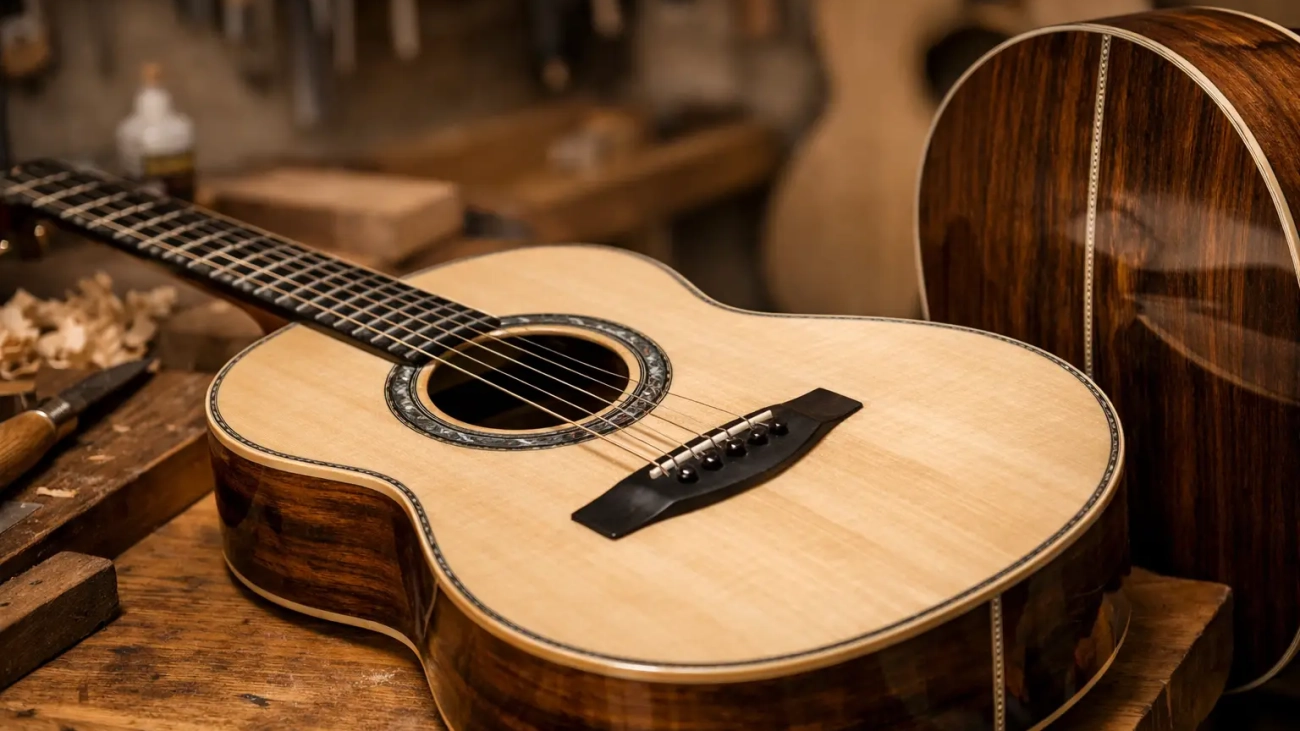
A serious player can feel the difference before the first full phrase is finished. The note leaves the string, enters the body, and returns with a kind of authority – not louder for the sake of volume, but more complete, more articulate, more alive. That is where premium acoustic guitars begin to separate themselves from ordinary instruments. They do not simply produce sound. They translate intention.
For many musicians, the search for a better guitar starts with disappointment. Factory instruments may be competent, even attractive, yet still resist the hand in subtle ways. The attack feels blunt. The response arrives a fraction too late. The bass overwhelms the trebles, or the trebles refuse to sing. Over time, the player adapts to the instrument’s limitations instead of the instrument serving the player’s voice. In the highest tier of guitar making, that compromise is no longer acceptable.
Why premium acoustic guitars feel different
The difference is not marketing language, exotic decoration, or a higher price tag alone. It begins with the fact that a fine acoustic guitar is an acoustic system under tension, where every choice affects every other choice. Top thickness, brace shaping, body geometry, neck profile, scale length, bridge weight, finish, and setup all influence how the instrument breathes and responds.
On a lesser build, these elements are often standardized for efficiency. On a superior build, they are adjusted in relation to one another. That distinction matters. A gifted luthier does not merely assemble quality components. He listens to the wood, understands its stiffness and elasticity, and builds toward a tonal outcome rather than a production target.
This is why two guitars made from the same species can sound profoundly different. Spruce is not simply spruce. Rosewood is not simply rosewood. Within each set of tonewood lives a different character – density, grain structure, velocity of sound, overtone behavior, damping. The work of the maker is to read those qualities and coax them into balance.
Materials matter, but judgment matters more
Discussions of premium instruments often begin with woods, and rightly so. The top remains the primary engine of the guitar’s voice. Cedar can offer immediacy, warmth, and lyrical color. Spruce often provides greater headroom, clarity, and long-term development. Backs and sides shape reflection, sustain, and tonal contour. Ebony, rosewood, maple, cypress, and other choices each contribute their own strengths.
Yet material alone does not create refinement. A superb set of wood in indifferent hands will not become a superb guitar. What elevates the final result is judgment – how the top is voiced, how the braces are tuned, how the body is allowed to resonate without losing structural integrity. Premium making is not a matter of adding more. It is often a matter of removing precisely enough.
The same is true of finish. A thick finish can inhibit movement and mute complexity. A finely applied varnish or carefully controlled thin finish protects the instrument while preserving its capacity to vibrate freely. This is one of those details many players cannot identify immediately by sight, yet they recognize it instantly in feel and tone. The guitar seems less covered and more awake.
Tone is only one part of the instrument
Players often speak about sound first, but a great guitar is also a physical relationship. The neck must invite rather than fight. String spacing must support the repertoire. Action must be low enough for ease and high enough for tone. The body depth, waist, and scale length all affect fatigue, reach, and control.
This is where standardized instruments can become frustrating, especially for advanced musicians. A player with a highly developed right hand may need a different response threshold than someone who plays with a lighter touch. A classical guitarist shaping polyphonic lines has different needs from a flamenco player seeking immediacy and percussive attack. A left-handed musician should not have to settle for a compromised version of someone else’s design.
When an instrument is built around the individual, these decisions become intentional rather than incidental. The guitar begins to feel less like an object acquired and more like a tool of expression that has been properly fitted to the artist using it.
The hidden virtue of responsiveness
If there is one quality that marks the finest acoustic instruments, it is responsiveness. Not simply volume, not merely sustain, but the speed and sensitivity with which the guitar answers the player’s touch. A responsive guitar gives more information back to the hand. It reveals color changes, dynamic gradations, and articulation with less effort and greater honesty.
That honesty can be demanding. Premium acoustic guitars are often less forgiving of careless technique because they reveal more. But for the serious player, that is precisely the gift. A nuanced instrument allows phrasing to become more nuanced. It enlarges the expressive range available to the musician.
This is also why choosing a fine guitar is never only about the first dramatic chord in a showroom. Immediate impressiveness can be misleading. A heavily voiced bass or bright top-end sparkle may attract attention quickly, yet become tiring over long sessions. The better question is whether the instrument continues to offer depth after an hour, a month, a year. Does it remain interesting? Does it invite better playing? Does it still have something to reveal?
Custom versus high-end production
There are excellent high-end production guitars in the world, and for some players they are entirely appropriate. They can deliver consistency, strong value, and immediate availability. For musicians who want a very specific tonal profile, ergonomic geometry, or aesthetic language, however, production inevitably reaches its limit.
A bespoke instrument begins where standardization ends. The builder can shape the guitar around repertoire, technique, body proportions, handedness, and tonal preference. One player may want transparency and separation for contrapuntal classical literature. Another may want dryness, speed, and explosive attack for flamenco. Another may seek a warm, rounded archtop voice that supports complex harmony without losing projection.
That level of personalization is not indulgence. For a committed musician, it is practical. The more advanced the player, the more clearly the instrument’s small decisions become large consequences.
In the hands of a master atelier such as Scharpach, the process becomes part of the value itself. Consultation is not a sales formality. It is how the future instrument is understood before it exists. The goal is not to deliver a luxury item in the abstract, but to create a guitar with a specific musical destiny.
How to judge premium acoustic guitars with clarity
The wise buyer listens past spectacle. Ornament can be beautiful, and beauty has a rightful place in a fine instrument, but decorative work should never compensate for tonal weakness. The first questions should concern voice, response, balance, and build integrity.
Pay attention to how evenly the instrument speaks across the register. Listen to whether the trebles carry substance rather than thin brightness. Notice whether the bass is supportive without becoming swollen. Test the dynamic range. A truly fine guitar should respond to restraint as convincingly as it responds to force.
Then consider tactile refinement. Does the neck encourage freedom in shifting positions? Does the setup feel precise and stable? Does the guitar seem coherent, as though every part belongs to the same idea? Premium work often has this sense of inevitability. Nothing feels arbitrary.
Finally, think beyond the first purchase. A superior instrument should mature with use, not merely survive it. Well-chosen woods and disciplined construction often allow the tone to deepen and open over time. This is one reason great guitars become lifelong companions and, often, heirlooms.
Price, value, and the long view
Premium instruments ask for real commitment. That fact should not be softened. The labor is extensive, the materials are rare, and the level of skill has been earned over decades. Yet the correct comparison is not with disposable goods. It is with years of practice, performance, recording, and artistic development.
A serious musician will spend countless hours with one instrument. Over that span, the guitar’s quality affects not only enjoyment, but technique, repertoire choices, confidence, and sound. A lesser instrument costs less at the beginning. It may cost more in frustration.
Not every player needs a bespoke guitar, and not every expensive guitar is truly premium. That is the essential nuance. The right instrument depends on where the player is, what the music demands, and how personally the guitar must answer back. But when the fit is right, the value becomes obvious in a way spreadsheets cannot explain.
The finest guitars remind us that music is shaped by matter – wood, air, tension, touch – and by the intelligence that brings those elements into harmony. If you are listening for your own voice rather than a generic idea of one, it is worth seeking an instrument built with the same seriousness.